
9 min read ·
Stop Replacing Batteries Until the Drain Is Measured
Repeated Telluride no-starts require battery, charging and key-off draw tests. Learn what to document before seeking warranty coverage or paying.
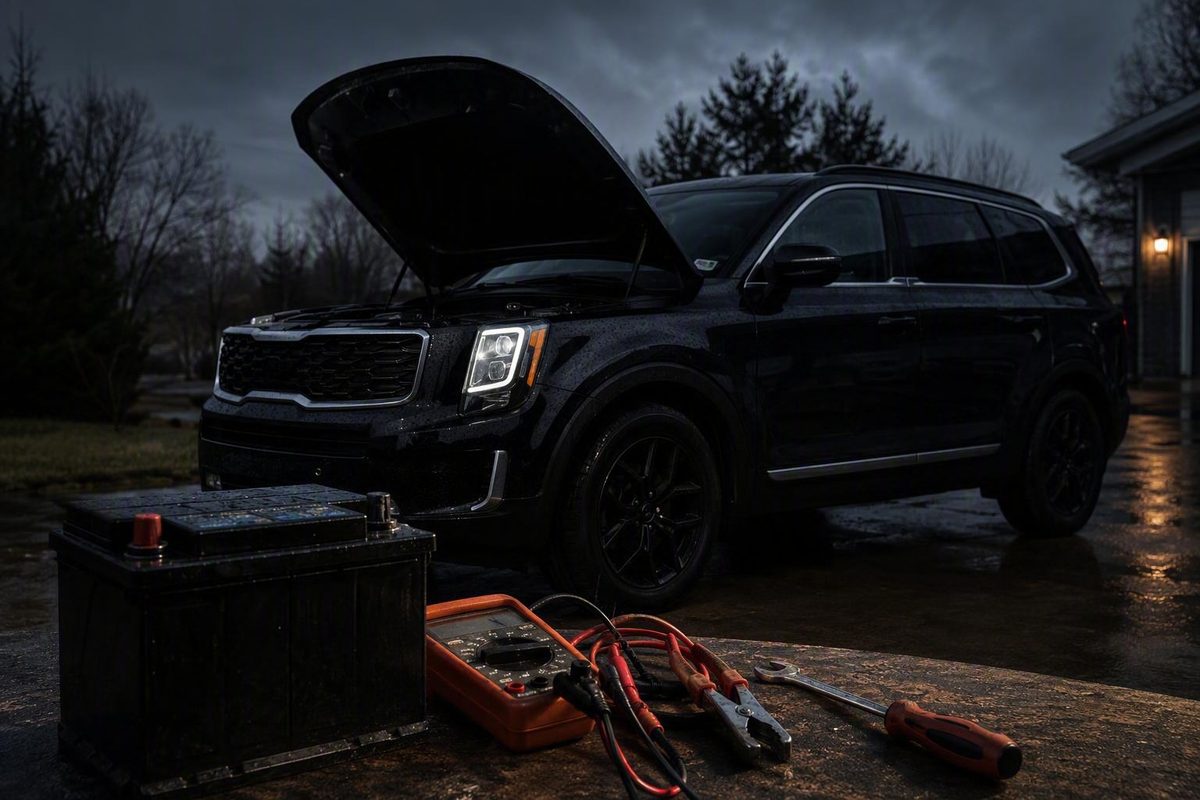
If your Kia Telluride battery keeps dying, fully charge and test the battery, verify charging output and connections, then request a measured key-off-current test before buying another battery. A proposed lawsuit alleges a no-sleep parasitic drain in 2020–2026 Tellurides, but that allegation does not diagnose your vehicle or guarantee warranty coverage.
Enter the measured draw and your battery details, then follow the claim path shown with the result.
Estimate how quickly a measured parked draw consumes battery capacity, then identify the records to obtain before authorizing a repair. The exact no-crank point cannot be calculated from battery capacity alone.
Calculation: consumed Ah equals draw in mA divided by 1,000, multiplied by 24 hours and days. Theoretical full-depletion time is battery Ah divided by draw in amps, then divided by 24. Real no-crank time can be earlier.
| Pattern | First Evidence to Request | Do Not Assume | Payment Position |
|---|---|---|---|
| One-time no-start | Full charge, battery test, terminals and charging check | A persistent module drain | Diagnose before replacing parts |
| Dies overnight or in 1–3 days | Settled key-off current and circuit isolation | The battery alone caused it | Seek warranty review if potentially eligible |
| Dies after replacement | Underlying cause plus post-repair battery retest | Another battery is the repair | Question an unsupported replacement bill |
| Stalls, warnings or display loss | Charging, connection and safety-related diagnosis | A jump makes it safe to drive | Tow when symptoms continue |
| Repair needed before claim decision | Itemized diagnosis and measured results | The lawsuit guarantees reimbursement | Pay if necessary and retain every receipt |
Sources: Kia warranty information; NHTSA 2022 Telluride complaint data; ClassAction.org report on Brenman v. Kia America. Lawsuit claims are allegations, and no universal no-crank threshold or key-off-current specification was provided.
Recover the Telluride Without Assuming It Is Fixed
Switch off lights, climate controls, audio, chargers and removable accessories. If you cannot confirm the approved jump points for your model year, use roadside assistance rather than improvising.
A discharged vehicle battery may prevent the power locks and key fob from working. A dealer video demonstrates the concealed manual key, hood release and labeled under-hood jump points on a 2025 Telluride. That layout should not be assumed to apply unchanged to every 2020–2026 model. Follow the manual for your vehicle’s entry method, connection sequence and cable-removal sequence. Watch the 2025 Telluride demonstration.
A successful jump proves only that external power restored enough voltage to operate the vehicle. It does not show whether the installed battery is worn out, merely discharged, inadequately recharged, poorly connected or being depleted while parked.
After recovery, have the battery fully charged with suitable equipment before it is tested. Testing it while deeply discharged may confirm that it cannot start the vehicle without showing whether it is internally damaged or why it lost charge.
Tow for Continuing Electrical Symptoms
Tow the Telluride rather than continuing to drive if the engine stalls or will not restart in traffic, a battery or charging warning remains on, displays flicker or go blank, numerous unrelated warnings appear together, or electrical power continues to weaken after the jump.
Stop handling the battery area if a terminal or cable is unusually hot, smoking, visibly damaged or producing a burning or electrical odor. The vehicle also needs professional assistance if it starts only while the jump pack or donor vehicle remains connected.
NHTSA complaints for the 2022 Telluride include owner reports involving repeated depletion, an undiagnosed draw, an alternator-related discharge and failure to restart after Auto Stop/Start operation. Those reports establish that the incidents were submitted; they do not establish one common cause or a failure rate. Review the NHTSA complaint data.
The Parking Interval Narrows the Test
A one-time no-start after a light was left on, extended accessory-mode use or a long period without driving does not establish a persistent parasitic draw. Charge and test the battery, inspect its terminals and grounds, verify the charging system and monitor for recurrence.
A battery that repeatedly dies overnight or after one to three days presents a stronger key-off-drain pattern. Before the appointment, unplug removable chargers, USB devices and power-outlet accessories. List dash cams, trackers, alarms, remote starters, amplifiers, trailer equipment and other hardwired electronics. Do not disconnect battery cables or pull fuses yourself.
If the Telluride starts reliably during regular use but struggles only after extended storage, account for battery age and tested condition, earlier deep discharges, storage duration, short-trip use, temperature and connected accessories. A compatible maintainer can preserve charge during storage, but it can also mask the timing of a drain and cannot repair its cause.
Failures while driving or immediately after Auto Stop/Start are more urgent than an ordinary parked no-start. Record whether the incident happened at the first start of the day, after a jump, at a traffic light, during low-speed driving or after warning lights appeared.
A New Battery Can Be Discharged by the Same Fault
“Discharged” describes the battery’s present state: it lacks enough usable charge to start the vehicle. “Defective” describes its condition after proper charging: it cannot adequately store or deliver power. A battery must be charged and tested to separate those conditions.
A replacement can die again if the charging system fails to replenish it, an alternator fault permits unwanted current flow, a connection creates excessive resistance, an accessory remains powered or an electronic module does not enter its intended low-power state.
Repeated deep discharge can also damage a lead-acid battery. Repairing the original electrical fault therefore may not restore the battery to reliable condition. The battery should be fully charged and retested after the underlying problem is corrected.
The proposed class action filed June 25, 2026 alleges that electronic modules or related systems in certain 2020–2026 Tellurides may fail to enter a low-power sleep state. It further alleges that charging or replacing a depleted battery may not correct the condition. These remain allegations, not a court finding, recall, settlement, manufacturer admission or diagnosis for every Telluride. Read the report on the proposed class action.
The Shop Must Separate Five Possible Causes
Battery Capacity Failure
The written findings should identify the battery’s state of charge, age, starting-capacity or state-of-health result and relevant history of deep discharge. Ask whether it was fully charged before the test. A depleted battery may fail a starting test without explaining the depletion.
Inadequate Charging or Alternator Trouble
The charging system must operate the vehicle and restore energy removed from the battery. A fault can leave it progressively undercharged even if a jump gets the engine running.
Some internal alternator faults can also allow unwanted current flow while the engine is off. One 2022 NHTSA complaint describes a dealer diagnosing an alternator that drained the battery, but one submitted report does not show that alternators explain Telluride failures generally.
Request actual charging findings rather than “alternator good.” When technically indicated, ask whether diode or reverse-current behavior was evaluated.
Loose or High-Resistance Connections
A charged battery may be unable to deliver starting current through a poor terminal, cable or ground. Resistance in the charging path can also prevent adequate replenishment.
Inspection should cover terminal tightness, corrosion, clamps, cables, chassis and engine grounds, damaged insulation and overheating. Where justified, the technician should perform voltage-drop testing under load and interpret it with service information for the exact vehicle—not a generalized internet threshold.
Accessories or Lights That Stay Powered
The inspection should include interior, vanity and cargo lamps; chargers; power-outlet devices; dash cams; trackers; alarms; remote starters; amplifiers; trailer equipment; and other factory or aftermarket accessories.
If the display says “battery discharging due to external electrical devices,” photograph the exact wording. It is a diagnostic clue, not proof that an owner-installed device caused the discharge.
Excessive Key-Off Draw From a Circuit or Module
Modern vehicles consume some current while parked for memory, security and communication functions. The relevant measurement is the current after that specific Telluride has had enough time to enter its intended sleep state.
Opening a door or liftgate, operating the locks, bringing the key fob near the vehicle, connecting diagnostic equipment or accessing a fuse box may wake modules. A reading taken too early may not represent the parked draw.
Owner reports have implicated an Integrated Body Unit or other modules in individual vehicles, while others describe batteries, alternators, accessories or no confirmed cause. An IBU replacement is not a default repair. The shop should first measure the draw and isolate the responsible circuit.
Request These Results in Writing
Ask the dealer or qualified electrical shop to perform and document these steps in order:
- Fully charge the battery with appropriate equipment.
- Print the battery load-test or state-of-health result.
- Verify charging-system performance under suitable operating conditions.
- Inspect battery terminals, grounds and cables.
- Perform voltage-drop tests where symptoms justify them.
- Measure key-off current if the discharge remains unexplained.
- Isolate the circuit if the measured draw is excessive.
- Retest the battery after correcting the underlying fault.
For a suspected parasitic draw, request the measured current, sleep time allowed, Kia service reference used, whether the reading was steady or intermittent and the circuit or fuse isolated. The repair order should also state which accessories were connected and how doors, the hood, liftgate, key fob and diagnostic equipment were handled during testing.
If a brief appointment ends with “could not duplicate,” request extended parked observation, current data logging or repeat testing over the overnight or multiday interval that normally produces the failure. An intermittent fault can be absent during one spot check.
Ask the dealer to search the exact VIN for open recalls, service campaigns, applicable technical bulletins and software updates. A remedy discussed for another year, trim or production range may not apply to your vehicle.
Before authorizing another battery, alternator, cable or module, ask: “Which measured result identified this component as the cause, which Kia test plan was used, and will the battery be fully charged and retested after the repair?”
Warranty Coverage Depends on the Diagnosis
Kia publishes a New Vehicle Limited Warranty term of 60 months or 60,000 miles from the date of first service, whichever comes first, covering most factory-defect repairs subject to its terms. Kia’s cited information also includes jump-start service under roadside assistance for new 2025 Kia vehicles. Coverage for a particular battery, repair, tow, model year or disablement must be confirmed from the applicable documents and vehicle record. Check Kia’s warranty information.
Do not assume a fixed warranty term for the Telluride’s conventional 12-volt starter battery. Ask the dealer to review the model year, first-service date, mileage, ownership status, maintenance history, battery replacement history and diagnosed cause. Kia’s separate high-voltage EV-battery coverage does not establish coverage for a Telluride starter battery.
A proposed lawsuit does not itself require Kia to reimburse a battery or electrical repair. No judgment or settlement is identified in the supplied evidence. Owners who pay while the matter remains unresolved should retain battery invoices, diagnostic charges, towing and roadside receipts, repair orders and correspondence. Those records may matter in a later warranty review, any eventual class-action process or a consultation with an independent attorney.
Build a Record Before Paying
For each failure, record:
| Record | Details To Capture |
|---|---|
| Vehicle state | Mileage, warnings and starting behavior |
| Timing | Parking interval and recent trip duration |
| Equipment | Battery age and connected accessories |
| Outcome | Jump, tow, tests, repairs and recurrence |
Also note whether the key fob worked, displays flickered or reset, Auto Stop/Start had just operated and the weather was unusually hot or cold. Photograph warnings when it is safe to do so.
Obtain a repair order for every visit, including visits when the vehicle starts normally or the concern cannot be reproduced. A precise entry such as “no electrical response after 36 hours parked following a 20-minute trip; battery replaced three months earlier” is more useful than “battery dead.”
Keep roadside-assistance receipts, towing records, battery invoices and copies of measured test results. If the case remains unresolved, request technical escalation through Kia, consider another qualified Kia dealer and retain the Kia case number.
If the Telluride stalled, failed to restart in traffic, lost critical displays or presented another safety concern, submit a factual NHTSA complaint. State what occurred, the displayed warnings and what the dealer found without asserting an unproven cause.
The decision to pay should follow the evidence: use warranty channels when a potentially covered factory fault is diagnosed, question another battery sale when no cause has been measured, and preserve every receipt if immediate repair is necessary while the warranty or lawsuit position remains unsettled.