
22 min read ·
What It Really Takes to Replace a Volt Battery
A pack priced thousands below a shop-installed alternative may still be a candidate, but the headline price does not establish its health or total cost.
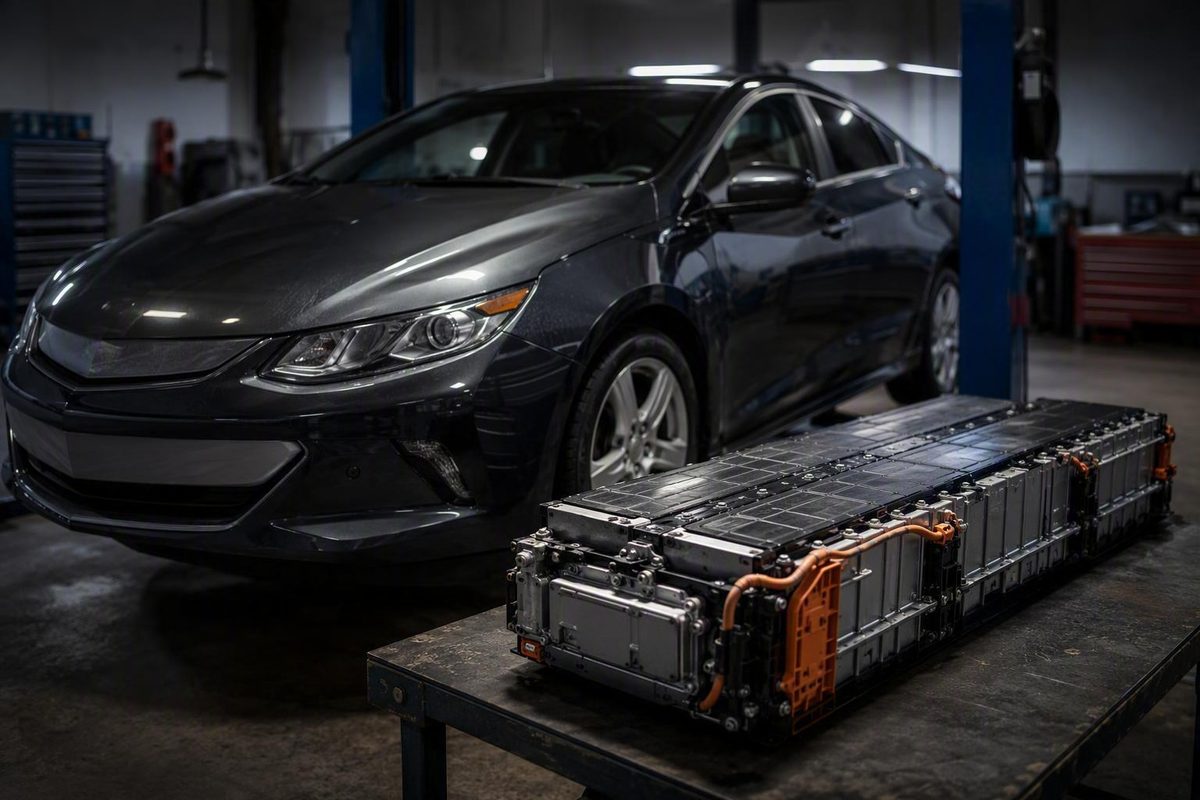
A Chevy Volt battery replacement quote is meaningful only after you know which battery is involved, what has failed, and which replacement fits the vehicle. The Volt has both a conventional 12-volt auxiliary battery and a high-voltage traction pack. Confusing the two can turn a manageable low-voltage problem into an unnecessary search for a much more expensive propulsion battery.
Current advertisements illustrate the market rather than establish a standard price. One used traction pack was advertised at $2,377.45 plus $399.99 freight in a marketplace listing. Specialty-shop offerings reached $7,999, with condition labels, warranties, installation arrangements, documentation, and availability varying by product in a commercial Volt battery guide.
The practical sequence is diagnosis first, fitment second, and price comparison third. This article is a limited survey of advertised listings, owner reports, and buyer questions—not Chevrolet service information or a substitute for diagnosis by a qualified hybrid or EV technician.
First, determine which Chevy Volt battery you mean
Choose the correct path
12-volt auxiliary battery: Located beneath the rear cargo-area tray. It supports the car’s low-voltage electrical systems. Follow this path if the battery is dead or weak and no high-voltage fault has been diagnosed.
High-voltage traction battery: Mounted beneath the vehicle. It stores energy used for electric propulsion. Follow this path only when testing points to a traction-pack, module, enclosure, cooling, or related high-voltage problem.
These batteries have different functions, prices, risks, tools, and replacement procedures. Do not combine a 12-volt battery price with traction-pack labor—or assume that a no-start or no-power condition automatically means the propulsion battery has failed.
A weak auxiliary battery deserves proper testing before anyone condemns the high-voltage pack. If your Volt has a dead or weak 12-volt battery but no diagnosed traction-system fault, begin with a 12-volt battery and charging-system evaluation.
A vendor-produced video demonstrates access beneath the rear cargo tray using 10 mm and 13 mm sockets. It disconnects the negative terminal first and reconnects it last. The video is not official Chevrolet guidance, however, and its broad aftermarket fitment claims are not independently established. Verify the correct battery specification, physical dimensions, terminal orientation, venting requirements, and torque values for your model year before following the Volt 12-volt battery demonstration.
Vendor materials also conflict over whether promoted aftermarket batteries are designated H4 or H5. That is another reason not to order solely from a generic “fits Chevy Volt” claim. Match the replacement to the vehicle and the battery actually installed, including any required vent connection.
The remainder of this guide focuses on high-voltage traction-pack diagnosis and replacement. That work is not an extension of the comparatively accessible cargo-area battery replacement.
Diagnose the problem before authorizing a complete pack
Reduced electric range is a reason to investigate. It is not, by itself, proof that the complete traction battery must be replaced.
Other diagnostic clues can include:
- The gasoline engine starting earlier or more frequently than expected
- A propulsion, charging, or high-voltage warning message
- Current or historical battery-related fault codes
- Slower or noticeably changed charging behavior
- Inconsistent performance under similar conditions
- Abrupt changes in indicated range or usable energy
Each symptom can have more than one cause. The available evidence does not establish a universal voltage, capacity, range-loss, or fault-code threshold that automatically requires complete-pack replacement.
Owner reports illustrate why detailed testing matters. In one first-generation case, an owner observed a particular cell group diverging from the others as the pack was depleted, even though the vehicle could still provide substantial electric operation under some conditions. That remains one person’s interpretation of scan data, not a universal replacement rule. It also suggests why behavior under load and depletion may reveal more than a single high-state-of-charge snapshot in the owner’s Gen 1 account.
Another owner reported that a 2017 Volt displayed P0A7F and declined to approximately 25–30 miles per charge, compared with a previously reported 40–60 miles. The discussion did not document a completed replacement or confirmed final cause, so the code and range change should be treated as diagnostic evidence rather than proof that every vehicle showing P0A7F needs a complete pack in the 2017 Volt discussion.
Pre-authorization diagnostic checklist
Before approving a complete pack, ask the shop to document:
- [ ] Current, pending, and historical fault codes. Request the actual codes and supporting test results, not only a verbal description such as “battery bad.”
- [ ] Cell-group balance and behavior. Ask what the shop observed at rest, while charging, under load, and as usable energy declined.
- [ ] The condition of the 12-volt system. A weak auxiliary battery should be identified rather than ignored.
- [ ] The condition of the battery enclosure. Ask whether the shop found impact damage, deformation, corrosion, breached seals, water, or road-debris intrusion.
-
[ ] Relevant cooling-system findings. Ask whether testing identified leaks, circulation problems, contamination, pump faults, or related codes.
-
[ ] The failed component in writing. The diagnosis should distinguish among the pack as a whole, a module, the enclosure, cooling hardware, sensors, wiring, and other systems.
- [ ] Why the proposed remedy follows from the results. “Low range” alone is not a sufficient technical explanation for buying a complete pack.
Physical damage is an important example. One 2015 Volt owner reported a quote of $8,887.14 for a remanufactured pack plus $1,030.88 labor and tax after road debris breached the enclosure. The owner said an independent hybrid shop instead sealed the enclosure for about $600. This was an anecdotal physical-damage repair—not an ordinary degradation repair or a representative replacement price—but it shows how inspecting the enclosure and obtaining another diagnosis can change the proposed work in the owner’s account.
Seek a second opinion from a qualified hybrid or EV specialist when the conclusion is uncertain, based mainly on lost range, or unsupported by component-level findings. Another diagnostic fee may be small compared with the cost of an unnecessary complete pack.
Advertised traction-battery prices by Volt model year
The figures below are advertised listing prices, not national averages, Chevrolet dealer prices, or guaranteed installed totals. Confirm the current price, stock status, product condition, warranty, and installation terms directly with the seller.
Broad model-year groups are useful for research but do not prove interchangeability. Before ordering, have both the seller and installer verify the full VIN, exact part number, configuration, and any superseding revision.
The underlying sources are commercial listings rather than independent market surveys. The marketplace listing supplies an August 19, 2026 update date, but the other captured pages do not provide a common price-capture date. Availability and terms may therefore have changed.
| Model-year group | Seller and seller-described condition | Advertised pack price | Advertised warranty | Installation status | Availability notes | Known or possible extras |
|---|---|---|---|---|---|---|
| 2011–2012 | Greentec: remanufactured | $3,999 | 18 months | Shop install only; contact seller | Confirm live availability | Labor, diagnostics, tax, coolant, towing, or other charges are not fully itemized |
| 2011–2012 | Greentec: condition not consistently documented beyond product label | $7,999 | 36 months | Shop install only; contact seller | Confirm live availability | Written quote needed to establish inclusions |
| 2011–2012 | Best Hybrid Batteries: retailer-described replacement | $5,789 | Three-year language appears in the description | Retailer offers shop installation | Listed in stock when captured | Installation, tax, shipping, core terms, and detailed warranty coverage are unclear |
| 2013–2015 | Greentec: remanufactured | $4,499 | 18 months | Marked shop install only; separate seller language discusses shipping and service arrangements | Confirm live terms | Residential delivery, core handling, return freight, labor, tax, or mobile service may apply |
| 2013–2015 | Greentec: condition not independently established beyond seller labeling | $7,999 | 36 months | Shop install only; contact seller | Confirm live availability | Complete installed inclusions are not itemized |
| 2013–2015 | Best Hybrid Batteries: retailer-described replacement | $5,889 | Three-year language appears in the description | Retailer offers shop installation | Marked backordered when captured | Installation and other charges are unclear |
| 2016–2019 | Best Hybrid Batteries: retailer-described replacement | $6,389 | Warranty options advertised; detailed terms incomplete | Retailer offers shop installation | Listed in stock when captured | Confirm labor, tax, core, coolant, and other charges |
| 2016–2019 | Greentec: seller-listed pack | $7,999 | Not detailed sufficiently for comparison in the captured material | Shop install only; contact seller | Confirm live availability | Installed total is not established |
For 2011–2012 and 2016–2019, Greentec advertised the listed $3,999 and $7,999 options and marked its products “shop install only” in its commercial guide. Its 2013–2015 category page displayed $4,499 and $7,999 products with 18-month and 36-month warranties, respectively on the seller’s model-year page.
Another retailer advertised $5,789 for 2011–2012, $5,889 for 2013–2015, and $6,389 for 2016–2019. The middle listing was marked backordered, while the other two appeared in stock. Warranty language varies across the page, and the displayed prices do not clearly establish whether installation or other charges are included in the retailer’s Volt collection.
The lower-priced used-pack example
A marketplace seller advertised a used pack for selected 2016–2018 Volt trims at $2,377.45 plus $399.99 flat-rate freight. The listing was last updated August 19, 2026, offered a 30-day return period and a listed 30-day warranty, and requested the buyer’s VIN for fitment review in the used-pack listing.
The listing did not provide the pack’s age, donor mileage, remaining usable capacity, diagnostic results, collision history, storage history, or a specific OEM part number. It also said its photos were for reference, so they might not show the exact pack supplied.
That missing information matters. A pack priced thousands below a shop-installed alternative may still be a candidate, but the headline price does not establish its health or total cost.
Do not calculate a simple average from these listings. They combine used and seller-described remanufactured products, different generations, different warranties, shop-install-only arrangements, and a freight-shipped marketplace part with limited health documentation. Averaging them would imply comparability the evidence does not support.
Turn the pack price into a realistic installed-cost estimate
An advertised pack price is only one line in the budget. Sellers may include some services, charge separately for others, or leave the arrangements to the buyer. Mark each item as included, excluded, or not yet confirmed.
Fill-in installed-cost worksheet
| Cost item | Amount | Included, excluded, or unconfirmed? | Who is responsible? |
|---|---|---|---|
| Initial diagnostics | $_____ | _____ | _____ |
| High-voltage battery pack | $_____ | _____ | _____ |
| Pack removal and installation labor | $_____ | _____ | _____ |
| Coolant draining, refilling, and bleeding | $_____ | _____ | _____ |
| Setup, programming, or relearn work quoted for this VIN | $_____ | _____ | _____ |
| Post-install testing and report | $_____ | _____ | _____ |
| Vehicle towing | $_____ | _____ | _____ |
| Outbound pack freight | $_____ | _____ | _____ |
| Residential-delivery or liftgate fee | $_____ | _____ | _____ |
| Sales tax and shop fees | $_____ | _____ | _____ |
| Mobile-service fee | $_____ | _____ | _____ |
| Core deposit | $_____ | _____ | _____ |
| Core packaging and return freight | $_____ | _____ | _____ |
| Disposal or recycling charge | $_____ | _____ | _____ |
| Estimated out-the-door total | $_____ |
Not every transaction will incur every charge. Programming or setup, for example, should not be assumed universal across all years and replacement arrangements. Ask what this VIN and exact pack require, and have the answer included in the written quote.
The reviewed seller listings generally do not establish an all-inclusive installed total. Even “shop install only” does not reveal whether the posted price includes diagnosis, labor, coolant service, tax, towing, or repeat labor if the replacement fails.
Greentec’s 2013–2015 page illustrates the need to reconcile terms directly with the seller. The displayed products are marked “shop install only,” but the same page also describes shipped-order terms: continental U.S. shipping included, a $200 residential-delivery charge, a $500 refundable core deposit, and a 45-day deadline to return the old battery. Return-shipping costs reduce the core refund. Ask the seller which terms apply to the exact product and purchase arrangement; do not assume that shipping terms override a shop-install-only label.
A shop-install transaction may consolidate responsibility with one business, but the posted price still needs to be itemized. A shipped used pack shifts more responsibility to the buyer, including fitment verification, freight scheduling, unloading, inspection, installation, rejected-part handling, return authorization, return freight, and eventual disposal.
The physical-damage case described earlier also shows why “battery price” and “repair bill” are different numbers: the owner-reported $8,887.14 pack quote was accompanied by $1,030.88 labor plus tax. That old, case-specific quote is not current market pricing.
Quote-comparison template
Send every shop the same questions:
- What is the complete out-the-door total, including tax?
- What work, testing, fluids, and materials are included?
- What is excluded or still subject to inspection?
- What exact pack, part number, and condition classification will be installed?
- What diagnostic findings justify the repair?
- What is the estimated pack lead time and vehicle completion date?
- When are the deposit, balance, and core charges due?
- Who owns, transports, returns, or recycles the old pack?
- Who pays freight and repeat labor if the supplied pack is incompatible or defective?
- What post-installation results will be documented?
Compare the resulting out-the-door totals, not only the largest number printed on each product page.
Compare full-pack, remanufactured, used, and limited repair options
Diagnosis may lead to several outcomes. A complete battery is not always the first valid remedy, but limited repair is not automatically safe, economical, or appropriate.
1. Repair a non-pack fault
The best outcome may be discovering that the pack itself is not the failed component.
This path avoids buying an unnecessary battery, but only a documented diagnosis can support it. Clearing a code without identifying why it appeared is not the same as resolving the fault.
2. Repair physical enclosure damage
Impact or intrusion damage may call for enclosure-specific work rather than replacement for electrochemical degradation. Whether such work is appropriate depends on the damage, internal condition, sealing requirements, electrical isolation, and the specialist’s ability to validate the repair.
The reported $600 enclosure repair is useful only as an example of a changed diagnosis. It does not establish a typical cost or suggest that a damaged high-voltage enclosure is safe to patch without professional assessment.
3. Perform module-level work
Some specialty shops may consider module replacement or other limited internal work when testing isolates a suitable failure.
The available evidence provides no objective Volt-wide threshold for deciding when module-level work is appropriate. Ask what failure was isolated and why limited work is preferable to a complete replacement.
4. Install a seller-described remanufactured pack
“Remanufactured” is not a sufficiently detailed technical description by itself. Sellers do not consistently disclose a standard process, and the term does not prove that every module has been replaced or that the resulting pack has factory-new capacity.
Ask:
- Which components were inspected, repaired, or replaced?
- How were modules selected—by age, capacity, resistance, voltage behavior, or another measure?
- How were modules balanced?
- What load, capacity, and electrical-isolation testing was performed?
- How was the enclosure inspected and sealed?
- Were cooling passages and connections checked?
- What final validation report comes with the pack?
- Will the pack identity or serial number appear on the invoice?
A lower-priced remanufactured pack with meaningful test documentation and labor coverage may present less uncertainty than a more expensive but poorly documented product. The reverse can also be true.
5. Install a used or other complete replacement pack
Request:
- Donor model year and VIN
- Donor mileage
- Exact part number and revision
- Collision location and damage description
- Removal and storage history
- Measured usable capacity or state of health
- Cell-group balance data
- Electrical-isolation test results
- Confirmation that listing photos show the actual pack
- Written return terms and freight responsibility
Labels such as “OEM,” “OEM replacement,” “new,” and “remanufactured” should be treated as seller descriptions until provenance, part number, and test documentation substantiate them. The reviewed commercial pages do not use those terms consistently enough to define product quality.
Do not assume any replacement will restore factory-new electric range.
Compare risk-adjusted cost
| Factor | Why it matters |
|---|---|
| Diagnostic certainty | A low price is irrelevant if the repair does not address the actual fault. |
| Health documentation | Capacity, balance, and isolation results can reduce uncertainty about the supplied pack. |
| Warranty coverage | Duration has limited value if labor, shipping, or diagnosis is excluded. |
| Installer responsibility | One accountable shop may simplify a failed-part claim. |
| Logistics | Freight, unloading, core return, and rejected parts can erase an online discount. |
| Expected ownership period | A long warranty may be less valuable if you plan to sell soon—or more valuable if it transfers. |
| Total installed price | This is the relevant cost, not the part listing alone. |
| Vehicle condition | A sound car with few pending repairs presents a different decision from one needing substantial additional work. |
The best balance is the option whose documentation, responsibility, warranty, and complete cost fit your risk tolerance—not necessarily the cheapest pack or most expensive label.
Verify compatibility, warranty coverage, and seller terms
Before ordering, create a written fitment record containing:
- Vehicle model year
- Generation
- Trim and relevant configuration
- Full VIN
- Exact battery part number
- Any superseding part revision
- Seller’s written fitment confirmation
- Installer’s written acceptance of that pack
- Product condition and provenance
- Serial number or inventory identifier, if available
Those are research shortcuts, not proof of interchangeability. The used marketplace listing is narrower, identifying selected 2016–2018 trims and asking the buyer to provide a VIN. Its generic part-number fields are insufficient to establish exact compatibility.
Do not treat “OEM” or “OEM replacement” as verified merely because it appears in a title. Ask whether the product is a used factory pack, a rebuilt assembly, a superseding GM part, or another type of replacement. Require the actual part number and available provenance.
Warranty-comparison table
| Warranty term | Seller A | Seller B | Seller C |
|---|---|---|---|
| Duration | _____ | _____ | _____ |
| Mileage limit | _____ | _____ | _____ |
| Parts covered | _____ | _____ | _____ |
| Removal and reinstallation labor | _____ | _____ | _____ |
| Diagnostic labor | _____ | _____ | _____ |
| Towing | _____ | _____ | _____ |
| Outbound replacement shipping | _____ | _____ | _____ |
| Failed-pack return shipping | _____ | _____ | _____ |
| Coolant service | _____ | _____ | _____ |
| Transferable to the next owner? | _____ | _____ | _____ |
| Geographic or installer limits | _____ | _____ | _____ |
| Maintenance or use exclusions | _____ | _____ | _____ |
| Claim authorization procedure | _____ | _____ | _____ |
| Remedy: repair, replacement, or refund | _____ | _____ | _____ |
| Expected claim lead time | _____ | _____ | _____ |
The reviewed advertising includes 18-month and 36-month warranties. Another retailer refers to three-year and six-year installation options, while its product descriptions use other warranty wording. Incomplete and inconsistent terms prevent a reliable comparison based on duration alone on the retailer’s product collection.
Vehicle warranty eligibility is a separate issue and cannot be decided from model year alone. Ask Chevrolet or an authorized representative to check the VIN, original in-service date, current mileage, jurisdiction, diagnosed component, failure cause, and governing GM warranty documents. Physical or collision damage raises different coverage questions from a qualifying internal defect.
Before paying, obtain written answers for four scenarios:
- The pack proves incompatible before installation.
- The pack arrives with visible freight damage.
- The pack fails the installer’s incoming tests.
- The pack fails after installation during the advertised warranty.
The agreement should identify who pays diagnosis, towing, labor, coolant, freight, storage, and replacement costs in each case. A warranty that provides another pack but leaves the owner paying removal, return freight, and reinstallation may be far less valuable than its headline duration suggests.
Why traction-pack replacement is a professional high-voltage job
A Volt traction-battery replacement should not be presented as an ordinary home repair. This guide deliberately does not provide step-by-step removal instructions.
At a high level, the process described in the available material includes disconnecting the 12-volt battery, disabling the high-voltage system, removing protective covers, draining coolant, and lowering the underbody pack. These tasks call for vehicle-specific service information, high-voltage training, appropriate lifting equipment, and the ability to evaluate the system after installation.
The principal concerns include:
- Exposure to dangerous high voltage
- Lifting and crushing hazards from a substantial battery assembly
- Damage caused by inadequately supporting the enclosure
- Cooling-system leaks or contamination
- Damage to high-voltage connectors, seals, or wiring
- A compromised enclosure or electrical-isolation fault
- Safe storage and transport of the removed pack
One forum participant described the pack as weighing roughly 500 pounds while discussing the difficulty of lowering and raising it without bending the frame. That is an owner’s approximate description, not an official specification, but it illustrates why improvised floor-jack handling is not a substitute for suitable lifting equipment and a battery table in the forum discussion.
This work is fundamentally different from accessing the 12-volt battery beneath the cargo tray. Familiarity with conventional battery terminals does not qualify someone to service a liquid-cooled high-voltage propulsion pack.
Questions for a prospective installer
Ask:
- What high-voltage training has the technician completed?
- Does the facility have an appropriate lift and battery table?
- Can it drain, refill, and evaluate the battery cooling circuit?
- Does it have Volt-capable diagnostic equipment?
- Is the business insured for high-voltage vehicle work?
- Will it install a customer-supplied pack?
- Who is responsible if that pack fails incoming inspection?
- How will the removed pack be stored and transported?
- Who handles recycling or core return?
- What setup, programming, or relearn work does this VIN require, if any?
- What functional testing follows installation?
- What workmanship warranty applies separately from the battery warranty?
Ask whether the shop can provide a post-installation report covering:
- Current and returning fault-code status
- Electrical-isolation checks
- Cell-group balance
- Cooling-system operation and leak checks
- Connector and enclosure inspection
- Any available capacity or usable-energy result
- Part number and identity of the installed pack
Not every test or setup procedure should be assumed universal across all Volt years. The shop should explain what applies to the specific VIN and replacement pack.
Decide whether replacement is financially sensible
There is no universal point at which every Volt should receive a replacement pack—or be retired. The decision depends on the car, the diagnosis, the replacement offered, and how long you intend to keep the vehicle.
Compare the complete installed quote with:
- The Volt’s current local value
- Mileage
- Body, paint, glass, and underbody condition
- Interior condition
- Tires, brakes, suspension, and other pending work
- Existing mechanical or electrical problems
- Realistic post-repair electric range
- Replacement-pack health documentation
- Warranty strength and geographic usefulness
- Expected ownership period
- The cost and suitability of replacing the vehicle
Do not assume an expensive pack restores the entire car to new condition. It addresses only the diagnosed battery-related problem, and the installed pack’s condition affects the result.
Cost-per-planned-year worksheet
Use this planning calculation:
Complete installed replacement cost ÷ realistic additional years of ownership = planned cost per added year
Fill in your figures:
- Complete installed cost: $__
- Additional years you realistically expect to keep the Volt: __
- Planned replacement cost per year: $__
This is budgeting arithmetic, not a prediction of pack life. Planning to keep the vehicle for four more years does not guarantee that the battery or the rest of the car will provide four trouble-free years.
Next, ask whether the repair leaves a reserve for unrelated work. If the battery consumes the entire maintenance budget, a later suspension, air-conditioning, charging, engine, or electrical repair may change the economics quickly.
Consider whether the warranty is useful where you live. A long warranty may have limited practical value if claims require transporting the vehicle or battery hundreds of miles, paying repeat labor, or using an inconvenient facility. A shorter warranty from the shop that performed the diagnosis and installation may offer clearer accountability.
Treat availability separately from affordability. One retailer’s 2013–2015 listing was marked backordered. Separately, a forum poster reported that a 2017 Volt remained at a dealer for about four months while awaiting a warranty-covered battery, with no firm arrival date. That is one owner’s unverified report, not evidence of a nationwide shortage, but it shows how an affordable or covered repair may still be impractical if delivery is indefinite in the reported delay discussion.
The cheapest pack is not necessarily the lowest-cost outcome. An undocumented used battery can lead to repeat labor, freight, storage, and return expenses. Fragmented responsibility also creates disputes: the seller may blame installation while the installer blames the supplied part.
Your practical choices are:
- Proceed when the failure is confirmed, the replacement fits by VIN and exact part number, and the itemized total and warranty make sense.
- Seek another diagnosis or source when the evidence is incomplete, the proposed pack lacks documentation, or the logistics are unfavorable.
- Decline the repair when the complete cost and uncertainty exceed the vehicle’s value to you.
Frequently asked questions
How much does a Chevy Volt high-voltage battery replacement cost?
There is no reliable single national figure in the reviewed evidence. Advertised products range from a lower-priced used pack plus freight to seller-described remanufactured and other specialty-shop offerings approaching $8,000.
Those are listing prices, not guaranteed installed totals. Diagnosis, labor, coolant service, towing, taxes, delivery, core handling, return freight, and VIN-specific setup may increase the bill. Compare itemized out-the-door quotes rather than product-page prices.
Can a bad Volt battery module be repaired instead of replacing the whole pack?
Possibly. A qualified specialist may consider module-level work when testing isolates a suitable problem. Physical enclosure damage or a non-pack fault can also lead to a narrower repair.
The available evidence does not provide a universal threshold for deciding when module work is appropriate. Ask how the failure was isolated, how replacement modules will be selected and balanced, how the pack will be sealed and tested, and what the warranty covers.
Does reduced electric range mean the complete traction battery has failed?
No. Reduced range is a diagnostic clue, not proof of complete-pack failure. Warning messages, changed charging behavior, early gasoline-engine operation, and fault codes should also be investigated rather than treated as automatic replacement triggers.
A complete-pack recommendation should identify the failed component and the test results supporting that conclusion.
Is Chevy Volt traction-battery replacement covered by warranty?
It may be, but eligibility cannot be determined from model year alone. Coverage can depend on the VIN, original in-service date, mileage, jurisdiction, failure cause, diagnosed component, and governing Chevrolet or GM warranty documents.
Ask an authorized representative to document the coverage decision. Also distinguish the vehicle warranty from a replacement seller’s warranty, which may cover the part while excluding diagnosis, towing, freight, coolant, or removal and reinstallation labor.
Can I replace the Chevy Volt battery myself?
It depends on which battery you mean. The cargo-area 12-volt battery is comparatively accessible, although specification, fitment, venting, terminal handling, and torque still require verification.
The underbody traction pack is not an ordinary DIY replacement. It involves dangerous high voltage, substantial weight, specialized lifting, cooling-system work, diagnostics, and pack-transport responsibilities. Professional service by a trained, insured hybrid or EV technician is the prudent path.
The diagnosis-first action plan is straightforward: identify which battery is involved, obtain a written high-voltage diagnosis, confirm any replacement by VIN and exact part number, and compare itemized installed quotes rather than sticker prices. Scrutinize pack history, health data, availability, warranty exclusions, and responsibility for the old battery.
Neither the lowest listing price nor the longest advertised warranty means much until the pack’s condition, fitment, inclusions, exclusions, and delivery terms are documented.