
22 min read ·
What It Really Takes to Replace an Insight Battery
Some Greentec shipped orders add a $500 refundable core deposit at checkout. Return deadlines, freight, labor, setup and warranty shape the final bill.
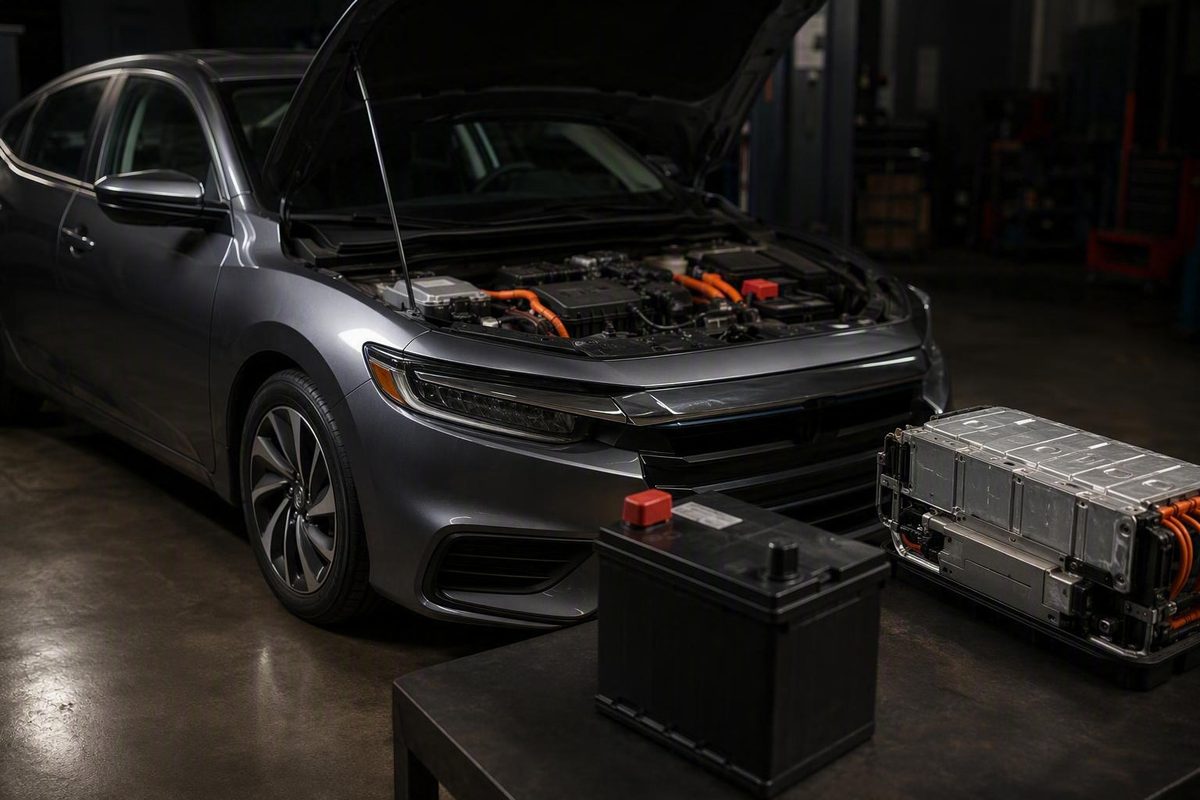
A Honda Insight battery replacement can mean two fundamentally different repairs. One is replacement of the conventional 12-volt auxiliary battery, generally a routine low-voltage job. The other is replacement of the high-voltage hybrid traction battery, which demands generation-specific parts, qualified diagnosis, specialized safety equipment, and trained handling. High-voltage battery work can cause serious or fatal injury and should be performed only by a qualified technician, according to an AutoZone-hosted installation safety transcript.
That distinction explains why one owner may receive a quote in the hundreds while another sees a four-figure price. Neither figure is meaningful until the estimate identifies the battery, model year, replacement pack condition, included labor, setup requirements, warranty terms, and core-return obligations.
The practical process is:
- Identify whether the concern involves the 12-volt or traction battery.
- Match the replacement to the 2000–2006, 2010–2014, or 2019–2022 generation.
- Confirm the failure through documented testing.
- Check possible Honda or emissions-related warranty coverage.
- Compare written, out-the-door quotes rather than product prices alone.
Editorial note: Product availability, prices, warranties, and service restrictions in this guide were checked against seller pages in August 2026. They are dated seller-reported terms or third-party estimates, not independent measures of battery quality. The available evidence does not include official Honda service procedures, current OEM Insight pack prices, or model-year warranty booklets. Fitment, factory procedures, setup requirements, and coverage therefore require VIN-specific confirmation from Honda or a qualified installer.
First, identify which Honda Insight battery needs attention
Every Honda hybrid has both a conventional 12-volt auxiliary battery and a high-voltage traction battery. The older Insight generations use Honda’s Integrated Motor Assist, or IMA, architecture, while the 2019–2022 car uses a two-motor hybrid system. The two batteries perform different jobs and require different diagnostic and replacement paths.
Use this two-path decision tree before comparing prices.
Path 1: Suspect the 12-volt auxiliary battery when:
- The vehicle has low-voltage electrical trouble.
- Starting or system initialization seems sluggish or inconsistent.
- Lights or accessories behave abnormally.
- The battery fails a load or conductance test.
- Testing finds low resting voltage or an apparent charging problem.
These clues justify testing, but they do not prove that the battery itself is defective.
Path 2: Investigate the high-voltage traction battery when:
- An IMA or hybrid-system warning appears.
- Electric assist seems weaker.
- The gasoline engine runs more frequently than before.
- The displayed charge level rises or falls unusually quickly.
- Fuel economy declines without another clear explanation.
- Regenerative braking feels reduced.
- Overall power or acceleration decreases.
- The battery-cooling fan becomes unusually noticeable.
These are possible traction-battery symptoms, not a diagnosis.
The simplest way to prevent a costly misunderstanding is to require precise wording. Ask every seller or repair shop to put either “12-volt auxiliary battery” or “high-voltage hybrid traction battery” on the estimate. If the quote only says “Honda Insight battery,” it is incomplete.
That matters especially when shopping online. A price in the hundreds may refer to a conventional battery or, in a limited case, a conversion component rather than a complete installed traction-pack repair. It must not be compared directly with a four-figure hybrid-battery listing.
Match the replacement to the Insight generation
“Fits Honda Insight” is not a sufficient compatibility statement. The three generations use different hybrid architectures, and a product or procedure for one generation cannot be assumed to fit another.
The 2000–2006 and 2010–2014 Insights are IMA-era vehicles. A Honda dealer service article generally identifies older IMA systems as using nickel-metal hydride, or NiMH, batteries. The 2019–2022 Insight instead uses a two-motor hybrid system. First-generation pack designs, conversion products, removal instructions, and control assumptions should not be carried over to the later car. These architecture distinctions and the need for VIN-specific diagnosis are summarized in the dealer’s Honda hybrid-system overview.
| Model years | Hybrid architecture | Documented aftermarket choices | Installation restrictions | Questions to resolve before purchase |
|---|---|---|---|---|
| 2000–2006 | IMA-era system; generally identified as NiMH | Remanufactured NiMH, an “8.0 Amp Cells” NiMH listing, shop-installed lithium upgrade, DIY conversion product | One lithium upgrade is marked shop-install-only; a separate conversion product is sold for DIY use | Exact compatibility, product condition, conversion requirements, installation coverage, cooling and control compatibility |
| 2010–2014 | IMA-era system; generally identified as NiMH | Aftermarket new-cell and remanufactured packs | Installation terms vary by product | Current price, pack provenance, installation availability, VIN compatibility |
| 2019–2022 | Two-motor hybrid rather than IMA | One documented aftermarket replacement listing | Documented listing is marked shop-install-only | VIN fitment, installation location, diagnostic setup, official Honda procedures, current OEM alternative |
The broadest documented aftermarket selection is for the 2000–2006 car. Greentec lists a remanufactured NiMH pack, an “8.0 Amp Cells” NiMH product, a shop-installed lithium upgrade, and a DIY lithium conversion product. Those are the seller’s labels, not independently verified performance categories. In particular, the “8.0 Amp Cells” wording does not provide a clearly expressed amp-hour capacity, so it should not be treated as proof of a measured capacity or durability advantage. Exact restrictions and compatibility should be confirmed against the first-generation seller listings.
For 2010–2014, the documented market includes a new-cell aftermarket listing and a remanufactured listing. Confirm the current price, whether installation is included, where it can occur, and precisely what the seller means by “new-cell” or “remanufactured.”
For 2019–2022, the documented aftermarket listing is marked shop-install-only. That does not prove it is the only replacement available, nor does it establish the price of a new Honda pack. It means only that this particular aftermarket product is not presented as a shipped DIY installation.
Before ordering either battery type, provide the seller with:
- The full VIN.
- Model year and trim.
- Current battery part number, if available.
- Emissions certification or market specification where relevant.
- Diagnostic codes and the shop’s written findings.
- Confirmation of any collision, flood, or salvage history.
For a 12-volt battery, do not choose a universal group size from an unfiltered retailer page. Retail searches can display several candidate sizes and unrelated products until the exact vehicle is selected. Match the vehicle-specific catalog result, physical dimensions, terminal orientation, hold-down arrangement, battery technology, and electrical specifications.
Diagnose the system before authorizing a traction-battery replacement
Warning lights and performance changes are reasons to test the car. They do not independently prove that the complete traction pack must be replaced.
Possible warning signs include reduced fuel economy, sluggish acceleration, reduced electric assist, increased gasoline-engine operation, rapid state-of-charge changes, weaker regenerative braking, reduced power, hybrid-system warnings, and unusual cooling-fan noise. Commercial battery providers report these symptoms, but they overlap with other vehicle problems.
Software issues, sensors, wiring, connectors, cooling restrictions, fan faults, and other hybrid components may also produce warning lights or poor performance. Replacing an expensive pack before investigating those possibilities risks buying a part that does not correct the original problem.
Greentec identifies:
- P0A80: “Replace Hybrid Battery Pack”
- P0A7F: “Hybrid Battery Pack Deterioration”
Those code names are useful clues, but they are not complete diagnostic conclusions. A code describes what the control system detected; it does not by itself establish which physical component failed, whether related faults are present, or whether the correct remedy is a complete pack. The seller itself recommends diagnosis alongside its Insight symptom and diagnostic-code descriptions.
A sensible diagnostic sequence is:
- Record the symptoms. Note when warning lights appear, whether the problem changes with temperature, and whether charge behavior, assist, fuel economy, or fan noise has changed.
- Scan all relevant modules. A generic engine-code scan may not retrieve every hybrid, battery, brake, or body-system fault.
- Save codes and freeze-frame information. Clearing codes first can remove useful context.
- Test the 12-volt battery and charging behavior. Confirm that the vehicle’s low-voltage foundation is sound.
- Inspect traction-battery cooling. Check the intake path, ducts, fan operation, and related faults without opening the pack.
- Review wiring, sensors, software, and related system faults.
- Obtain pack-condition testing. Ask what was measured, what limits were used, and how the result supports whole-pack replacement.
- Request the report in writing. Competing shops can then quote the same confirmed problem.
Do not authorize a pack simply because a seller’s symptom list resembles your experience. Ask which tests ruled out other causes and why the shop recommends complete replacement instead of further diagnosis or another repair.
Collision-damaged 2019–2022 cars require additional caution. A Gen 3 Insight forum discussion reports that a severe collision may cause safety systems to open the high-voltage contactors. The measurement point can therefore affect the voltage reading. A zero reading outside the pack does not, by itself, prove every internal cell is at zero or that the pack is irreparable. This is user-generated rather than official Honda guidance, but the collision-damaged third-generation discussion illustrates why crash isolation and internal battery condition must be distinguished through qualified diagnosis.
Honda Insight battery replacement cost: separate the two jobs
There is no responsible single average for “Honda Insight battery replacement.” The 12-volt and high-voltage jobs require separate budgets.
The figures below are August 2026 snapshots. KBB provides a localized third-party estimate; the remaining figures are seller-advertised prices. None is a guaranteed quote or independent assessment of battery quality. Taxes, labor, diagnosis, shipping, installation availability, sale status, and warranty terms can change.
Conventional 12-volt battery cost
| Price reference | Advertised or estimated amount | What it covers | Important limitation |
|---|---|---|---|
| KBB, 2020 Insight near ZIP 22030 | $319–$454 | Parts and labor | Localized conventional-battery estimate, not a traction-pack price |
| KBB dealer estimate | $319–$375 | Parts and labor | Same year and location limitation |
| KBB independent-shop estimate | $388–$454 | Parts and labor | Same year and location limitation |
| AutoZone displayed candidates | $179.99–$299.99 | Battery product before a $22 refundable core deposit | No model year selected; exact fitment not established |
Kelley Blue Book estimated $319–$454 installed for a 2020 Insight near Fairfax, Virginia, including $319–$375 at a dealer and $388–$454 at an independent shop. The localized KBB battery-replacement estimate concerns a conventional battery, not the high-voltage traction pack.
AutoZone displayed possible conventional batteries from $179.99 to $299.99, each before a $22 refundable core deposit. Because no exact model year and configuration were selected, these are browsing examples rather than confirmed fitment. The retailer’s Insight battery results display multiple group sizes and require vehicle verification.
High-voltage traction-battery advertised prices
The Greentec prices, conditions, warranty headlines, and shop-install restrictions in the following table come from the seller’s generation-spanning Insight listings. Terms should be reconfirmed in a dated quote.
| Generation and seller listing | Advertised price | Stated condition or type | Headline warranty or restriction |
|---|---|---|---|
| 2000–2006 Greentec | $1,395 | Remanufactured NiMH | 12 months |
| 2000–2006 Greentec | $2,095 | “8.0 Amp Cells” NiMH listing | 36 months |
| 2000–2006 Greentec | $2,899 | Lithium upgrade | 36 months; shop-install-only |
| 2000–2006 Greentec | $900 | DIY lithium-ion conversion product | 30-day limited warranty |
| 2000–2006 Best Hybrid Batteries | $1,749 | Replacement IMA battery listing | Unlimited mileage advertised; duration not established |
| 2010–2014 Greentec | $2,095 | New-cell listing | 36 months |
| 2010–2014 Greentec | $1,499 displayed sale price | Remanufactured | 12 months; other seller material cited $1,795 |
| 2010–2014 Best Hybrid Batteries | $1,749 | Replacement IMA battery listing | Unlimited mileage advertised; duration not established |
| 2019–2022 Greentec | $2,499 | Aftermarket replacement listing | Shop-install-only |
For 2000–2006, the four Greentec prices represent materially different products and service models. The $900 DIY conversion product should not be compared as though it were an installed replacement equivalent to the $2,899 shop-installed lithium upgrade.
For 2010–2014, Greentec displayed $2,095 for a new-cell product and a $1,499 sale price for a remanufactured product. Another part of the seller’s material cited $1,795 for the remanufactured version, making a dated written quote essential.
For 2019–2022, the advertised $2,499 product is marked shop-install-only. It is an aftermarket listing, not a Honda dealer-installed price.
Best Hybrid Batteries separately advertised $1,749 for both its 2000–2006 and 2010–2014 listings and promoted an unlimited-mileage warranty. The supplied material does not establish the warranty duration, full exclusions, installation, taxes, shipping, or core charges. Its Insight product collection supports advertised-price comparison, not conclusions about installed cost or quality.
The available evidence does not establish a current dealer-installed OEM traction-battery price for any Insight generation. Obtain that figure directly from a Honda dealer using the VIN, diagnostic findings, mileage, and warranty status. Do not infer it from aftermarket listings or dealer estimates for other Honda hybrids.
Compare OEM, new-cell, remanufactured, used, and lithium choices
Product terminology is inconsistent across the market. Insist on a precise description before deciding that one quote is cheaper or better.
OEM new
Request a VIN-specific part number, availability, installed price, and written warranty from a Honda dealer. No current Insight-specific OEM price or warranty is established here.
Aftermarket new-cell
It does not automatically mean OEM, Honda-approved, identical to the original pack, or equal in durability. Ask:
- Who manufactured the cells?
- Are all cells new?
- Which original housings, electronics, or other components are reused?
- What testing does the completed pack receive?
- Is installation included?
- What failures and costs does the warranty cover?
Remanufactured, rebuilt, or restored
These labels may refer to materially different processes. Do not treat “remanufactured,” “rebuilt,” and “restored” as interchangeable unless the seller defines its process in writing.
Compare these products using:
- Advertised condition.
- Pack provenance.
- Test documentation.
- Warranty duration and mileage cap.
- Labor and freight coverage.
- Installation method.
- Core and return requirements.
The evidence documents advertised availability and terms, but it does not independently establish which pack offers the best capacity, reliability, durability, or lifecycle value.
Used donor pack
A used battery may be removed from a salvage or donor vehicle and sold without substantial rebuilding. Low donor mileage is helpful context, but it does not prove health.
Before buying a used pack, request:
- Donor model year and full part number.
- VIN or application compatibility.
- Donor mileage and reason for dismantling.
- Collision and water-exposure history.
- Storage duration and conditions.
- Measured capacity or available state-of-health results.
- Block or module imbalance results, where applicable.
- Connector, enclosure, and cooling-interface condition.
- Return rights if the pack cannot be installed or fails post-installation testing.
- Warranty duration and covered remedy.
- Required registration, initialization, programming, or setup.
“8.0 Amp Cells” NiMH listing
This is the seller’s product label. The supplied listing does not clearly express the specification in amp-hours or provide independent capacity testing. Ask the seller what the number means, how it is measured, what completed-pack testing is performed, and whether the original control and cooling arrangements are retained.
Lithium conversion or upgrade
The documented lithium products apply to specific first-generation offerings. They are not automatic replacements for every Insight and should not be generalized to 2010–2014 or 2019–2022 cars.
The available evidence does not resolve whether a particular conversion is legal in every jurisdiction, emissions-compliant, acceptable to an insurer, compatible with factory controls and cooling, or independently proven over long-term use. Obtain written answers before treating a conversion as equivalent to a standard replacement.
Finally, compare the repair with the rest of the car. Consider corrosion, collision history, engine and transmission condition, tires, brakes, air conditioning, upcoming maintenance, and how long you intend to keep it. There is no universal repair-versus-retire threshold because vehicle condition, local value, and owner needs vary.
Turn the headline price into an out-the-door total
A product page rarely states the full financial commitment. Build the quote from separate line items:
| Cost item | Amount to request |
|---|---|
| Diagnostic testing | $_____ |
| Battery or conversion product | $_____ |
| Removal and installation labor | $_____ |
| Programming, registration, initialization, or setup | $_____ |
| Shop supplies | $_____ |
| Mobile-service travel | $_____ |
| Shipping or commercial delivery | $_____ |
| Residential-delivery surcharge | $_____ |
| Sales tax and other applicable charges | $_____ |
| Refundable core deposit | $_____ |
| Expected return-freight deduction | $_____ |
| Towing | $_____ |
| Cash required before core refund | $_____ |
| Expected final cost after core refund | $_____ |
For specified Greentec shipped orders, the seller says it adds a $500 refundable core deposit at checkout. The old pack must be returned within 45 days, and return freight is deducted from the refund. Continental-U.S. shipping is described as included, while residential delivery adds $200. These terms appear on the seller’s first-generation product page linked earlier and should be reconfirmed for the exact product.
A simple cash-flow example shows why this matters:
- Advertised pack: $2,095
- Refundable core deposit: $500
- Checkout outlay: $2,595
- Possible residential delivery: +$200
- Taxes, diagnosis, labor, and other charges: not yet included
- Later core refund: reduced by return freight, assuming an eligible core is returned on time
The deposit may be temporary, but the owner still needs the cash at checkout. Return freight becomes a final cost rather than a temporary outlay. Missing the deadline or returning an ineligible core can make part or all of the deposit permanent.
Core-credit rules may require the original unit to:
- Match the purchased application or part type.
- Remain intact.
- Be returned in the supplied container.
- Arrive within the stated deadline.
- Meet the seller’s eligibility conditions.
Do not let a shop recycle, retain, or dispose of the original pack until responsibility for the core is clear.
Installation language also requires scrutiny. “Professional installation available” does not mean installation is included. It may mean shop-only installation at the seller’s facility, local mobile service subject to technician coverage, or optional labor at an additional charge.
Your written quote should state whether diagnosis is credited toward installation and who pays diagnosis, labor, travel, and freight if the replacement pack fails under warranty. A free replacement battery can still leave the owner with a substantial bill for testing, removal, return shipping, and reinstallation.
Evaluate the warranty before choosing the lowest quote
A useful warranty is more than a large number beside a product.
| Warranty question | What to obtain in writing |
|---|---|
| Duration | Start date and number of months or years |
| Mileage limit | Unlimited or capped; exact cap |
| Covered failures | Defects, electrical failure, imbalance, warning codes, or another defined condition |
| Degradation threshold | Whether gradual capacity loss is covered and how it is measured |
| Diagnostics | Who decides the pack failed and who pays testing costs |
| Labor | Whether removal and reinstallation are covered |
| Freight | Who pays shipment in both directions |
| Mobile travel | Whether a return technician visit is included |
| Exclusions | Cooling faults, collision, flooding, improper installation, storage, vehicle defects, commercial use, or modifications |
| Transferability | Whether coverage follows the vehicle after sale |
| Claim procedure | Required records, authorization, deadlines, and contacts |
| Remedy | Repair, replacement, prorated credit, or refund |
| Repeat claims | Whether a replacement continues the original term or starts a new one |
The documented headline terms differ sharply: one first-generation DIY conversion listing advertised a 30-day limited warranty; specified remanufactured Greentec packs carried 12-month terms; and selected Greentec products advertised 36 months with unlimited mileage. These terms are not equivalent without the exclusions, remedies, and cost responsibilities.
Electron Hybrid Solutions advertises 12-month/15,000-mile and 36-month/45,000-mile warranties. Its supplied page does not establish applicable Insight model years, exclusions, included labor, or claim expenses, so the advertised warranty options require product-specific written confirmation.
Best Hybrid Batteries advertises unlimited mileage, but the supplied material does not show the warranty’s duration or complete terms. “Unlimited mileage” does not reveal whether gradual capacity loss, diagnostics, labor, freight, or travel are covered.
Before paying out of pocket, investigate possible original Honda or emissions-related coverage. Ask a Honda dealer to check:
- Full VIN.
- Original in-service date.
- Current mileage.
- Registration and operating jurisdiction.
- Emissions certification.
- Title and collision history.
- Maintenance history where relevant.
- Exact diagnosed failure.
The previously cited Honda dealer article states that hybrid-battery coverage in Illinois is commonly 8 years or 100,000 miles, while some qualifying vehicles registered and operated under California-emissions provisions may receive up to 10 years or 150,000 miles. Those are general dealer statements, not official confirmation for a particular Insight. Coverage may depend on model year, jurisdiction, in-service date, emissions status, title history, maintenance, mileage, and the diagnosed condition.
Obtain VIN-specific coverage confirmation in writing before authorizing an out-of-pocket pack. Ask not only whether the car remains within a time and mileage limit, but also whether the diagnosed failure is covered.
Choose a qualified installer and treat high voltage as the boundary
Removing, opening, rebuilding, or installing a high-voltage traction battery can cause serious or fatal injury. It is not an appropriate project for an untrained owner.
The AutoZone-hosted transcript cited at the beginning illustrates the required preparation: disabling the battery breaker, using Class 0 high-voltage gloves with leather protectors, working with a CAT III 1,000-volt-rated meter, verifying voltage, using suitable tools, and handling the complete pack safely. The transcript says the work should be attempted only by a qualified technician. It does not identify the applicable Insight generation, so it must not be used as a universal service procedure.
This guide intentionally does not provide step-by-step traction-battery removal, opening, rebuilding, or installation instructions.
A first-generation forum guide from 2014 documents one owner’s rebuild process, but its author says it is not exhaustive and instructs readers to verify the process independently. It is dated, incomplete in the supplied record, and not an official Honda procedure. It also describes a PTC sensing-circuit override. That safety-related modification should not be recommended because the available evidence does not establish Honda approval. The user-authored rebuild discussion demonstrates complexity, not a safe substitute for factory information and training.
Screen prospective installers by asking:
- Are the technicians trained for high-voltage hybrid systems?
- Have they worked on this exact Insight generation?
- Do they have model-specific service information?
- Do they use suitable high-voltage protective equipment and test instruments?
- Can they scan all relevant modules and perform pack-condition testing?
- Are they insured for hybrid-battery work?
- Who handles a warranty failure?
- Who pays repeat diagnosis, labor, travel, and freight?
- Who packages and returns the core?
- What post-installation tests are documented?
- Is the service shop-based, mobile, or product-only?
- Is installation included in the quoted price?
Shop installation, mobile installation, and a shipped DIY product are different service models. A company may advertise more than one, but that does not mean every product qualifies for every service or that mobile coverage is available in every area.
Routine 12-volt replacement is a separate low-voltage job. Even then, confirm fitment and secure the battery correctly. KBB’s conventional-battery guidance says to disconnect the negative cable before the positive and reconnect the positive before the negative; follow vehicle-specific instructions and use a qualified shop if terminal access, battery specifications, or hybrid-system behavior is uncertain.
Use a written quote and post-installation checklist
Copy this request into an email to each seller or installer:
Please provide a written Honda Insight battery-replacement quote using VIN _ and model year _.
Identify the battery as either a 12-volt auxiliary battery or a high-voltage hybrid traction battery. For a traction battery, state whether it is OEM new, aftermarket new-cell, remanufactured, rebuilt, restored, used, or a conversion.
Include:
- Battery chemistry and part number
- Exact model-year and VIN compatibility
- Pack manufacturer and provenance
- New and reused components
- Measured condition or completed test results
- Diagnostic fee and whether it is credited toward repair
- Removal and installation labor
- Programming, registration, initialization, calibration, or other setup
- Shop supplies, taxes, travel, delivery, and shipping
- Core-deposit amount, return deadline, packaging, eligibility, and return freight
- Who retains or recycles the old pack
- Warranty duration, mileage cap, exclusions, labor, diagnostics, travel, and shipping coverage
- Total cash due before core refund
- Expected out-the-door cost after an eligible core refund
Require the seller to choose a specific condition category rather than using vague phrases such as “replacement battery” or “refreshed.” If the seller will keep or recycle the old pack, verify whether that satisfies the core obligation or causes you to lose a deposit.
After installation, ask the technician to:
- Clear and rescan relevant modules.
- Save the final code report.
- Verify the battery-cooling intake, ducts, and fan operation.
- Confirm that warning lights remain off.
- Road-test the vehicle.
- Verify that the original symptoms are resolved.
- Document remaining or pending codes.
- Explain any required monitoring or follow-up inspection.
A participant in the previously cited third-generation forum discussion claims that replacement packs must be registered using Honda Diagnostic System software. That is not official confirmation of a universal 2019–2022 requirement. Ask the installer or Honda dealer for VIN-specific service information and written confirmation of any registration, initialization, calibration, or software procedure.
Code clearing alone does not prove a successful repair. The final invoice should document functional testing, cooling operation, road-test results, and the post-repair scan.
Keep copies of the original diagnosis, code printout, exact part description, invoice, warranty, core-return receipt, tracking information, freight documents, and final scan. Those records will matter if the fault returns or a warranty claim becomes necessary.
How much is a Honda Insight hybrid battery replacement?
The documented aftermarket advertisements reviewed in August 2026 range from $1,395 to $2,899 for several complete-pack or installed-upgrade listings. A separate $900 first-generation DIY conversion product should not be treated as a complete professional replacement quote.
Other examples include $2,095 new-cell or seller-labeled “8.0 Amp Cells” listings, a $2,499 shop-install-only 2019–2022 listing, and $1,749 products advertised by another seller for 2000–2006 and 2010–2014 cars. Final cost can increase with diagnosis, labor, taxes, setup, delivery, core deposits, and return freight.
No current dealer-installed OEM Insight traction-battery price is established by the available evidence. Obtain a VIN-specific quote.
How can I tell whether my Insight needs a 12-volt battery or a hybrid battery?
Low-voltage electrical trouble or sluggish system initialization points toward testing the conventional 12-volt battery and charging system. Hybrid warnings, reduced assist, rapid charge-gauge changes, increased engine operation, weaker regeneration, lower fuel economy, reduced power, or unusual battery-fan noise justify traction-system diagnosis.
No single symptom proves which battery has failed. Ask the shop to test the 12-volt system, scan all relevant modules, inspect traction-battery cooling, review related faults, and document pack-condition testing.
Do P0A80 or P0A7F mean the complete battery pack must be replaced?
Not automatically. Commercial listings identify P0A80 as “Replace Hybrid Battery Pack” and P0A7F as “Hybrid Battery Pack Deterioration,” but code names are not complete diagnostic conclusions.
A qualified technician should interpret the code using model-specific information, related codes, 12-volt condition, cooling-system inspection, wiring and sensor checks, and pack test results. Request the code printout and written reasoning behind a whole-pack recommendation.
Is Honda Insight hybrid-battery replacement safe to do yourself?
Not for an untrained owner. High-voltage traction-battery work can cause serious or fatal injury and requires specialized training, protective equipment, voltage verification, model-specific information, and safe pack handling.
A product sold as “DIY” does not make the work routine or appropriate for a general home mechanic. Conventional 12-volt replacement is a separate task, but it still requires correct fitment and safe cable handling.
Is a remanufactured or used Insight battery worth considering?
It can be, particularly when a new OEM quote is difficult to justify against the car’s overall condition. Value depends on the pack’s provenance, testing, installation package, warranty, and total cost—not only its purchase price.
For a remanufactured pack, require a written explanation of what was tested, replaced, matched, and reused. For a used pack, verify compatibility, donor and storage history, measured condition, imbalance results, return rights, setup requirements, and warranty. Low donor mileage alone does not prove that a used battery is healthy.
The final decision should follow five steps: identify the battery type, confirm the exact Insight generation and VIN, obtain a documented diagnosis, check original warranty coverage, and compare written out-the-door quotes that disclose condition, labor, setup, warranty, shipping, and core terms. The lowest advertised pack price is not necessarily the lowest final cost, and high-voltage work belongs with a qualified hybrid technician.