
6 min read ·
Most 12-Volt Car Batteries Weigh 25–50 Pounds—Here’s How to Check Yours
A conventional 12-volt passenger-car battery is typically 25–50 lb; see AGM, lithium, hybrid and EV ranges, plus how to verify yours.
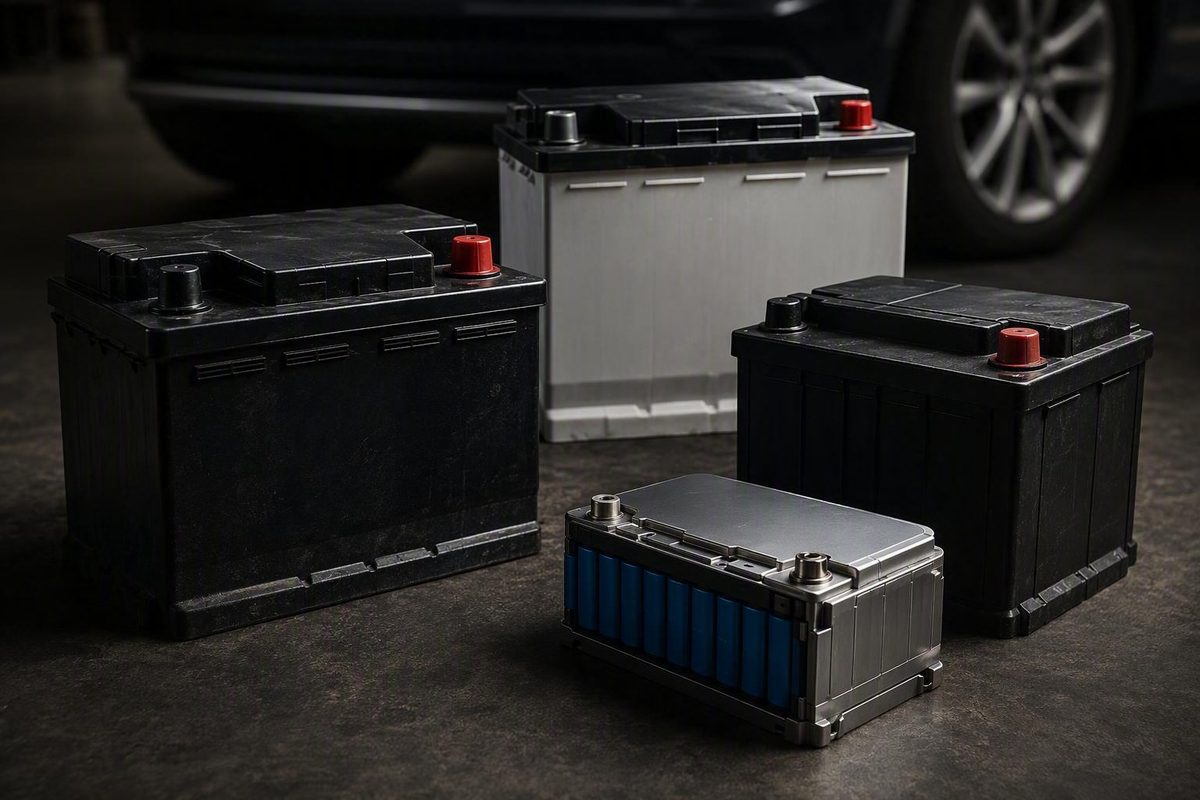
Most conventional 12-volt passenger-car batteries weigh about 25–50 pounds (11–22 kg), with 30–50 pounds serving as a practical range when planning to carry or remove one. This estimate applies to a starter or auxiliary battery—not the much larger traction pack that propels a hybrid or electric vehicle. Exact weight depends on the battery model, chemistry, size, capacity, and construction, so verify the part number before purchasing or lifting it. Published estimates place a typical passenger-car 12-volt battery at approximately 11–22 kg, or 25–50 pounds.
The quick answer: expect about 25–50 pounds
For an ordinary gasoline or diesel passenger vehicle, expect the battery to weigh roughly as much as a moderately heavy suitcase. Compact batteries can fall below the typical range, while batteries for diesel engines, SUVs, pickups, commercial vehicles, or vehicles with greater starting demands may exceed it.
Two 12-volt batteries can have different case dimensions, internal plate arrangements, capacities, terminal positions, and intended applications. There is no universal weight for every 12-volt battery.
The distinction matters with electrified vehicles. These batteries perform different jobs and fall into entirely different weight categories.
Car battery weight chart by type
The following figures are broad planning estimates, not specifications for a particular battery or vehicle. Flooded lead-acid, AGM, and EFB ranges come from published battery-type estimates, which also demonstrate that the categories overlap rather than having fixed weights (battery-type ranges from Uplus).
| Battery type | Estimated weight | Estimated metric weight | Common application |
|---|---|---|---|
| Flooded lead-acid | 35–45 lb | 16–20 kg | Conventional passenger-car starter battery |
| AGM | 30–60 lb | 13–27 kg | Starter or auxiliary battery where AGM is specified |
| EFB | 35–55 lb | 16–25 kg | Enhanced flooded starter battery |
| Lithium 12-volt starter | 10–20 lb | 4.5–9 kg | Lightweight starter battery in compatible applications |
| Heavy-duty starter | 50–70+ lb | 23–32+ kg | Commercial vehicles or larger engines |
| Hybrid traction pack | 100–300 lb | 45–136 kg | Propulsion assistance in a hybrid |
| Full EV traction pack | 400–1,200+ lb | 180–544+ kg | Primary propulsion energy storage in an EV |
The lithium, heavy-duty, hybrid, and EV figures are likewise broad estimates rather than model-specific specifications. Published ranges put lithium starter batteries around 10–20 pounds, heavy-duty batteries around 50–70 pounds or more, hybrid packs around 100–300 pounds, and full EV packs anywhere from hundreds to more than 1,000 pounds (SETEC Power’s automotive battery weight overview).
The final two rows describe complete propulsion packs, not replacements for a 12-volt starter battery. Their mass varies substantially with capacity, chemistry, enclosure, cooling hardware, model year, drivetrain, and vehicle configuration.
A lighter lithium starter battery is not automatically a suitable substitute for a lead-acid battery. Compatibility depends on documented application guidance, charging requirements, physical fit, terminal layout, and the vehicle’s electrical specifications.
Why two 12-volt batteries can have different weights
Voltage alone says little about a battery’s weight. The main variables include:
- Chemistry: Lead-acid and lithium batteries use different materials and internal designs.
- Physical group size: A larger case can hold more internal material, although products in the same group can still differ.
- Capacity: Batteries intended for different electrical demands may use different quantities or arrangements of active material.
- Plate design: The quantity, thickness, and construction of internal plates affect performance and mass.
- Case construction: The case, separators, terminals, handles, and structural components all add weight.
- Vehicle requirements: Engine size, starting demand, accessory load, and manufacturer specifications influence battery selection.
Conventional flooded lead-acid batteries are particularly heavy because they contain dense lead-based plates and liquid electrolyte.
It does not assign one exact weight to every battery in that group.
AGM batteries also are not always heavier than flooded batteries. Their published ranges overlap substantially, so the exact product specification is more reliable than an assumption based only on chemistry.
Real manufacturer examples show the range
A manufacturer specification sheet gives a better estimate than a general average when the exact product is known. These selected examples come from clearly readable conventional 12-volt automotive rows in the Deka SLI specification sheet.
| BCI group | Deka part number | Listed weight |
|---|---|---|
| 42/52R | 542/58R | 19.5 lb |
| 26 or 26R | 526MF | 29 lb |
| 24F | 524MF | 37 lb |
| 48 (H4/53) | 548MF | 39 lb |
| 65 | 565MF | 41.5 lb |
These examples span 19.5–41.5 pounds, showing why one average cannot describe every conventional automotive battery. Deka identifies the listed weights as approximate, so they are suitable for planning rather than precision measurement.
Do not transfer these figures to other brands, chemistries, or applications. Even if another battery shares the same group number, consult that product’s label or datasheet for its listed weight.
How to find the exact weight before lifting or buying
Use this sequence before removing or ordering a battery:
- Identify which battery you are dealing with. Determine whether it is a 12-volt starter or auxiliary battery rather than a high-voltage traction pack.
- Record its identifying information. Note the brand, complete part number, battery technology, and BCI group number.
- Inspect the label. The weight may be printed on the case, although not every battery label includes it.
- Search the manufacturer’s documentation. Use the complete part number to find the catalog entry or datasheet rather than searching by voltage alone.
- Confirm vehicle fitment separately. If the label is inaccessible or incomplete, consult the owner’s manual, automaker service information, parts catalog, retailer fitment listing, or a qualified workshop.
Do not infer an exact weight from “12V,” the vehicle class, or the BCI group number. Those details can narrow the possibilities, but they do not identify the internal construction of a particular battery.
Weight is also only one part of replacement selection. Confirm:
- Case dimensions and hold-down design
- Positive and negative terminal positions
- Required flooded, EFB, AGM, lithium, or other technology
- Capacity and reserve-capacity requirements
- Cold-cranking specifications
- Vehicle-specific charging and battery-management requirements
When handling a conventional battery, keep it upright and prevent tools or other metal objects from bridging its terminals. Use assistance or suitable lifting equipment whenever the load is uncomfortable; published handling guidance likewise emphasizes upright transport and protection against terminal short circuits.
For a proposed lithium replacement, check the battery maker’s application guidance and the vehicle manufacturer’s specifications. Saving weight does not compensate for incorrect dimensions, hold-down fit, terminal layout, starting capability, charging behavior, or electrical specifications.
The cited 25–50-pound range is a useful planning estimate for a conventional passenger-car battery, not a substitute for checking the product itself. Before buying or removing one, identify the exact part number, verify the manufacturer’s listed weight, and confirm every fitment and technology requirement.
Does a heavier car battery automatically have more cold-cranking amps or reserve capacity?
Compare the manufacturer’s CCA and reserve-capacity ratings for the exact model while also confirming the required chemistry, dimensions, hold-down, and terminal arrangement.
Can I replace a lead-acid car battery with a lighter lithium battery?
Only when the lithium battery is documented as compatible with the application. It must have the correct dimensions, hold-down, terminal layout, starting capability, operating specifications, and charging requirements. Check the battery manufacturer’s application guidance and the vehicle manufacturer’s documentation rather than assuming that a lighter lithium model is a drop-in replacement.