
4 min read ·
A High-CCA Car Battery Must Still Match the Vehicle
Higher CCA can add cold-start margin, but fit, battery type, capacity and vehicle requirements matter more than chasing the largest number.
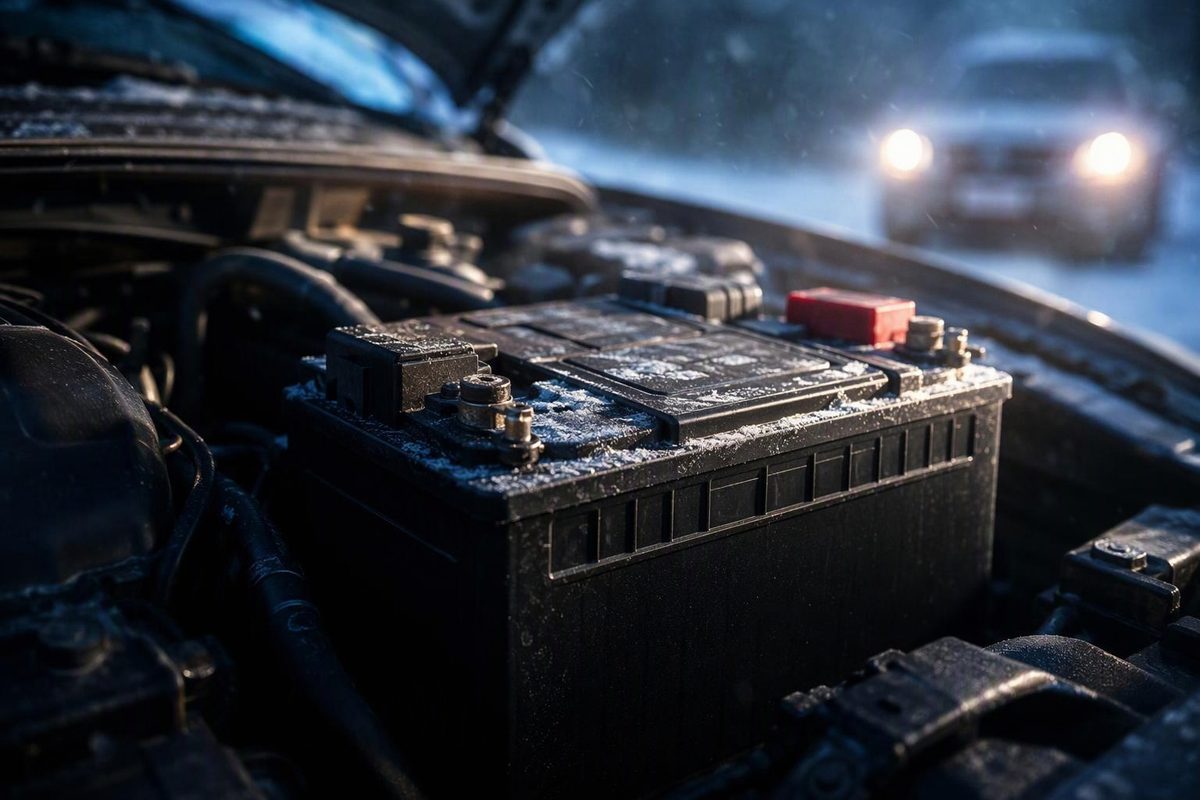
A car battery with high cold-cranking amps can provide extra starting margin in severe cold, but the highest CCA number is not automatically the best choice. Start with the battery specified for the vehicle’s year, make, model, engine and equipment. Among batteries confirmed to fit, choose one that meets or modestly exceeds the required CCA.
Do not trade correct group size, terminal layout, battery technology or electronic setup requirements for a larger CCA number.
What CCA actually tells you
Cold-cranking amps measure a battery’s ability to deliver current at 0°F (-17.8°C) for 30 seconds while maintaining at least 7.2 volts for a 12-volt battery (Interstate’s explanation of CCA testing). CCA is therefore a cold-start capability rating—not a measure of how much energy the battery stores or how long it can power accessories.
A 750-CCA battery does not continuously force 750 amps into the starter. The starter draws current according to its load and circuit conditions; the rating describes what the battery can supply in the standardized test.
Do not confuse CCA with:
- CA (cranking amps): measured at 32°F, so its rating will normally be higher than the CCA rating for the same battery.
- Ah (amp-hours): a measure of electrical storage capacity.
- RC (reserve capacity): a standardized measure of how long a battery can support a specified load before reaching the test endpoint. See what battery reserve capacity means.
Compare CCA with CCA, not with CA or an unexplained “cranking amps” figure.
Is a higher-CCA battery acceptable?
A somewhat higher CCA rating can be acceptable when the battery is a listed fit for the exact vehicle. Treat the vehicle maker’s figure as a minimum to meet, not a specification to undercut. A higher CCA rating alone does not mean the starter will receive that full current continuously.
Stop and recheck the application if obtaining the higher rating requires any of these changes:
- a different case or group size;
- reversed terminal positions or an incompatible post type;
- an improvised hold-down;
- a change from AGM or EFB to a conventional flooded battery;
- substantially different amp-hour or reserve capacity;
- bypassing required battery registration or coding.
The case must sit fully in the tray, the original hold-down must secure it, and the cables must reach without stretching or crossing. A battery that merely fits into the available space is not necessarily a correct replacement. Midtronics recommends matching the OEM group size, CCA range and battery type, particularly where the vehicle monitors battery condition and charging.
Some battery-management systems require registration, adaptation or coding after replacement. The procedure—and whether changing capacity or chemistry requires additional coding—varies by vehicle. Check the applicable service information before disconnecting the old battery.
When paying for higher CCA makes sense
Higher CCA is most useful when the vehicle regularly sits outside in very cold weather. Low temperature slows battery chemistry while the engine can require more current to turn. AAA Oregon/Idaho says its Automotive Research Center found that a car battery loses about 35% of its strength at 32°F and about 60% at 0°F; it also says cold starting may require up to twice the normal current (AAA winter battery guidance).
A higher-CCA option within the correct fitment can therefore be sensible when:
- the vehicle repeatedly starts around or below 0°F;
- the application catalogue lists multiple valid CCA ratings for the same engine and battery type; or
- two otherwise suitable batteries differ in CCA and the added cold-start margin justifies the price.
Even then, more has diminishing value. Physical fit, specified battery technology and adequate capacity remain requirements. For a cold-climate purchase, compare exact-fit batteries rather than buying by CCA alone; the cold-weather battery guide covers the other checks.
Use this order when choosing
- Confirm the exact vehicle: year, make, model, engine, trim and start-stop equipment.
- Check an OEM specification or current fitment catalogue: do not rely only on the label fitted by a previous owner.
- Match voltage and battery technology: AGM, EFB or flooded as specified.
- Verify physical fit: case dimensions, terminal positions, vent connection and hold-down style.
- Meet the specified CCA: a modestly higher figure is a secondary benefit, not permission to ignore steps 1–4.
- Compare capacity, warranty and date code: CCA alone does not establish overall quality or accessory runtime.
- Confirm installation requirements: determine whether registration, coding or settings recovery is needed and what a shop quote includes.
Do not use a high-CCA purchase to mask a fault. Slow cranking can also result from a discharged battery, loose or corroded connections, excessive cable voltage drop, a starter problem or a charging-system fault. Test the battery and starting and charging systems before replacing a relatively new battery. If the engine does not crank, follow these no-crank checks first.