
19 min read ·
What You Could Actually Pay to Replace a RAV4 Hybrid Traction Battery
Two cited 2016–2018 remanufactured offers support about $2,800–$3,100 installed, before taxes, diagnosis, and possible additional repairs.
The short answer: realistic replacement-cost scenarios
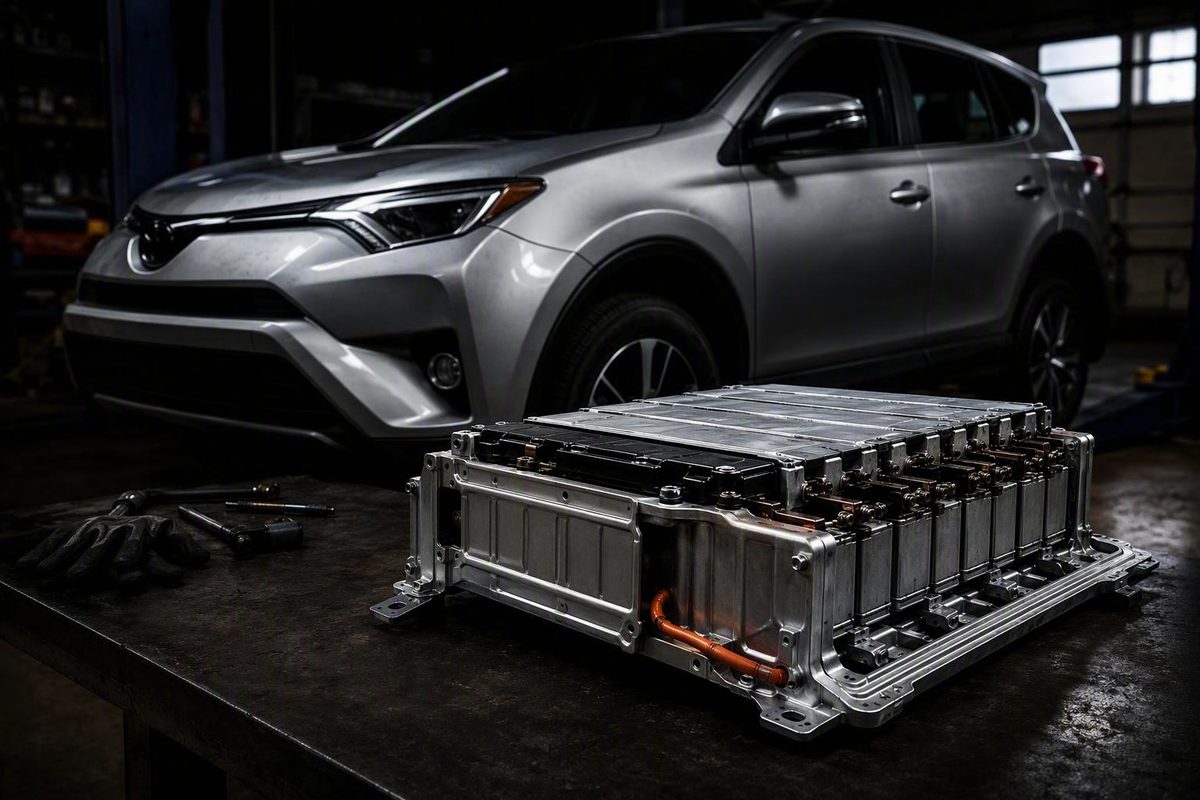
This guide analyzes advertised planning examples for the high-voltage traction battery in a standard Toyota RAV4 Hybrid. That pack stores energy for the hybrid powertrain and supports the electric motor. It is not the conventional 12-volt auxiliary battery, and it is not the larger traction battery in the plug-in RAV4 Prime.
There is no defensible single nationwide RAV4 Hybrid battery replacement cost in the available evidence. The clearest advertised examples are:
| Planning scenario | Advertised battery price | Advertised installation | Starting total | Important limitation |
|---|---|---|---|---|
| 2016–2018 remanufactured pack with mobile installation | $2,500 | $300 | $2,800 | Limited service area; taxes, diagnosis, and unrelated repairs are not clearly included. Hybrid Restoration offer |
| 2016–2018 remanufactured pack with professional installation | $2,549 | About $500 | About $3,049 | Installation varies by location; taxes, diagnosis, and some delivery fees are extra or unspecified. Best Hybrid Batteries listing |
| New OEM planning estimate | Roughly $3,000–$9,000 | Not consistently specified | No reliable installed total | The commercial estimates do not consistently state whether labor, diagnosis, taxes, or other charges are included. Greentec Auto cost guide |
The first two rows support a practical planning range of approximately $2,800–$3,100 installed for particular remanufactured 2016–2018 offers. They do not establish a national average, document actual customer invoices, or show what every RAV4 Hybrid owner will pay.
The new-OEM evidence is much broader. Greentec Auto estimates a new Toyota OEM battery at approximately $3,000–$9,000 and separately estimates labor at $500–$1,000. Santa Cruz Toyota gives a $3,000–$8,000 estimate for a new RAV4 Hybrid battery. Because the descriptions and inclusions differ, those figures cannot be turned into one dependable installed total.
Do not describe the combined span from the least expensive remanufactured offer to the highest OEM estimate as a “typical” price. It blends different:
- Model years and trims
- Battery chemistries and part numbers
- New, remanufactured, and used conditions
- Pack-only and installed prices
- Shipping and mobile-service arrangements
- Core-return requirements
- Warranty durations and coverage
- Providers and geographic markets
- Taxes, diagnosis, and additional repairs
Price-status note: These are figures displayed in the supplied commercial pages, not independently rechecked transaction prices. Seller pricing, inventory, warranties, freight terms, and service areas can change. Ask each provider to date its quote and confirm the terms in writing.
What the advertised price may leave out
The price beside a battery is not necessarily the checkout total, and the checkout total may not be the final net cost. A useful quote identifies every charge while separating refundable deposits from permanent expenses.
| Cost component | What to confirm |
|---|---|
| Battery pack | Whether it is new OEM, remanufactured, or used; exact fitment and part number |
| Diagnosis | Whether testing is included, waived after repair, or billed separately |
| Removal and installation | Flat-rate or hourly labor; whether removal of the old pack is included |
| Taxes | Whether sales tax applies to the pack, labor, shipping, or other charges |
| Shipping or freight | Commercial versus residential delivery, lift-gate service, and remote-area fees |
| Mobile service | Travel limits, service area, work-location requirements, and old-pack removal |
| Core deposit | Amount temporarily charged until the old pack is returned and accepted |
| Core-return freight | Whether the seller supplies a prepaid label or arranges freight pickup |
| Delivery surcharges | Residential, remote-area, appointment, lift-gate, or redelivery fees |
| Setup procedures | Whether the replacement requires programming, initialization, or calibration |
| Additional repairs | Cooling-system, connection, wiring, or other work identified during diagnosis |
The $2,549 remanufactured-pack example illustrates the calculation:
$2,549 pack + approximately $500 professional installation = approximately $3,049
That does not necessarily equal the final bill. The seller advertises contiguous-U.S. shipping but says remote-area or residential freight delivery can cost extra. Its listing also does not establish that diagnosis, sales tax, or vehicle-specific additional repairs are included.
Labor figures vary with scope. Greentec Auto estimates approximately $500–$1,000 for RAV4 Hybrid installation. Kalispell Toyota gives a broader $500–$1,500 labor estimate, but its article concerns Toyota hybrids generally rather than the RAV4 specifically. It is useful as context, not as a vehicle-specific quote. Kalispell Toyota’s general estimate
Core handling creates an important distinction between net cost and cash required upfront. Hybrid Restoration says mobile installation does not require a core deposit because its installer removes and retains the old pack. For shipped orders, the seller states that it charges a $1,000 refundable core deposit and includes a prepaid core-return label. The same listing prices its remanufactured battery at $2,500 with three-year coverage, $2,900 with four-year coverage, and $3,300 with five-year coverage before the selected delivery or installation charge. Hybrid Restoration terms
For example, a shipped $2,500 pack subject to a $1,000 core deposit could require a $3,500 initial battery-related payment before tax and separate installation. If the complete eligible core is returned on time and the seller accepts it, the deposit should not remain part of the net replacement cost. It still affects the cash or available credit needed upfront.
Use this formula when requesting an out-the-door estimate:
Pack + diagnosis + removal and installation + shipping or mobile service + taxes and fees + additional work = estimated final cost
List a refundable core deposit separately:
Estimated final cost + refundable core deposit = possible upfront cash requirement
Do not subtract the deposit until the seller accepts the returned core and issues the refund. Ask about the deadline, required condition, packaging, freight scheduling, possible deductions, and what happens if the carrier is delayed.
Taxes, diagnostic charges, and additional repairs are not clearly included in the concrete offers reviewed here. The written quote should state whether its total is fixed or subject to inspection and should require your approval before extra work is performed.
New OEM, remanufactured, and used packs are not equivalent quotes
A lower remanufactured price and a higher new-OEM estimate are not competing prices for an identical product. Condition, fitment, sourcing, included labor, core handling, and warranty administration can differ.
| Quote type | Condition | Exact fitment | Advertised price evidence | Installation status | Replacement warranty | Labor coverage | Core and shipping terms | Typical provider |
|---|---|---|---|---|---|---|---|---|
| New OEM | New manufacturer-supplied pack | Verify by VIN and part number | Broad commercial estimates of roughly $3,000–$9,000 | Often unclear in published estimates | Obtain current written terms | Do not assume it is included | Ask whether a core or delivery charge applies | Toyota dealer or OEM-parts installer |
| Remanufactured example A | Fully remanufactured | Seller specifies 2016–2018 | $2,549 | Professional installation typically about $500 extra | Three years and unlimited mileage advertised; six years offered for $765 more | Complete claim terms not supplied | Contiguous-U.S. shipping advertised; some delivery fees may apply | Battery seller plus installer |
| Remanufactured example B | Remanufactured | Seller specifies 2016–2018 | $2,500, $2,900, or $3,300 depending on warranty | $300 mobile installation where available | Three-, four-, or five-year options advertised | Seller describes broader coverage for installed purchases; verify the contract | No deposit with mobile service; $1,000 refundable deposit for shipped orders | Specialist or mobile installer |
| Used | Previously installed battery | Verify individually | Broad dealer estimate of $1,500–$3,500 | Unclear | Provider- and part-specific | Unclear | Unclear | Dealer, recycler, salvage source, or specialist |
New OEM
New OEM identifies a manufacturer-supplied replacement, but it does not by itself tell you the installed cost. Commercial RAV4-oriented sources place a new battery or replacement broadly around $3,000–$9,000, with inconsistent explanations of labor and fees. Santa Cruz Toyota also estimates used Toyota hybrid battery replacement at $1,500–$3,500, but it does not itemize diagnosis, labor, taxes, or other charges for either category. The same dealer page describes enhanced coverage of 10 years or 150,000 miles from first use and says that it replaced an earlier 8-year/100,000-mile warranty; that is a dealer summary, not a substitute for official VIN-specific confirmation. Santa Cruz Toyota’s estimates and warranty summary
Ask whether a new-OEM quote includes:
- The complete pack assembly
- Diagnosis
- Removal and installation
- Required setup procedures
- Taxes and shop fees
- Treatment of the removed pack
- Replacement-part warranty
- Warranty labor
Two OEM quotes are not comparable if one is pack-only and the other is an out-the-door repair.
Remanufactured
A remanufactured battery has been rebuilt or reconditioned rather than sold as a new Toyota OEM pack.
Greentec Auto publishes an advertised range of approximately $2,000–$2,850 for remanufactured RAV4 Hybrid batteries. Its guide also notes that battery chemistry may be lithium-ion or nickel-metal hydride depending on year and trim and that prices can change with market conditions and inventory. These are commercial estimates from a replacement-battery seller, not independently measured market averages. Greentec Auto’s remanufactured range
The two more specific offers apply to 2016–2018 vehicles. One combines a $2,500 remanufactured option with $300 mobile installation. The other lists a $2,549 fully remanufactured assembly and says professional installation typically costs about $500.
Warranty selection can materially change the advertised price. One seller’s three-, four-, and five-year selections rise from $2,500 to $2,900 and $3,300 before service charges. The other includes a three-year, unlimited-mileage warranty and offers six years for another $765.
Warranty duration alone does not establish value. Ask whether coverage includes:
- The replacement battery
- Diagnostic labor for a claim
- Removal of the failed replacement
- Delivery of another pack
- Return shipping
- Repeat installation
- Mobile travel charges
- Mileage limits
- Transfer to another owner
- Prorating
- Commercial or rideshare use
- Geographic restrictions
- Installation, water, collision, or cooling-system exclusions
A long parts-only warranty could still leave the owner paying freight and labor. A shorter warranty with broader repeat-service coverage could transfer more of the practical risk. The written contract determines the difference.
Used
A used battery is a previously installed pack sold without being represented as new. The available dealer estimate of $1,500–$3,500 is broad and does not establish model-year coverage or consistent labor and fee inclusions.
The evidence does not establish that used batteries are universally a good or bad choice. It shows why a low advertised price cannot be compared fairly with new or remanufactured pricing without additional information.
For a used quote, request:
- Source vehicle’s model year
- Exact part number
- Available test documentation
- Written replacement warranty
- Installed price
- Core requirements
- Shipping and return terms
If those details are unavailable, price may be the only clearly known variable.
Why model year, trim, and VIN can change the price
The strongest concrete offers in the available evidence cover only 2016, 2017, and 2018 RAV4 Hybrid vehicles. Owners of other model years should not assume those packs fit or that the same installation price applies.
The available commercial research says RAV4 Hybrid traction-battery chemistry may be lithium-ion or nickel-metal hydride depending on year and trim. It does not provide an authoritative, complete year-and-trim chemistry map. Therefore, do not assume every RAV4 Hybrid uses the same chemistry or assembly.
Before ordering, provide the VIN and obtain written confirmation of:
- Model year and trim
- High-voltage battery chemistry
- Replacement condition: new OEM, remanufactured, or used
- Manufacturer or remanufacturer
- Compatible part number
- Included electronics and hardware
- Programming, initialization, or calibration requirements
- Installation location and method
- Warranty eligibility and scope
Best Hybrid Batteries lists G9510-0R030 and G9510-0R020 for its fully assembled 2016–2018 remanufactured product. The seller says electronics are included and programming is not required. It also offers three-year unlimited-mileage coverage and a six-year option for an additional $765. These statements apply only to that seller’s product and should not be generalized to every replacement or model year. Best Hybrid Batteries specifications
A model-year description is less specific than VIN-based verification. As a purchasing precaution, ask the provider to confirm in writing that the quoted part fits the submitted VIN before it ships or is installed.
Other supported price variables include:
- Vehicle location
- Local labor rates
- Battery inventory
- Shipping distance and delivery type
- Seasonal demand
- Selected warranty
- Mobile, in-shop, dealer, or separately arranged installation
- Immediate collection or later shipment of the old core
If your RAV4 Hybrid is not a 2016–2018 model, use the advertised examples only to understand how a quote is constructed. Do not extrapolate their pack prices, part numbers, or installation terms to your vehicle.
Because the traction battery is a high-voltage component, this article does not provide removal, testing, shipping-preparation, or installation instructions. Use the provider-selection process to identify who is responsible for the work rather than treating a shipped pack as an ordinary 12-volt battery purchase.
Check Toyota warranty eligibility before paying
Contact Toyota or a Toyota dealer with the VIN before authorizing an owner-paid traction-battery replacement. Do this even if an independent provider has already diagnosed the vehicle. Warranty eligibility can change who performs the repair and how much the owner pays.
Have the following information ready:
- Full VIN
- Model year and trim
- Current odometer reading
- Original in-service date, if known
- State or jurisdiction of original sale and current registration
- Ownership status
- Service and previous-repair records
- Written diagnostic findings
- Current official Toyota warranty terms applicable to the VIN
The supplied commercial summaries conflict. One Toyota dealer describes enhanced hybrid-battery coverage of 10 years or 150,000 miles from first use and says it replaced an earlier 8-year/100,000-mile warranty. Greentec Auto instead summarizes coverage as 8 years/100,000 miles or up to 10 years/150,000 miles in certain states. Neither summary should be treated as the controlling warranty document.
Ask Toyota or the servicing dealer to confirm in writing:
- Whether the vehicle remains within the applicable time and mileage limits
- Which date Toyota treats as the beginning of coverage
- Whether the diagnosed condition is covered
- What diagnostic documentation is required
- Whether prior battery or electrical repairs affect eligibility
- Whether an ownership change matters
- Which costs, if any, remain the owner’s responsibility
- Whether a particular facility must perform the repair
- What warranty applies to a replacement installed under coverage
Do not authorize a nonrefundable battery order until you understand whether it could complicate a Toyota warranty claim. Likewise, do not assume a generalized mileage-and-time statement guarantees coverage. Model year, first-use date, jurisdiction, diagnosis, mileage, and the official terms applicable to the VIN can all matter.
The evidence supplied for this article does not include current official Toyota warranty documentation establishing the complete transition rules and qualifications for every model year. The dealer and seller summaries are therefore useful prompts for verification, not final determinations of coverage.
Diagnose the hybrid system before replacing the complete pack
A hybrid-system warning deserves attention, but it does not by itself prove that the complete traction battery needs replacement.
Commercial and dealer guidance identifies several reasons to request professional inspection:
- Reduced fuel economy
- Sluggish acceleration or reduced power
- More frequent engine operation
- A hybrid-system warning or other warning light
- State-of-charge readings that rise and fall unusually
- A loud or continuously operating battery fan
- Unusual powertrain behavior or sounds
Greentec Auto lists reduced economy, sluggish acceleration, frequent engine operation, hybrid warnings, unstable charge readings, and persistent battery-fan operation as possible battery warning signs. Kalispell Toyota similarly identifies reduced power, lagging acceleration, increased engine operation, warning lights, and unusual sounds as reasons to seek inspection. Kalispell Toyota’s warning-sign discussion
Those symptoms can justify testing, but the supplied evidence does not establish which diagnostic codes prove complete-pack degradation, what test thresholds apply, or what diagnosis should cost.
Request a written report identifying:
- The customer complaint and observed symptoms
- Stored and current fault codes
- Tests performed
- Relevant measured results
- The technician’s conclusion
- Why complete-pack replacement is recommended
- Whether another hybrid-system fault was found
- Whether additional work is required
Ask the shop to distinguish traction-pack degradation from other possible hybrid-system faults. That does not mean assuming a sensor, cooling fan, connection, wiring component, or control system is responsible. It means asking for evidence before approving the most expensive proposed repair.
Be cautious with claims that a single inexpensive cell or module can always be replaced. The only low-cost cell-repair figure in the evidence is an anecdotal claim from a 2020 UK owner forum. It does not establish current U.S. pricing, technical suitability, safety, diagnostic standards, or durability for a particular RAV4 Hybrid. Historical owner-forum discussion
Use diagnosis as a decision gate:
- Verify the fault and obtain the findings in writing.
- Check Toyota warranty eligibility using the VIN and diagnosis.
- Then compare complete, itemized replacement quotes.
How to compare dealer, specialist, mobile, and shipped-battery quotes
Replacement channels package cost and responsibility differently.
| Channel | Potential advantages | Questions and trade-offs |
|---|---|---|
| Toyota dealer | Route for Toyota warranty review; access to OEM sourcing and Toyota-trained service personnel | Confirm diagnosis, battery condition, labor, fees, and replacement-warranty terms |
| Independent hybrid specialist | May offer remanufactured alternatives and hybrid-focused service | Rebuilding standards and warranty administration vary; identify who performs and stands behind the work |
| Mobile installer | On-site replacement; old core may be collected immediately | Service areas can be limited; confirm travel fees, site requirements, and repeat-visit coverage |
| Shipped battery with separate installation | May expand product choice beyond local inventory | Buyer may need to coordinate freight, storage, installation, core return, and warranty labor |
Commercial sources associate dealerships with OEM parts and Toyota-trained technicians, while specialists may offer remanufactured alternatives. That does not prove either channel is always better. The stronger quote is the one that fits the exact vehicle, follows a documented diagnosis, states the total cost, and clearly assigns responsibility.
The mobile example reviewed here advertises $300 installation in limited parts of specified south-central and lower-Midwestern states. The seller says no core deposit applies because its installer removes the old battery.
The same seller’s shipped-order arrangement includes freight fulfillment, a prepaid core-return label, and a $1,000 refundable core deposit. The buyer may then need to coordinate the delivered pack, an installer, and timely return of the old assembly.
Before choosing a shipped battery, determine:
- Who receives and inspects the freight
- Whether residential or lift-gate delivery costs extra
- Where the battery can be stored
- Who will install it
- Whether that installer covers labor on a customer-supplied pack
- Who repacks the old core
- Who schedules its return
- How quickly it must be shipped
- Who pays if the replacement develops a covered fault
Use this checklist for every quote:
- VIN, model year, and trim
- Battery chemistry
- New OEM, remanufactured, or used condition
- Manufacturer or remanufacturer
- Exact part number
- Diagnosis and its price
- Battery price
- Removal and installation labor
- Programming, initialization, or calibration
- Taxes and shop fees
- Shipping, freight, travel, and delivery charges
- Core-deposit amount
- Core-return deadline and refund conditions
- Installation location
- Estimated out-the-door total
- Warranty duration and mileage limit
- Parts, labor, delivery, and repeat-installation coverage
- Exclusions, transferability, and prorating
- Business responsible for administering a claim
Date every quote. Inventory, freight, labor, discounts, and service areas can change, so an older advertisement may not remain available.
Most importantly, establish who owns the problem if the replacement develops a covered fault. Ask whether the warranty administrator arranges diagnosis, removal, return shipping, replacement delivery, and repeat installation—or whether some of those costs fall back on you.
Do not mix RAV4 Hybrid, RAV4 Prime, and 12-volt battery prices
The RAV4 name can lead search results to combine three different batteries:
-
The standard RAV4 Hybrid high-voltage traction battery, which supports the hybrid powertrain and electric motor
-
The RAV4 Prime high-voltage traction battery, which belongs to the plug-in-hybrid model
The headline figures in this guide apply only to the first category. A 12-volt battery quote is not a traction-pack replacement quote. A RAV4 Prime estimate should not be blended into standard RAV4 Hybrid budgeting.
A Toyota World presenter cites third-party RAV4 Prime examples ranging from roughly $10,000 before labor to around $19,000 and attributes the difference to the Prime’s larger lithium-ion pack, specialized components, greater complexity, availability, and labor requirements. The figures are compiled from indirect third-party sources rather than itemized Toyota invoices, so they should be used only to show why Prime pricing requires a separate analysis. Toyota World comparison
Before requesting a quote, state:
- Exact vehicle name: RAV4 Hybrid or RAV4 Prime
- VIN
- Model year
- Request for the high-voltage traction battery, not the 12-volt auxiliary battery
A three-step action plan
First, identify the vehicle and part. Confirm that the quote concerns the standard RAV4 Hybrid high-voltage traction battery. Require VIN-based confirmation of fitment, condition, chemistry, and part number.
Second, verify the repair and possible coverage. Obtain a written diagnosis and contact Toyota or a Toyota dealer about VIN-specific warranty eligibility before authorizing owner-paid work.
Third, compare at least two itemized quotes. Each should identify battery condition, pack price, diagnosis, labor, taxes, freight or mobile service, core terms, setup procedures, and replacement-warranty coverage.
For budgeting, approximately $2,800–$3,100 installed is supported by the two cited remanufactured offers for 2016–2018 RAV4 Hybrids, before taxes, diagnosis, and possible additional repairs. New-OEM planning estimates are broader—roughly $3,000–$9,000—and their inclusions are less consistently stated.
Those figures are advertised planning examples, not a nationwide average or a prediction of the final invoice. The most useful number is a dated, written, VIN-specific total for the diagnosed repair.
Frequently asked questions
How much is a RAV4 Hybrid battery replacement with labor?
For the two advertised 2016–2018 remanufactured examples analyzed here, the starting installed totals are approximately $2,800 and $3,049. One combines a $2,500 pack with $300 mobile installation; the other combines a $2,549 pack with approximately $500 professional installation.
Diagnosis, sales tax, freight surcharges, and additional repairs may not be included. The examples also do not automatically apply to other model years. New-OEM estimates are broader and do not consistently identify labor or other charges.
Is a RAV4 Hybrid battery covered for 10 years or 150,000 miles?
It may be, but the available dealer and seller summaries do not support treating that coverage as universal. One dealer describes enhanced coverage of 10 years or 150,000 miles from first use, replacing an earlier 8-year/100,000-mile warranty. Another commercial source describes 8 years/100,000 miles or up to 10 years/150,000 miles in certain states.
Contact Toyota or a Toyota dealer with the VIN, mileage, original in-service date, model year, jurisdiction, and diagnosis. Ask for the official terms applicable to that vehicle and written confirmation of whether the diagnosed failure and related charges are covered.
Does a 2016–2018 RAV4 Hybrid replacement battery require programming?
Two sellers describe their own assembled remanufactured 2016–2018 products as requiring no programming or as plug-and-play. Those are seller-specific product statements, not universal instructions for every replacement battery, installer, or RAV4 model year.
Give the installer the VIN and exact replacement part number. Ask whether programming, initialization, calibration, or another post-installation procedure is required and included.
How much can a core deposit add to the upfront payment?
One provider says its shipped orders require a $1,000 refundable core deposit. That temporarily adds $1,000 to the amount charged even though it should not remain part of the net cost if the old pack is returned and accepted under the seller’s terms.
The same provider says mobile installation avoids the deposit because its installer takes the old battery. Confirm the return deadline, required core condition, freight process, deductions, and refund timing in writing.
What warning signs mean the RAV4 Hybrid battery should be tested?
Possible reasons to request an inspection include reduced fuel economy, sluggish acceleration or reduced power, frequent engine operation, a hybrid-system warning, unstable state-of-charge readings, and a loud or continuously running battery fan.
None of those symptoms proves that the complete traction pack needs replacement. Ask for the fault codes, tests, measured results, and recommended repair in writing, then verify warranty eligibility before comparing replacement quotes.