
5 min read ·
Start With the Symptom, Then Test Before Replacing Parts
First identify whether the engine cranks, then use battery measurements and starter-circuit results before replacing the battery or starter.
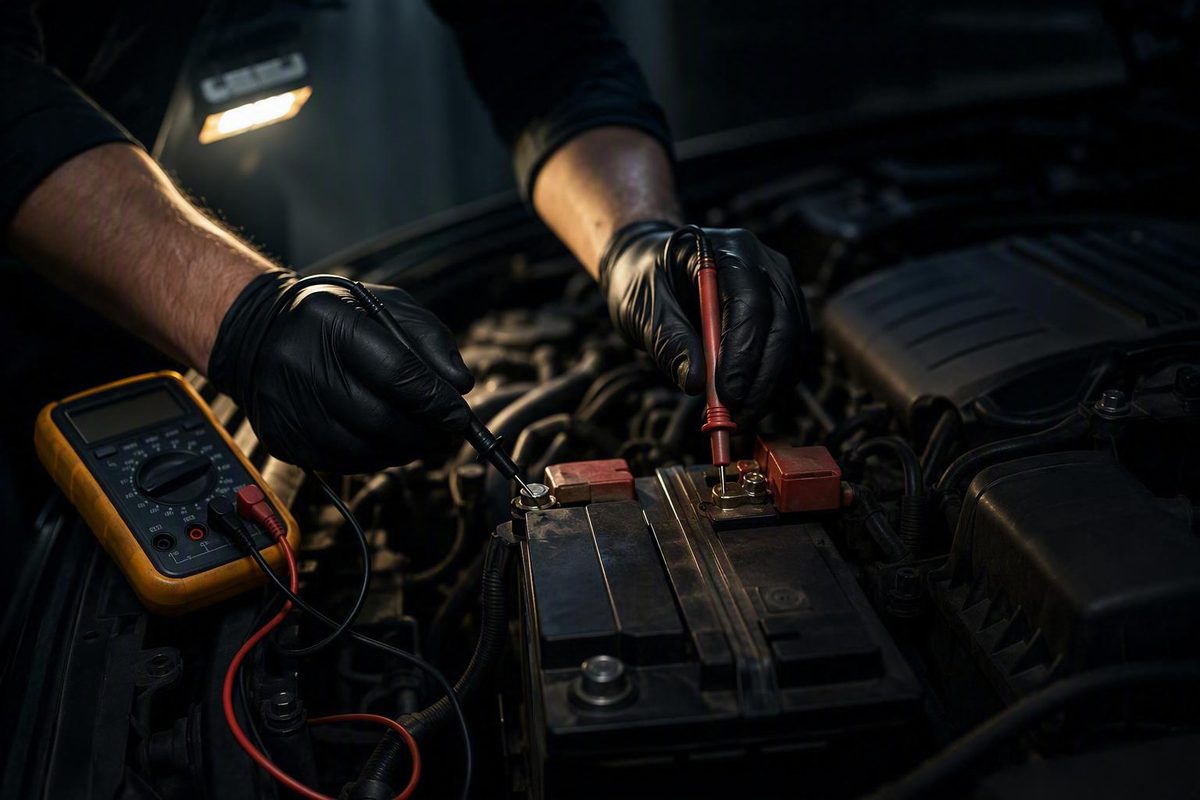
This checklist addresses only the first condition. In a no-crank complaint, low battery charge may be contributing, or the starter control circuit may require testing, but the symptom alone does not prove that the battery, relay, solenoid, or starter has failed.
First, determine whether the engine is cranking
Observe one start attempt closely. Does the engine turn over, turn unusually slowly, or not move at all? Record what actually happened rather than describing every failure to start as a “dead battery.”
Note:
- Whether the engine cranked
- What you heard and observed
- The ambient temperature
- Whether charging the battery changed the result
- Any battery test measurements already available
They do not identify a defective component by themselves.
If the engine turns over at its normal speed but never runs, stop following this checklist.
Use this battery-to-starter decision table
The sequence below comes from GM Preliminary Information PIE0283, “Engineering Information – No Crank/No Start in Cold Ambient Temperatures”. It is a technician procedure for a narrowly defined group of GM vehicles with qualifying cold-weather complaints and service histories—not a universal procedure for every no-crank vehicle.
| Finding | Next check | Interpretation |
|---|---|---|
| Battery state of charge is low | For a vehicle covered by the GM procedure, the technician warms the battery to room temperature, charges it, and retests | Low charge may be contributing, but it does not prove the battery is defective |
| Charging restores cranking | Record the result; use applicable service diagnostics if the discharge recurs | Restoring charge changed the condition but did not establish why the battery was discharged |
| No-crank remains after the specified battery checks | Continue with the professional starter-control-circuit sequence | More evidence is needed before condemning the battery or starter |
| Starter S-terminal lacks 12 volts while Start is commanded | Verify starter-relay operation | The missing signal does not identify which control-circuit component is responsible |
| Diagnosis points toward the starter | Continue with the specified solenoid and starter evaluation | Do not replace the starter based on the no-crank symptom alone |
Every step should produce a measurement or test result. Owners of vehicles outside the bulletin’s eligibility requirements should follow the diagnostic procedure specified for their own vehicle rather than transferring this sequence to another make, model, engine, or operating condition.
Check battery condition with more than one measurement
For an eligible vehicle, the GM procedure tells the technician to record:
- Battery voltage
- Measured cold-cranking amperage
- The cold-cranking amperage rating printed on the installed battery’s label
Voltage is therefore not treated as the only indicator. The measured cold-cranking result is considered alongside the rating of the battery actually installed in the vehicle.
A low state of charge is one possible contributor to the cold-weather complaint covered by the bulletin. It is not proof of an internal battery defect, and it does not explain why the charge became low.
If you do not have the specified tester or cannot interpret its results, obtain a qualified battery test and retain the recorded readings.
When the starter circuit needs professional diagnosis
Under the GM procedure, a no-crank condition that remains after the specified battery checks leads to a starter-control-circuit test. The technician checks for 12 volts at the starter S-terminal while the ignition is held in the Start position. If the signal is absent, the procedure directs the technician to verify starter-relay operation and then consult the applicable starter-solenoid diagnostic information.
An absent S-terminal signal directs attention to the control side of the circuit, but it does not prove that the relay or any other individual component has failed. Likewise, the bulletin does not establish that the starter has failed merely because the signal is present.
S-terminal, relay, solenoid, and starter evaluation is technician-level work under the bulletin. It depends on the correct service information, test equipment, and interpretation of the circuit during a start command. The appropriate result may be further diagnosis rather than immediate battery or starter replacement.
Cold-weather case study: the limits of the GM guidance
GM documented reports of no-crank or no-start behavior at 20°F (-7°C) or colder in the following vehicles:
- 2014 Chevrolet Silverado 1500
- 2015 Chevrolet Suburban and Tahoe
- 2014 GMC Sierra 1500
- 2015 GMC Yukon and Yukon XL
The vehicles also had to have a 4.3-liter, 5.3-liter, or 6.2-liter Gen 5 engine with RPO LV3, L83, or L86, according to the manufacturer’s preliminary engineering bulletin.
Even a listed vehicle was not automatically covered. GM instructed technicians to use the procedure only when the customer had reported the condition and the relevant preliminary-information number appeared in the vehicle’s applicable warranty or investigation history. Otherwise, technicians were told to use the published service diagnostics.
The document was preliminary engineering information, not a recall. GM was gathering pre-repair information and had not determined the root cause. The cold temperature describes the circumstances in which customers reported the condition; it does not prove that cold weather or a weak battery was the definitive cause.
Vehicles outside the listed models, engines, temperature condition, or service-history requirements require their manufacturer’s standard diagnostic process.
Know when this checklist no longer applies
Stop this no-crank pathway if the engine turns over normally but does not run. That symptom requires a different diagnostic process based on the specific vehicle.
Use roadside assistance or a qualified technician if you cannot obtain the battery testing specified for your vehicle or if diagnosis reaches the starter control circuit. Provide a concise symptom record containing:
- Whether the engine cranked
- The ambient temperature
- Available battery voltage and cold-cranking test results
- The battery’s labeled cold-cranking rating
- Whether charging changed the condition
The practical sequence is to identify whether the engine cranks, document the conditions, and obtain the battery measurements required by the applicable vehicle procedure. If the no-crank condition remains, proceed to qualified starter-circuit diagnosis. Testing narrows the cause; the symptom alone does not justify replacing a battery or starter.