
11 min read ·
Your Tesla VIN Usually Won’t Reveal the Exact Battery—Here’s What to Check Instead
Modern VINs generally cannot confirm LFP, NCA or NMC; early Model S codes are limited exceptions. Confirm the pack via the vehicle screen or service records.
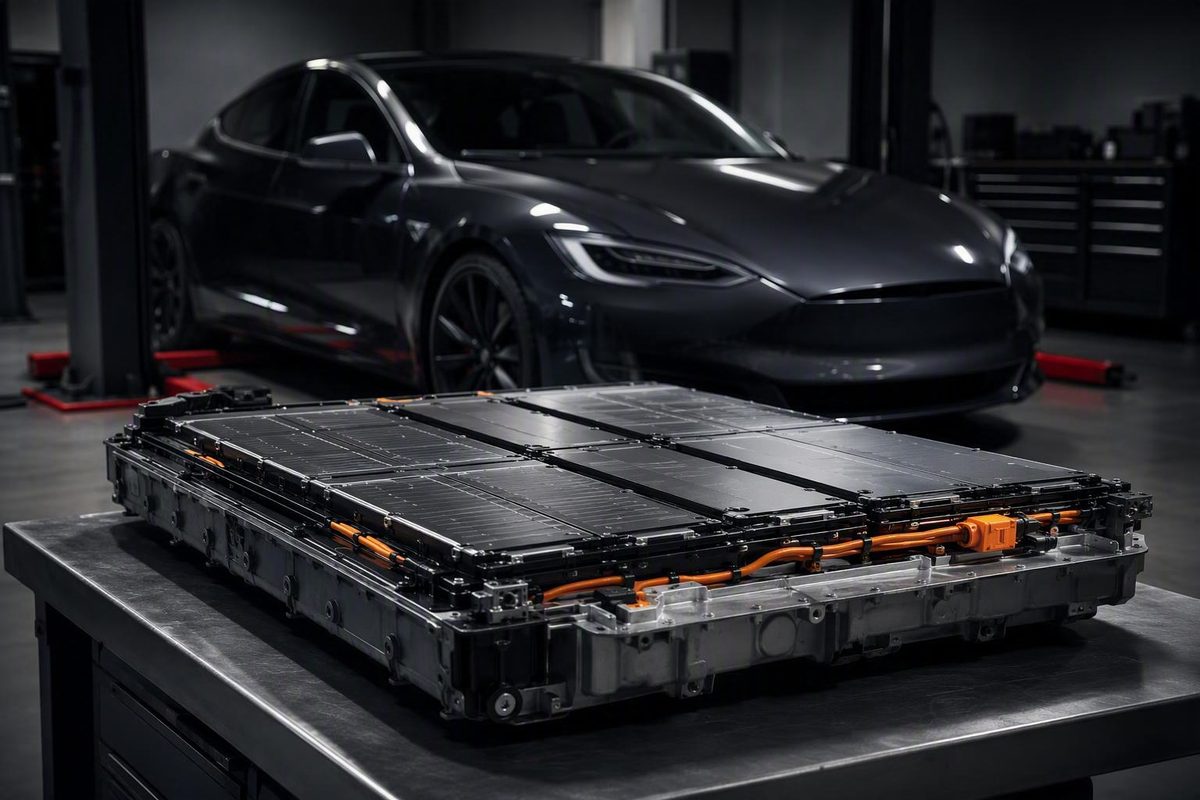
A Tesla VIN can usually identify the model, model year, assembly plant, and selected drivetrain details, but it generally cannot confirm the high-voltage battery’s chemistry, cell format, supplier, usable capacity, or health. Early Model S vehicles are a limited exception: certain year-specific VIN characters indicate broad historical capacity tiers. For most Teslas, use the VIN as a starting point, then verify the installed pack through the vehicle display, service information, or identifying details already accessible on the pack.
The short answer: a VIN usually cannot identify the exact Tesla battery
You generally cannot determine whether a modern Tesla has an LFP, NCA, or NMC battery from its VIN alone. The VIN also does not establish whether the cells are cylindrical or prismatic, who supplied them, the pack’s exact gross or usable capacity, or how much capacity remains.
VINs are more reliable for broad vehicle attributes, including:
- Vehicle model
- Model year
- Assembly plant
- Body or restraint configuration
- Selected drive-unit or drivetrain information
- Electric propulsion type
Be careful when a decoder labels position 7 as “Battery Type.” A result such as “Electric” identifies electric propulsion; it does not distinguish LFP from nickel-based NCA or NMC chemistry. The standard identifier contains 17 characters, but the meaning assigned to an individual position can change by model and model year, as the TeslaTap VIN decoder and example results illustrate.
It also matters how a service produces its result:
- VIN decoding: The service interprets information represented directly by characters in the VIN.
- VIN-linked lookup: The service uses the VIN as a key to retrieve records from a database or API.
- Calculation: The service estimates a value from retrieved data.
- Inference: The service assumes a likely specification based on trim, factory, market, or production period.
A lookup may therefore display information that is not encoded in the VIN. Unless the service explains its source and method, do not assume a battery-capacity or health figure came from decoding a particular character.
For owners and used-EV shoppers, the practical question is not just what the car was built with, but what pack is installed now.
Use this decision tree before decoding any battery-related character
Follow this sequence before assigning battery meaning to position 7 or 8:
- Read position 4 and identify the model.
- Read position 10 and identify the model year.
- Determine whether the vehicle is an early Model S covered by the historical tables.
- Only then interpret a historically battery-related position.
Tesla’s official Model S documentation identifies position 4 as the series and position 10 as the model year. For the covered Model S years, position 4 is S, while the position-10 year codes run from C for 2012 through M for 2021. These mappings and the battery-related positions below are specific to the Model S service-manual VIN tables.
| Position-10 code | Model year | Position-10 code | Model year |
|---|---|---|---|
| C | 2012 | H | 2017 |
| D | 2013 | J | 2018 |
| E | 2014 | K | 2019 |
| F | 2015 | L | 2020 |
| G | 2016 | M | 2021 |
The order matters because a VIN position can change meaning over time. Position 8 combines motor and broad battery-tier information for 2012–2013 Model S vehicles. In applicable 2014–2015 Model S tables, position 7 carries broad capacity information. In later covered Model S schemes, position 7 generally identifies the vehicle as electric rather than specifying battery chemistry or capacity.
This official historical framework covers Model S model years 2012 through 2021 only. Do not extend it to Model 3, Model X, Model Y, Cybertruck, Roadster, later Model S production, or another Tesla without documentation for that model and year.
Model year is also not necessarily the calendar year in which the car was assembled. A vehicle assigned the next model year may have been manufactured late in the preceding calendar year.
The VIN may be available:
- At the lower corner of the driver-side windshield
- On the driver-side door jamb or certification label
- In the Tesla app or Tesla account
- On the vehicle’s Software screen
Physical locations can vary by market and may be mirrored on right-hand-drive vehicles. Record the complete VIN and check visually similar characters before using a decoder.
Early Model S VIN battery codes: the limited historical exception
Tesla’s Model S service manual provides the clearest documented exception to the rule that a VIN does not reveal battery details. Its year-specific tables support the following motor and capacity categories, although overlapping 2014–2015 columns prevent a more precise claim about exactly when every convention began or ended in the official VIN documentation.
| Model year | VIN field and code | Supported meaning | Limitation |
|---|---|---|---|
| 2012–2013 Model S | Position 8: C | Base AC motor; Tier 2 battery, 31–40 kWh | Broad tier only |
| 2012–2013 Model S | Position 8: G | Base AC motor; Tier 4 battery, 51–60 kWh | Broad tier only |
| 2012–2013 Model S | Position 8: N | Base AC motor; Tier 7 battery, 81–90 kWh | Chemistry not established |
| 2012–2013 Model S | Position 8: P | Performance AC motor; Tier 7 battery, 81–90 kWh | Chemistry not established |
| Applicable 2014–2015 Model S | Position 7: S | Standard-capacity lithium-ion | Exact kWh not specified |
| Applicable 2014–2015 Model S | Position 7: H | High-capacity lithium-ion | Exact kWh not specified |
| Separate 2015 Model S table | Position 7: V | Ultra-high-capacity lithium-ion | Exact applicability is unclear |
A tier such as 81–90 kWh is not proof that the car has exactly 85 kWh of nominal or usable energy. These categories do not establish:
- Gross physical pack capacity
- Driver-accessible or usable energy
- A software-imposed capacity limit
- Current remaining capacity or degradation
- Cell chemistry or format
- Cell or pack supplier
- Battery condition
Treat the codes as historical classifications. They can narrow the original configuration of an early Model S, but they do not provide a complete specification for the battery currently installed.
Why E and F are not universal chemistry codes
Some third-party decoder charts associate F with LFP and E with nickel-based NMC or NCA. That shorthand may describe certain models, factories, markets, or production periods, but it is not consistent enough to prove chemistry across the Tesla fleet.
Tesla’s later covered Model S documentation uses E to indicate “electric,” not a particular lithium-ion chemistry. That alone prevents E from functioning as a universal NCA or NMC code.
There are also reported exceptions in third-party vehicle data. Tesla-Info says some US-market 2022 Model 3 Standard Range Plus vehicles fitted with LFP batteries used E, despite E commonly being interpreted as nickel-based lithium-ion. The decoder warns that character meanings can vary by time, country, and other vehicle attributes and may not be universally followed.
Retailer and decoder tables sometimes add conditions involving the factory or position 8. Those rules should not be transferred to another model, year, or market without documentation for that exact application.
Confidence level for chemistry based only on E or F: ambiguous.
An E or F code can be a clue worth investigating. It is not confirmation of LFP, NCA, or NMC, and it does not establish the cell supplier, format, capacity, or health.
How to verify the installed battery when the VIN is inconclusive
Use the following checks in confidence order, recognizing that no method is documented as universally available. A third-party Tesla battery guide describes an explicit “High Voltage Battery type: Lithium Iron Phosphate” vehicle-screen entry, says some Model S and Model X labels may show capacity while Model 3 and Model Y labels may show only a part number, and treats an approximately 80% daily charging recommendation as a clue rather than proof in its battery-identification guidance.
- Look for an explicit entry in the vehicle interface. Open Controls > Software > Additional Vehicle Information. If the screen explicitly states “High Voltage Battery type: Lithium Iron Phosphate,” treat that as strong direct evidence for the stated LFP attribute.
The available evidence does not establish that this field appears on every Tesla, in every market, or under every software version. If it is missing, that proves nothing about the battery chemistry.
- Ask Tesla Service about the installed pack. Provide the complete VIN and ask whether available vehicle systems or service records identify the current battery. For a used vehicle, ask whether the pack has been replaced and whether the record identifies the replacement part number or specification.
This is a request, not a guaranteed disclosure. The information available—or the detail Tesla Service provides—may vary. A record is most useful when it clearly refers to the currently installed pack rather than only the factory configuration.
- Record an accessible pack label or part number. If a pack label is already accessible during an inspection, photograph the full label and record the complete part number. Depending on the model and production period, the label may state capacity or may provide only a part number.
Match a part number against an authoritative parts or service reference. A similar-looking number in an informal post is not sufficient evidence of chemistry or capacity.
- Use charging guidance only as a clue. A charging screen with separate Daily and Trip regions, or a comparatively lower daily recommendation, may suggest a nickel-based battery. It is not definitive. Likewise, permission or guidance to charge frequently to full does not by itself prove that the pack is LFP.
For a used-car purchase, photograph the relevant Additional Vehicle Information screen, obtain available service history, and preserve any label or part-number evidence. Do not rely solely on the seller’s trim description or a generic decoder result.
Worked examples: what two VIN results do—and do not—tell you
Example 1: A 2012–2013 Model S with N in position 8
After position 10 establishes that the vehicle falls under the applicable early Model S scheme, N in position 8 supports this conclusion:
The original VIN scheme indicates a base AC motor and an 81–90 kWh battery tier.
It does not support describing the battery as an exact 85 kWh usable pack. It also does not identify the chemistry, cell format, supplier, present capacity, or condition.
Example 2: A 2022 Tesla with E in position 7
In TeslaTap’s published example, position 7 is E and the returned value is “Electric.” Other positions identify the 2022 model year and drivetrain details, but E does not establish chemistry in that example decode.
The defensible conclusion is:
Position 7 describes electric propulsion in this decoding scheme; chemistry, supplier, cell format, and capacity remain undetermined from that character.
Use this interpretation key when reviewing a result:
| Confidence | Evidence | What it supports |
|---|---|---|
| Confirmed attribute | Authoritative record explicitly referring to the current pack | Only the battery attribute specifically recorded |
| Strong direct evidence | Explicit vehicle-screen battery-type entry | The attribute displayed, subject to the screen’s availability |
| Suggestive | Charging guidance or model-specific circumstances | A likely chemistry that still needs verification |
| Ambiguous or not determinable | E/F decoder code or modern VIN alone | No firm conclusion about exact chemistry, capacity, supplier, format, or health |
What third-party VIN and battery-health tools may actually be doing
An online tool can produce a detailed battery result without decoding that information from the VIN characters. Separate its output into four classes:
- VIN-encoded facts: Attributes represented directly by one or more VIN positions.
- Database- or API-retrieved records: Information found by using the VIN as a lookup key.
- Calculated values: Estimates derived from retrieved data.
- Unsupported inference: Conclusions based on assumptions about trim, factory, build period, or nearby VINs.
For example, the developer of the Speckr tool says it retrieves VIN-linked Tesla data through an API and receives what appears to be current usable capacity plus a percentage. The developer says the tool then calculates an original-capacity figure from those values. These are developer claims made in a Tesla Motors Club discussion of the service, not independently verified measurements or official Tesla specifications.
“Capacity” can refer to several different values:
- Gross physical pack capacity
- Nominal capacity
- Usable capacity after buffers
- Energy accessible to the driver
- Software-limited capacity
- Calculated original capacity
- Current estimated capacity
The developer also reports that battery-health data may be unavailable for some older vehicles.
Before entering a VIN into a third-party service, check:
- Whether an account or owner authentication is required
- Whether the VIN is processed locally or sent to a server
- Where the underlying data comes from
- Whether the result is retrieved or calculated
- How long the VIN and account information are retained
- Whether the service shares data with other parties
Do not use third-party output as the sole basis for a vehicle purchase, pack repair, warranty claim, or safety decision.
Frequently asked questions
Can a Tesla VIN tell me the exact battery capacity in kWh?
Usually not. Early Model S VIN schemes can identify broad historical capacity tiers, but those tiers are not exact gross, nominal, usable, software-accessible, or remaining capacities. A modern Tesla VIN generally cannot reveal the precise capacity of the installed pack.
What should I do if Additional Vehicle Information does not show a battery type?
Do not infer chemistry from the missing field. Ask Tesla Service to check available vehicle and service records, determine whether the pack has been replaced, and record any pack label or part number that is already accessible. Treat charging guidance as supporting evidence, not confirmation.
Can a replacement Tesla battery differ from the pack implied by the original VIN?
Use the VIN to identify the model and year—and, for an early Model S, possibly a broad historical capacity tier—but do not treat it as proof of modern battery chemistry or exact capacity. Confirm the installed pack through an explicit vehicle-screen entry, a service record that clearly identifies the current pack, or identifying details from the pack itself.