
20 min read ·
How to Choose and Replace the Right 12-Volt Battery for Your Tundra
Verify fitment by VIN, test the battery and charging system, compare installed costs, then disconnect negative first and reconnect positive first.
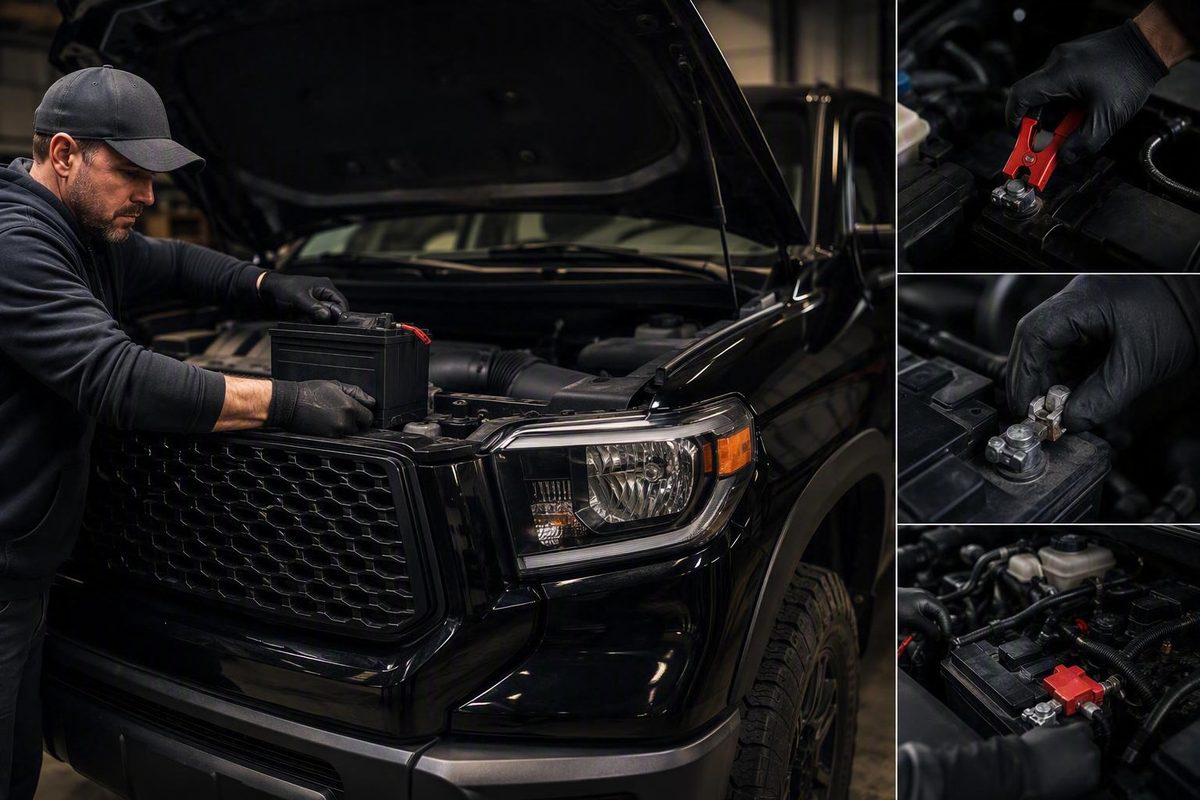
A Toyota Tundra battery replacement should begin with fitment, not a universal group-size recommendation.
This article is therefore a fitment-verification and replacement-safety guide rather than a definitive year-by-year size chart. The supplied evidence does not establish an authoritative battery specification for every Tundra configuration.
The reliable approach is to identify the exact truck and battery system, verify the replacement through the owner’s manual and authoritative application information, compare it physically with the installed battery, test the battery and charging system, and only then choose between DIY installation and professional service.
Start Here: Which Tundra Battery Are You Replacing?
This guide does not provide instructions for removing, diagnosing or replacing a hybrid model’s high-voltage traction battery. It also should not be treated as a configuration-specific procedure for a hybrid auxiliary 12-volt battery. If you cannot positively identify the battery and system, use qualified Toyota service rather than applying a generic procedure. Toyota itself describes battery replacement as electrical work safest when performed by trained technicians and directs owners to vehicle-specific manual guidance. Toyota outlines the limits and hazards of its general battery procedure.
Service descriptions can be ambiguous. Kelley Blue Book publishes a replacement estimate for a 2023 Tundra Hybrid CrewMax and uses a conventional battery-service discussion, but its page does not explicitly identify which battery the estimate covers. Separately, a Utah Toyota dealer’s offer expressly excludes both hybrid batteries and hybrid 12-volt batteries. These examples show why “battery replacement” is not precise enough: ask the provider to identify the battery, part specification and included work. The dealer offer states its hybrid exclusions and other conditions.
Model year, engine, trim, drivetrain and hybrid status can affect fitment and service details. Do not assume that a replacement recommended for a previous-generation V8 truck will fit a newer turbocharged or hybrid configuration. Likewise, a video or owner report about one Tundra does not establish battery location, specification, access or reset requirements for every generation.
The quick answer for a safe Tundra battery replacement is:
- Record the model year, engine, trim, drivetrain and hybrid status.
- Confirm which low-voltage battery you are servicing.
- Check the owner’s manual and an authoritative VIN-based Toyota or battery-manufacturer application catalog.
- Inspect the installed battery’s label, dimensions, terminal positions and hold-down.
- Test the battery, connections and charging system before declaring the battery defective.
- Buy only a replacement that satisfies every physical and electrical requirement.
- For a conventional 12-volt replacement, disconnect negative first and reconnect positive first.
- Complete post-installation charging, accessory, warning-light, warranty and recycling checks.
If you cannot positively identify the battery or the system connected to it, stop and consult a Toyota service department or another qualified technician.
How to Confirm the Correct Battery Size and Specifications
There is no evidence-supported battery group that fits every Toyota Tundra. Retail category pages show several possibilities, but an unconfigured product page is only a starting point.
For example, AutoZone has displayed Tundra-category batteries in groups 24F, 27F, 35 and 94R/H7. The products cover different case designs, chemistries, output ratings and warranties, and each displayed listing prompts the shopper to verify fitment for the particular truck. That is not evidence that these groups are interchangeable. AutoZone shows multiple possible groups and vehicle-fitment warnings.
Walmart illustrates the same catalog problem from another angle. Its category heading identifies Tundra batteries as groups 27F and 24F, yet visible cards include DH7, 140R and H7/94R products, some marked as sponsored. Category placement does not establish compatibility with a specific truck. Walmart provides vehicle-configuration fields while displaying products from several groups.
A fitment workflow that avoids guesswork
Use this process before buying or carrying a battery to the truck:
- Identify the vehicle completely. Record the model year, engine, trim, two- or four-wheel-drive configuration and hybrid status. Keep the VIN available.
- Read the applicable owner’s manual. Look for specifications, cautions and configuration-specific service information.
- Use authoritative application data. A Toyota parts lookup based on the VIN or a reputable battery manufacturer’s configured catalog is more useful than an unfiltered category page.
- Resolve conflicting results. If the manual, VIN catalog, retailer and installed battery disagree, do not select whichever answer is easiest to buy. Ask a Toyota parts department or qualified technician to resolve the mismatch.
- Inspect the installed battery label. Record its group, chemistry, CCA, reserve capacity and part number when visible. Because the installed battery may be an incorrect prior replacement, treat it as supporting evidence rather than final authority.
- Measure and inspect the tray. Confirm case length, width, height, base shape and available clearance.
- Check terminal orientation. Compare both batteries from the same viewing position and identify the positive and negative posts by their markings. Do not rely on a product photo.
- Examine the hold-down. The replacement must work with the original strap, bracket or base clamp.
- Check cable reach. Both cables must reach the correct posts naturally, without stretching, crossing or twisting.
- Confirm electrical performance and chemistry. Match the applicable voltage, minimum CCA, reserve-capacity and battery-technology requirements.
Why the group number is not enough
A valid replacement must have:
- Correct case dimensions and clearance
-
Correct positive and negative terminal positions
-
Proper hold-down or base-clamp geometry
- Required CCA and reserve capacity
-
Required battery chemistry
-
A secure mounting position
The difference between group 27 and 27F is an important warning. Depending on the specification and viewing orientation, their terminals may be arranged differently. One Tundra owner reported buying a group 27 after seeing “27” on the old battery, then connecting it with reverse polarity because the truck reportedly required a 27F layout. The owner described the horn and lights activating, followed by starting trouble, warning lights, blown fuses and inoperative accessories. This is an anecdote—not proof that every Tundra requires 27F—but it demonstrates why polarity must be checked physically before a cable touches a post. The owner’s account describes the reported reverse-polarity event.
Do not rotate an unsuitable battery, force or cross the cables, modify the tray or improvise a hold-down. Toyota’s general guidance calls for correctly aligning and securing the replacement so it cannot move; improper handling can damage the electrical system, start a battery fire or cause injury.
Nor does a longer advertised warranty make a battery suitable. Establish fitment first, then compare performance and warranty terms among confirmed-fit products.
An authoritative year-by-year chart would be convenient, but the available evidence does not establish dimensions, polarity, chemistry, CCA and reserve capacity across every Tundra year and powertrain. For that reason, use VIN-specific information rather than an incomplete universal chart.
Flooded or AGM: Choose Chemistry Only After Fitment Is Confirmed
Flooded and absorbent glass mat batteries are both lead-acid designs, but they contain and manage electrolyte differently.
A conventional flooded battery contains free liquid electrolyte and is generally the less expensive option. Depending on its design, it may require fluid-related maintenance and must remain in its intended orientation.
An AGM battery holds electrolyte in fiberglass mats. It is valve-regulated and spill-resistant under normal operation, rather than incapable of venting under every condition. AGM batteries generally tolerate cycling and partial-discharge events better than conventional flooded batteries.
Broad passenger-car examples place flooded batteries at $80–$180 and AGM batteries at $180–$350. These are general market ranges, not Tundra-specific quotes. The same comparison emphasizes that the vehicle’s required specification comes first. Battery Tender compares AGM and flooded construction, use cases and broad prices.
When AGM may be worth considering
AGM may deserve consideration when:
- The owner’s manual or authoritative application data specifies AGM.
- The truck experiences frequent partial discharge.
- Trips are often short.
- Accessories create substantial demand while the engine is off.
- The truck sits for extended periods.
- Reduced fluid maintenance is important.
- A confirmed-fit AGM is available with the required capacity and terminal layout.
These conditions do not override the truck’s specification. If the vehicle requires AGM, use the required type. If it currently uses a flooded battery, do not assume that AGM is an approved upgrade merely because it costs more or carries a higher advertised rating. Verify the substitution through Toyota information, authoritative battery-manufacturer application data or a technician familiar with that configuration.
What about charging voltage and AGM modifications?
Online Tundra discussions disagree about whether AGM installation requires higher charging voltage or a diode modification. The discussion is anecdotal and does not resolve the question across all model years and charging systems. A Tundra owner forum documents the unresolved disagreement.
Do not install a diode, change a fuse, alter an alternator circuit or make another charging-system modification based only on forum advice. The supplied evidence does not establish such a modification as necessary or appropriate.
Once fitment and chemistry are confirmed, compare candidates using the same criteria:
- Required CCA and reserve capacity
- Battery technology
- Dimensions and terminal positions
- Hold-down compatibility
- Free-replacement warranty period
- Any later prorated coverage
- Local availability and manufacture date
- Core-deposit terms
- Installation and terminal-service charges
- Charging-system testing
- Total cost after taxes and fees
The best replacement is the correctly specified battery that suits the truck’s use and offers acceptable warranty and service value—not simply the one with the largest number on its label.
What Toyota Tundra Battery Replacement Costs
A complete Toyota Tundra battery replacement price can include more than the battery itself. Request an itemized quote covering:
- Battery price
- Refundable core deposit
- Installation labor
- Battery and charging-system tests
- Terminal cleaning or replacement
- Taxes
- Disposal or environmental charges
- Shop-supply fees
- Post-installation testing
- Any required initialization or diagnostic work
- Warranty coverage
Prices and promotions are volatile. Confirm current availability and the final out-the-door amount before buying or authorizing work.
Retail battery examples
As a time- and location-sensitive snapshot, AutoZone displayed possible Tundra-category batteries from $99.99 to $299.99, plus a $22 refundable core deposit. The products represented different groups, flooded and AGM construction, outputs from 490 to 850 CCA, and warranties from three months to five years. This is not a like-for-like range for one confirmed Tundra because the listings differ in size, technology and specification. AutoZone provides the displayed retail, core, CCA and warranty figures.
Ask about the deadline, receipt requirements, acceptable battery condition and refund method. Budget for the deposit at purchase even if it will not remain part of the final net cost.
Installed-price examples
Kelley Blue Book displayed an installed range of $290–$380 for a 2023 Toyota Tundra Hybrid CrewMax near ZIP 22030. Its dealer estimate was $324–$380, while its independent-shop estimate was $290–$340. The dealer breakdown listed $194–$228 for parts and $130–$152 for labor. These numbers apply only to the stated vehicle and location, and the page does not explicitly identify which battery on the hybrid is covered. KBB provides the localized vehicle, parts and labor figures.
A Toyota dealer in Murray, Utah, advertised $169.99 for eligible 2023 Tundra battery service through September 30, 2026, including installation and terminal service. The offer excludes hybrid batteries and hybrid 12-volt batteries, applies only at that dealership, and says taxes, labor, disposal or shop fees may be additional. Because the page does not clearly identify the battery brand, exact specification, warranty or whether every component of the replacement is included, request a written out-the-door quote. The promotion should be rechecked before publication or purchase and removed from comparison after expiration.
Do not combine these examples into a national average. Retail prices may exclude labor and diagnostics, while installed quotes may include services that a DIY buyer must arrange separately.
How to compare replacement options
| Option | Questions to ask |
|---|---|
| DIY | Is the battery confirmed by VIN? What are the battery price, core deposit, taxes, tools, terminal supplies and recycling arrangements? Can you lift and secure it safely? |
| Parts-store installation | Is installation offered for this exact truck? Does it include terminal cleaning, charging-system testing and post-installation checks? Who handles resets or damaged hardware? |
| Independent shop | Which brand, group, chemistry, CCA and reserve capacity are included? Are diagnostics, terminal service, disposal and core return included? |
| Toyota dealer | Is the battery Toyota-branded or otherwise OEM-spec? What warranty applies? Does the quote include diagnostics, installation, taxes, fees and any required initialization? |
| Mobile service | Will fitment be verified before arrival? Are testing, core removal, installation and warranty support included? |
Separate the free-replacement period from any later prorated warranty. Ask whether labor is covered, proof of purchase is required or usage restrictions apply.
DIY may cost less when fitment is certain, access is straightforward, required tools are already available and no diagnostic or initialization work is needed. It is not automatically the cheapest choice once testing, tools, damaged hardware, resets and service complications are considered. Professional service may offer better value when fitment is uncertain, corrosion is severe, access or lifting is difficult, or an electrical fault remains unresolved.
Test Before Replacing: Battery Failure or Another Electrical Problem?
Slow or difficult cranking can indicate a weak battery, but it is not a diagnosis. Other clues include dim or flickering lights, charging warnings, intermittent electrical behavior, visible corrosion and unusual odors. Toyota notes that difficult starting, dim lights, unusual smells and warning-light behavior can accompany battery or related electrical problems.
Several faults can produce overlapping symptoms:
- Loose or damaged terminals
- Corrosion between a terminal and cable end
- A discharged but otherwise serviceable battery
- Alternator or charging-system trouble
- Starter or starter-circuit problems
- A parasitic draw while parked
- Damaged grounds or positive cables
- Long storage
- Repeated short trips
- Accessories used while the engine is off
Replacing the battery without testing may leave the actual cause unresolved.
Start with a visual inspection
With the truck off and the key or fob away from the vehicle as appropriate:
- Inspect the case for cracking, swelling, leakage or deformation.
- Look for corrosion around terminals and cable ends.
- Check whether either terminal is loose.
- Inspect cables for damaged insulation, stiffness, fraying or heat damage.
- Confirm that the hold-down is present and secure.
- Look for evidence that the battery shifted.
- Note unusual heat or odor without leaning over the battery.
A rotten-egg odor may be associated with gas released by an overheated or overcharged battery. Avoid smoking, flames and sparks, move away from the immediate area, and arrange qualified assessment instead of treating a hot, swollen, leaking or strongly odorous battery as a routine swap. Toyota explains the odor warning and recommends protective equipment and spark avoidance.
Test the battery and charging system
A useful diagnosis may include:
- State-of-charge measurement
- Battery conductance or load testing
- Connection inspection and voltage-drop testing
- Charging-system output checks
- Starter-circuit evaluation
- Parasitic-draw testing when the battery drains while parked
Test results require context.
KBB says many mechanics suggest a load test every two years. This is general maintenance advice, not a Toyota-mandated interval, and one test cannot guarantee future performance. KBB states the two-year load-test suggestion.
Battery life varies. General supplied guidance commonly describes about three to five years, but heat, cold, storage, short trips, towing and electrical loads can change actual service life. A Toyota dealer page gives the three-to-five-year range, while KBB’s own guidance varies between roughly three to four years and a longer average under less demanding conditions. The dealer describes a general three-to-five-year truck-battery lifespan.
Some Tundra owners have reported original-battery failures after roughly two to three-and-a-half years. Those accounts illustrate individual experiences, not Tundra reliability statistics or a mandatory replacement schedule. The owner discussion contains the reported failure ages.
A truck that repeatedly needs a jump requires diagnosis. The same is true if a new battery quickly goes flat, cranking remains slow, a charging warning persists or electrical behavior changes with engine speed. Repeated battery replacement is not a substitute for identifying a connection, charging, starter or parasitic-draw fault.
Safe DIY Replacement Sequence for a Tundra 12-Volt Battery
This is a general conventional 12-volt procedure, not a generation-specific Toyota service manual. Consult the owner’s manual and applicable Toyota service information for the exact battery location, access steps, precautions, tools and torque specifications. Do not apply this generic sequence to a hybrid auxiliary battery without configuration-specific Toyota guidance.
Use a trained technician if:
- You cannot identify the battery or system positively.
- Access requires removing unfamiliar components.
- The battery cannot be lifted safely.
- The case is leaking, swollen, cracked, hot or strongly odorous.
- Corrosion is severe or has damaged the tray or cables.
- The battery repeatedly discharges for an unknown reason.
- Reverse polarity may have occurred.
- You are near components identified as part of a high-voltage system.
- The manual requires procedures or tools you do not have.
Toyota warns that improper battery handling can damage electrical systems, cause a battery fire or cause injury, and it identifies trained service as the safest option.
Preparation checklist
Before touching the terminals:
- Park on a flat, dry surface.
- Shift into Park and set the parking brake.
- Switch off the ignition and accessories.
- Keep the key or fob away as appropriate.
- Allow the truck and battery area to cool.
- Remove rings, watches and other metal jewelry.
- Wear safety glasses and suitable gloves.
- Keep cigarettes, flames and sparks away.
- Use tools in good condition.
- Arrange lifting help if needed.
- Have the confirmed replacement ready.
- Review the owner’s manual.
Do not place tools on the battery or allow metal to bridge a terminal and grounded vehicle metal. Toyota’s general procedure warns that improper handling can create fire, injury and electrical-system risks.
Verify before disconnecting
Photograph the installed battery, cable routing, hold-down and terminal orientation. Identify both terminals by their markings rather than relying only on cable color.
Place the old and new batteries in the same viewing orientation and compare:
- Positive and negative post positions
- Case dimensions and height
- Hold-down features
- Terminal style
- Chemistry and label specifications
- Vent provisions, if applicable
If anything differs unexpectedly, stop and recheck the application. Do not test fitment by touching an uncertain cable to a post.
Removal: negative first
Toyota’s general procedure disconnects the negative cable first, then the positive cable.
Proceed carefully:
- Loosen and remove the negative cable.
- Position it so it cannot spring back onto the post.
- Loosen and remove the positive cable.
- Protect the positive cable end from accidental contact.
- Release the correct hold-down strap, top bracket or base clamp.
- Store fasteners where they cannot fall into the engine compartment.
- Lift the battery upright using its handle or a suitable carrier.
- Get help rather than twisting or dropping a battery that is too heavy.
Do not pull on a cable to remove a stuck terminal. Use an appropriate terminal-removal method.
Inspect and clean
With the old battery removed:
- Inspect the tray for corrosion, debris and damage.
- Check the hold-down and fasteners.
- Examine both cable ends for corrosion or deformation.
- Clean accessible corrosion using an appropriate battery-terminal method.
- Keep debris and cleaning material away from unrelated components.
- Replace damaged hardware or cables instead of improvising a repair.
Toyota’s general procedure calls for cleaning terminal corrosion before installing and securing the replacement. If cleaning exposes substantial cable or clamp damage, stop and arrange repair.
Install: positive first
Set the replacement in the verified orientation. Confirm that it sits flat and no cable is trapped underneath. Reinstall the proper hold-down so the battery cannot move.
Then:
- Connect the positive cable first.
- Connect the negative cable last.
- Confirm that each terminal is fully seated and secure.
- Apply terminal protection only when appropriate for the battery and manufacturer guidance.
- Reinstall protective covers.
- Confirm that neither cable is stretched, twisted or rubbing nearby parts.
Third-party guidance sometimes lists memory-saving equipment, but the available evidence does not establish a validated universal Tundra procedure. Do not improvise a keep-alive connection with a jump pack or spare battery merely to preserve settings. If maintaining power is required for a specific configuration, use the applicable service procedure or qualified help.
Post-Installation Checks, Resets, Warranty, and Recycling
Do not consider the job complete merely because the truck starts.
Before starting
Confirm that:
- Positive and negative cables are on the correct posts.
- Terminal clamps are seated and secure.
- The hold-down prevents movement.
- No tools or fasteners remain near the battery.
- Protective covers are installed.
- Cables are not strained or contacting sharp or hot parts.
- There is no leakage, swelling, unusual heat, smoke or odor.
- The surrounding area is clear.
If the horn or lights activate unexpectedly during connection, sparking is excessive, or polarity may have been reversed, stop. Do not keep reconnecting the battery, attempt repeated starts or replace fuses blindly. An owner’s reverse-polarity account describes warning lights, failed accessories and blown fuses after an incorrectly oriented battery was connected, although the exact damage was never conclusively diagnosed. The forum account illustrates why abnormal behavior requires diagnosis.
Start and verify operation
Start the truck and observe cranking behavior. Then check:
- Instrument-panel warning lights
- Exterior and brake lights
- Turn signals and hazard lights
- Audio and infotainment
- Power windows
- Door locks and remote functions
- Climate control
- Other regularly used accessories
Some indicators illuminate during a normal startup check and then go out. Persistent warnings, multiple failed accessories, smoke, unusual heat or odor are reasons to switch the truck off and seek assistance.
Verify charging-system operation, especially if the old battery repeatedly discharged or the replacement does not remain charged.
Settings and possible resets
Disconnecting the battery may reset the clock, radio presets, trip information, or certain automatic window and sunroof functions. Exact effects vary by model year and equipment. A dealer service page lists those settings as possibilities rather than universal outcomes.
A third-party demonstration involving a 2015 Tundra Platinum 5.7L V8 warns that radio presets may be lost and says some vehicles may call for a radio security code or temporarily behave differently while the transmission relearns. These are qualified possibilities, not effects established for every Tundra. The 2015 demonstration discusses possible post-disconnection changes.
The available evidence does not establish whether any particular Tundra requires battery registration, a battery-monitor reset, initialization or scan-tool work. It also does not prove that no Tundra requires them. Owners of newer or hybrid configurations should check the applicable manual or qualified Toyota service information.
If a convenience function stops working normally, look up the exact initialization procedure for that model year. Do not repeatedly cycle components or clear diagnostic codes without understanding the cause.
Warranty and recycling
Keep the receipt and warranty documents. Record:
- Installation date
- Vehicle mileage
- Battery brand and part number
- Group and chemistry
- CCA and reserve capacity
- Seller and installer
- Test results, if supplied
Before purchase, distinguish free-replacement coverage from any later prorated period. Keep documentation somewhere accessible rather than only in the truck.
Return the old lead-acid battery through an appropriate retailer or recycling channel. If you paid a core deposit, return the old battery within the seller’s required period and retain proof of the refund.
Frequently Asked Questions
What battery size fits a Toyota Tundra?
There is no single supported size for every Tundra. Unconfigured retailer catalogs show possibilities including 24F, 27F, 35 and H7/94R, but they also require vehicle-specific fitment checks.
Use the owner’s manual and authoritative VIN-based application data, then physically verify dimensions, polarity, hold-down design, cable reach, chemistry, CCA and reserve capacity. Group 27 and 27F should not be assumed interchangeable because terminal orientation may differ.
Can I replace a Tundra’s flooded battery with an AGM battery?
Only after confirming that AGM is approved for the exact truck. If authoritative vehicle information specifies AGM, match that requirement. Otherwise, verify the substitution through Toyota information, a reputable battery manufacturer’s application catalog or a qualified technician.
AGM may better tolerate repeated cycling and partial discharge, but those potential benefits do not override fitment or charging-system requirements. Do not modify the charging system based only on forum advice.
How much does Toyota Tundra battery replacement cost?
Costs depend on specification, chemistry, location, labor, testing and fees. One retailer snapshot showed $99.99–$299.99 before a $22 refundable core deposit, but the listings covered different products rather than one confirmed configuration.
A localized KBB example for a 2023 Tundra Hybrid CrewMax near ZIP 22030 was $290–$380 including parts and labor, but the page does not explicitly identify which hybrid battery the estimate covers.
Request an itemized quote covering the battery, core deposit, labor, tests, terminal service, taxes, disposal, shop charges, warranty and post-installation checks. These examples are not nationwide averages.
Which battery terminal should I disconnect first on a Toyota Tundra?
For the general conventional 12-volt procedure, disconnect the negative terminal first, followed by the positive terminal. During installation, connect the positive terminal first and the negative terminal last.
Before touching either cable, switch the truck off, verify polarity, remove metal jewelry, use eye protection and gloves, and prevent tools from bridging a terminal to grounded metal.
Will replacing the Tundra battery erase settings or require a reset?
Disconnection may erase the clock, radio presets or trip information and may affect certain automatic convenience functions. The exact effects vary by model year and equipment.
The supplied evidence does not establish a universal requirement—or universal absence of a requirement—for battery registration, monitor resets, initialization or scan-tool service. Check the manual or applicable Toyota service information, particularly for newer or hybrid configurations.
The fitment-first plan is simple: identify the exact truck and low-voltage battery, verify every physical and electrical requirement through authoritative vehicle information, test before replacing, compare the complete installed cost, disconnect negative first and reconnect positive first. Uncertain fitment, hybrid-system confusion, severe corrosion, abnormal sparking, possible reverse polarity or persistent warning lights are reasons to stop and use qualified service.