
3 min read ·
Full-Size Ford Transit Battery Location: Under the Driver’s Seat
Find the full-size Ford Transit battery, locate under-hood jump points, and check the different guidance for Transit Connect and E-Transit.
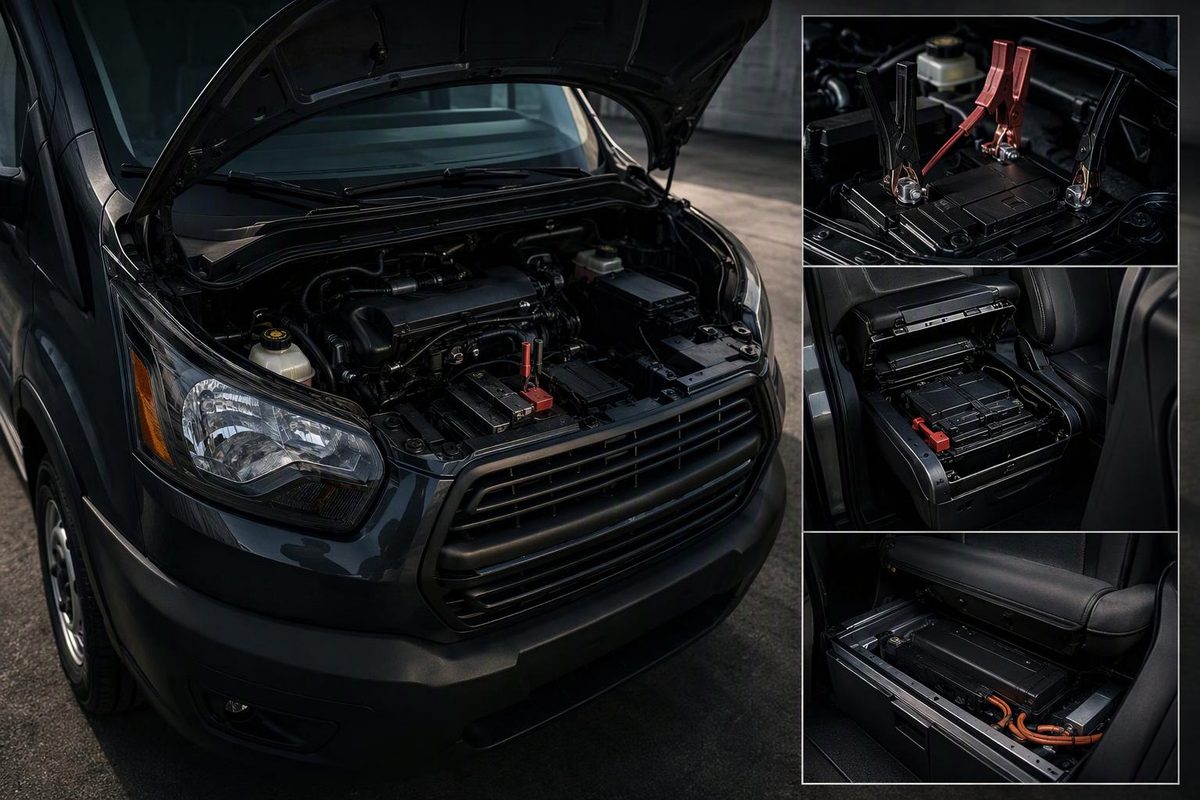
On the North American full-size Ford Transit examples below, the main 12-volt battery is under the driver’s seat—not in the engine bay. Ford’s 2015 Transit manual and 2024 gasoline Transit manual confirm that location. If you only need a jump-start, use the designated connections under the hood; you do not need to uncover the battery.
Check the exact model name first. Transit Connect and E-Transit should not be treated as the same battery-access job. These examples use North American manuals; check your own year and market before removing parts.
Confirm which van you have
| Vehicle/manual example | Where to look or what to do |
|---|---|
| Full-size 2015 Transit | Main battery under the driver’s seat; jump-start connections under the hood. |
| Full-size 2020 Transit and 2024 gasoline Transit | Battery compartment under the driver’s seat; Ford’s removal instructions also cover a second battery where fitted. |
| 2020 Transit Connect, 2.5L, left-hand drive | Battery in the engine compartment, identified as E in Ford’s under-hood diagram. |
| 2024 E-Transit | Use the battery-electric instructions, not the gasoline seat-access procedure. Ford directs owners to an authorized dealer for 12-volt battery servicing. |
Sources: Ford’s 2020 Transit battery instructions, Transit Connect under-hood diagram, and E-Transit servicing guidance.
Need a jump-start? Open the hood
For the 2024 gasoline Transit, Ford identifies two remote connection points:
- Positive (+): next to the fuse box, beneath a red cap. Lift the cap to expose the terminal.
- Negative/ground (−): a post on the driver’s side near the hood hinge. Remove its rubber covering.
These are connection points, not the battery itself. Ford specifically warns against attaching the negative jumper cable elsewhere on the van: use the designated ground point. Follow the complete Ford jump-start procedure for cable order and disconnection.
Need the battery itself? Start at the seat base
For the 2020 Transit and 2024 gasoline Transit procedures, Ford begins by fully raising the driver’s seat and sliding it fully forward. The initial access steps are to pull up the tabs on the cover, where fitted, then unhook the next cover and tuck it beneath the seat.
Stop before loosening seat hardware if you only wanted to find the compartment. Actual battery removal goes further: Ford lists seat-track end caps, front seat-adjustment end-stop bolts, battery-clamp and cover bolts, terminal covers and cable clips. This is not simply a lid-and-two-terminals replacement. Use the illustrated 2024 removal instructions only if they match your van. The 2015 manual lists different seat-track hardware steps, so do not substitute this later procedure for that year’s instructions.
Two details matter before starting:
- Dead battery and power seat: Ford says to jump-start the vehicle so the seat can be moved into the access position.
- One or two batteries: establish what is fitted before buying. Ford notes that a single battery can be oriented differently in the tray, so identify polarity from the terminal markings—not an assumed position.
Before planning a replacement
Ford requires a replacement of exactly the same specification in its 2024 gasoline instructions. Verify the existing battery label and exact-vehicle fitment rather than ordering from “Ford Transit” alone. Reinstall terminal covers and cable clips, and securely refasten the seat-runner bolts before replacing the covers.
Where a vent tube is fitted, it must be properly reconnected: Ford warns that leaving it disconnected can allow harmful gases into the cabin. See the 2020 Transit battery warning.
The 2024 manual also specifies a battery-sensor reset after installing a new battery. Check your year’s requirements rather than assuming reconnecting the terminals completes the job.
For a shop quote, ask whether it includes testing, one battery or two, seat-base access labor, vent and cover refitting, any required sensor reset, and disposal of the old battery. Those details make quotes comparable without assuming a universal Transit replacement price.