
7 min read ·
Find Your Transit Battery Without Removing The Wrong Parts
Locate the Ford Transit’s 12-volt battery, identify the correct jump-start points, and check seat access, dual-battery setups and replacement requirements.
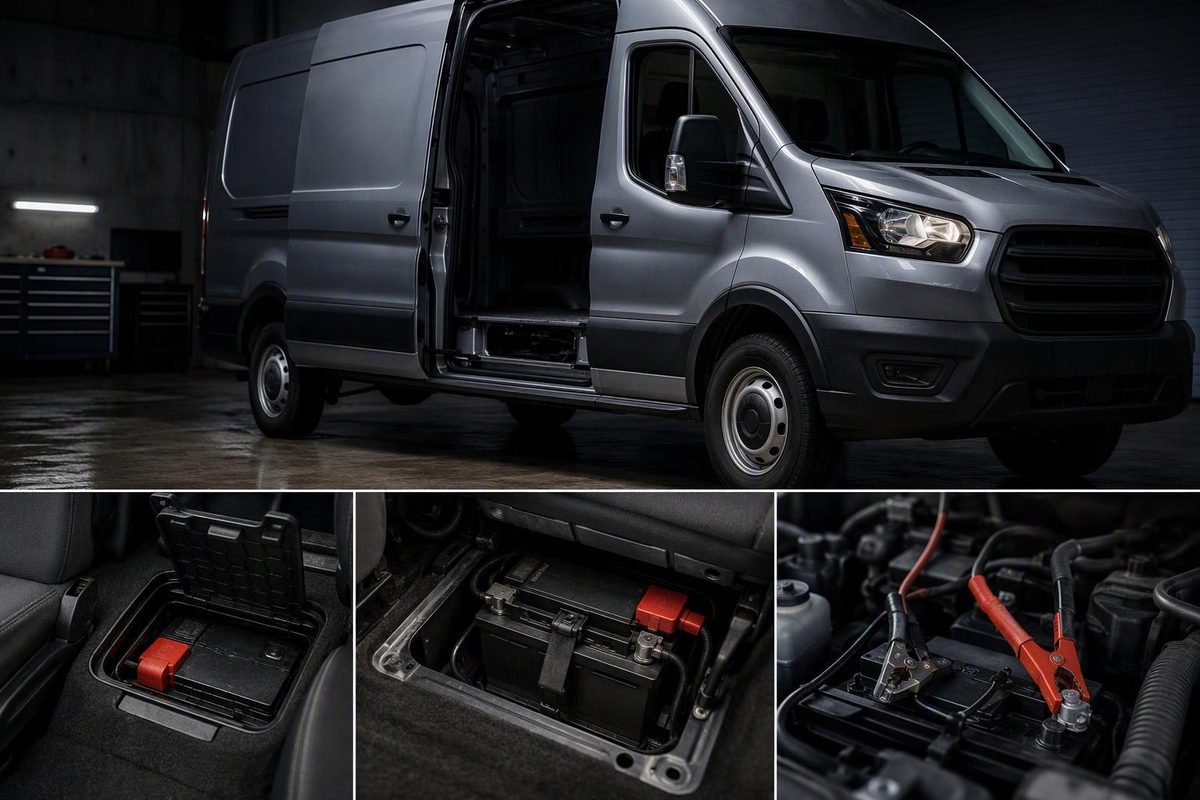
The 12-volt battery is under the driver’s seat on the North American full-size Ford Transit models covered here—not in the engine compartment. Ford’s 2015 Transit manual and 2020 Transit manual both identify that location. The E-Transit’s 12-volt battery is also under the driver’s seat in the North American manual discussed below; the 2023 Transit Connect’s battery is under the hood.
If your full-size Transit only needs a jump-start, locating the battery does not mean you need to uncover it. Use the designated remote connection points and the jump-start procedure for your exact engine and year. Battery replacement, by contrast, requires access to the seat compartment and its covers.
Select your Transit version and job to see the location and the next step.
Transit Battery Location Finder
Under the driver’s seat
The 12-volt battery is inside the van. Moving the seat alone does not complete access; use the matching illustrated procedure.
For a jump-start, use the designated remote points rather than opening the battery compartment.
Source: Ford 2020 Transit owner’s manual, battery-access section. Coverage is limited to the cited North American manuals.
The Transit Name Does Not Identify One Battery Layout
Before moving the seat or removing trim, distinguish a full-size Transit from a Transit Connect or E-Transit. The badge alone is not enough to choose a removal procedure. The manuals cited here cover specific North American vehicles; they do not establish the location or fastener sequence for every Transit sold elsewhere.
| Vehicle Covered | 12-Volt Battery Location | Access Guidance |
|---|---|---|
| Full-size Transit, 2015 and 2020 manuals | Under driver’s seat | Use matching seat-access instructions |
| Full-size Transit, March 2025 manual | Under driver’s seat | Check single- or dual-battery layout |
| E-Transit, March 2025 manual | Under driver’s seat | Dealer servicing directed |
| Transit Connect, 2023 manual | Engine compartment | Do not use Transit seat instructions |
Ford’s North American Transit manual, March 2025 edition, pages 377–379, places the full-size Transit battery under the driver’s seat and covers both single- and dual-battery arrangements. Finding one battery is therefore not proof that the van has only one.
That same manual identifies the E-Transit’s under-seat 12-volt battery. This is separate from its high-voltage propulsion battery. Ford directs owners to an authorized dealer for 12-volt battery servicing and warns against trying to jump-start the high-voltage battery with a 12-volt supply; the relevant guidance appears on pages 340 and 379.
The 2023 Transit Connect under-hood overview identifies its battery in the engine compartment. Applying the full-size Transit’s seat-access instructions to that model would send you to the wrong place.
For other model years, older overseas Transits or Transit Custom models, check the owner’s manual for the exact vehicle and market. These sources do not provide a universal location chart for those vehicles. A familiar-looking seat base or engine compartment does not confirm that the procedure matches.
Jump-Starting A 2020 Transit Uses Under-Hood Points
For a 2020 Transit with a 3.5-liter Duratec or EcoBoost engine, Ford identifies remote positive and ground connections under the hood. Those points let you connect jumper cables without opening the battery compartment beneath the seat.
| Connection | Ford’s Identified Location |
|---|---|
| Positive (+) | Access terminal beside the under-hood fuse box, beneath a red cap |
| Negative/ground (−) | Designated post on the driver’s side near the hood hinge, beneath a removable rubber covering |
The positive access terminal is not the battery itself. Likewise, the designated ground post is a specified connection point, not an invitation to choose any nearby metal part. Ford says to make the final negative jumper-cable connection to that ground point—not another part of the van.
Use the complete Ford jump-start procedure for the 2020 Transit when it matches your engine and vehicle. The locations above do not establish the connection layout for every Transit engine, model year or market.
For a different version, verify both designated points in its manual before connecting cables. Knowing that the battery is under the seat is not enough to identify the correct under-hood jump points. The battery-location section and the jump-start section answer different parts of the job.
E-Transit owners must also keep the two electrical systems separate. The under-seat location refers to the 12-volt battery; it does not make the propulsion battery a jump-start target. Use the applicable Ford guidance rather than transferring the combustion-engine procedure to the electric model.
Moving The Driver’s Seat Is Only The First Access Step
For a combustion-engine Transit whose manual matches these instructions, park securely and identify the battery-compartment covers beneath the driver’s seat. Move the seat while it still has power. Ford’s 2020 manual says to jump-start the vehicle first if a discharged battery prevents a power seat from moving.
That instruction addresses an access problem: the seat may need to move before the battery can be reached. It does not mean the battery compartment has to be opened to supply that initial jump-start. Use the designated remote points and the applicable jump-start procedure.
Sliding the seat forward does not complete battery access. Ford’s illustrated procedure includes trim or a cover flap, seat-track end caps where fitted, specified seat-stop bolts, and the battery clamp and cover. Terminal covers and cable clips are also involved. The under-seat location is the starting point, not a complete removal guide.
Use the illustrated 2020 battery-access instructions only when they match your van. Identify the parts shown before loosening anything. If the seat hardware or covers differ from the illustrations, do not fill the gap by removing whichever bolts appear easiest to reach.
The distinction between editions is concrete. The 2015 manual, pages 213–214, describes rear seat-track bolts, while the 2020 online instructions describe front end-stop bolts. Both manuals place the battery under the driver’s seat, but that shared location does not make their bolt-removal sequences interchangeable.
Stop before loosening seat hardware if you cannot identify the specified fasteners or securely reinstall them. Seat-runner fastening is part of the completed job, not an optional finishing step. E-Transit owners should follow Ford’s dealer-service direction instead of using this combustion-engine removal guidance.
Match The Replacement To The Existing Battery Specification
Do not order a battery by “Ford Transit” alone. Check the existing battery label and exact-vehicle fitment. Ford requires a replacement of exactly the same specification, so the location of the compartment does not establish which battery belongs inside it.
The sources summarized here do not supply a universal battery size, capacity or replacement price for every Transit. They also do not establish one specification that covers both single- and dual-battery arrangements. If those details are missing from a listing or quote, confirm them against the actual vehicle rather than treating a broad model-name match as sufficient.
Battery count needs checking before removal as well as before purchasing. Ford’s March 2025 North American manual covers single- and dual-battery configurations and warns that disconnecting only one battery does not isolate a multi-battery vehicle’s electrical system. A visible disconnected terminal on one battery is not proof that the entire system is isolated.
For the applicable 2020 Transit procedure, Ford calls for disconnecting the negative terminal first. That instruction belongs within the full replacement procedure; it does not override the need to identify all batteries or follow the correct instructions for the vehicle’s arrangement.
Ford also requires correct reinstallation of terminal covers and cable clips, along with secure fastening of the seat-runner bolts. These components are part of the job even though they are not the new battery. See Ford’s replacement cautions for the covered vehicle.
Where a vent tube is fitted, Ford says it must be reconnected to prevent harmful gases from entering the cabin. The qualification matters: check the arrangement fitted to your van rather than assuming every battery installation has the same vent connection. An under-seat battery replacement is not finished simply because the terminals are attached and the engine starts.
A Sensor Reset And A Sleep Period Are Different Steps
Replacement may require a battery-sensor reset. Ford’s March 2025 North American manual specifies a reset procedure and, separately, an eight-hour locked, ignition-off sleep period for state-of-charge relearning. The two instructions should not be collapsed into a single generic “battery reset.”
A sensor-reset procedure addresses one requirement; the stated sleep period addresses relearning. If your applicable manual calls for both, completing one does not establish that the other has been satisfied. Check pages 377–380 of the March 2025 manual for the covered configurations.
Do not apply that edition’s procedure automatically to a 2015 Transit, a Transit Connect or an overseas model. The cited instruction establishes what Ford specifies in that manual, not a universal reset sequence for every vehicle wearing a Transit badge.
When arranging professional replacement, ask which reset or relearning requirements apply to your particular van. A quote that includes installation should make clear whether any required sensor procedure is included and what, if anything, remains for you to do afterward.
A Shop Quote Should Include The Seat-Compartment Work
Give the shop the year, engine and battery count when requesting a quote. Specify whether the vehicle is a full-size Transit, Transit Connect or E-Transit. That avoids pricing the job as an ordinary under-hood battery swap when the applicable battery is beneath the driver’s seat.
Ask whether the price includes battery testing, access to the seat compartment, a replacement matching the required specification, and reassembly of the vent connection, covers and cable clips where fitted. Also ask about any required sensor reset and old-battery recycling. The draft sources provide no replacement-cost figure, so there is no supported dollar estimate to apply across these versions.
For a jump-start, the immediate task is different: identify the correct remote positive and ground points, not the seat fasteners. For replacement on a covered combustion-engine Transit, confirm the battery count, specification and illustrated access sequence before dismantling the compartment. For E-Transit 12-volt servicing, follow Ford’s authorized-dealer direction.