
5 min read ·
What Fits in Place of an H7 Battery—and What Still Needs Checking
Dimensions use a 315 × 175 × 190 mm maximum envelope, not a guaranteed exact product size. Also verify polarity, hold-down, chemistry and ratings.
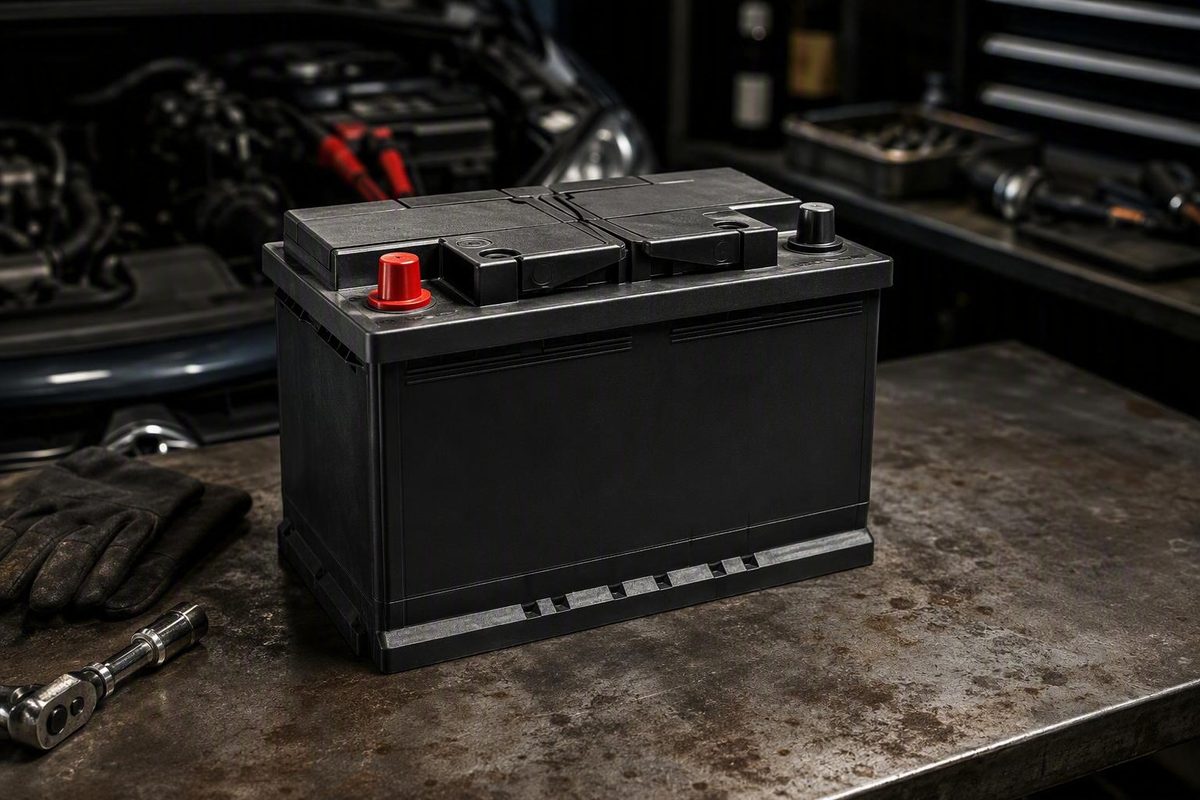
An H7 battery corresponds to BCI Group 94R and EN LN4. That cross-reference identifies the basic size family, but it does not by itself guarantee vehicle compatibility. Before buying, confirm the tray, hold-down, terminal orientation, cable reach, required chemistry, electrical ratings, and exact vehicle application.
H7 battery size at a glance
Quick answer
- DIN-style designation: H7
- BCI group: 94R
- EN designation: LN4
- Maximum overall dimensions: 315 × 175 × 190 mm
- Approximate dimensions: 12.4 × 6.9 × 7.5 inches
- Polarity: Positive terminal on the right
- General category: 12-volt automotive starting-battery size
These designations, dimensions, and terminal location come from the Battery Council International cross-reference chart. The dimensions are the maximum overall group-size envelope—not an assurance that every H7 product measures exactly 315 × 175 × 190 mm.
Individual batteries may measure slightly below that envelope. Compare the selected battery’s published dimensions or product drawing with the available space, including total installed clearance around the terminals, clamps, cover, handle, vents, and nearby components.
The chart lists the positive terminal on the right. Third-party battery guidance describes this as right-positive when the battery is viewed from the terminal-facing front. Because the apparent orientation reverses when viewed from the opposite side, compare the replacement’s terminal diagram directly with the installed battery.
H7 is commonly used for a 12-volt automotive battery size. It does not establish a single cranking output, amp-hour capacity, reserve capacity, construction, or warranty.
What the group-size label does—and does not—tell you
A BCI group-size classification considers voltage, maximum overall dimensions, terminal arrangement, and fit-related features. These standardized characteristics make H7, LN4, and 94R useful cross-reference terms when identifying a replacement.
However, products carrying the same group-size label can differ in:
- Cold-cranking amps (CCA)
- Amp-hour capacity (Ah)
- Reserve capacity
- AGM or flooded lead-acid construction
- Weight
- Warranty
- Price
The group label also does not independently establish compatibility with a particular year, make, model, engine, or equipment package. Different versions of the same vehicle may use different batteries based on their electrical requirements, factory equipment, or start-stop configuration.
Use the owner’s manual, installed-battery label, vehicle-manufacturer information, or an authoritative fitment database for the final decision. If a generic product listing conflicts with vehicle-specific information, follow the vehicle requirement.
Pre-purchase H7 fitment checklist
Measure the battery compartment if practical and compare it with the replacement’s published dimensions and terminal diagram. Do not consider only the nominal battery footprint; inspect the complete installed area for cables, clamps, covers, vent connections, handles, brackets, and nearby bodywork.
| Check | What to verify | Why it matters |
|---|---|---|
| Group labeling | Look for H7, LN4, or 94R | Establishes the correct basic size family |
| Tray dimensions | Confirm that the tray accommodates the selected battery, within the 315 × 175 mm maximum footprint | Prevents overhang or interference with tray edges |
| Height clearance | Treat 190 mm as the maximum overall group height, then verify the product drawing and installed clearance | Prevents interference with covers, brackets, clamps, or bodywork |
| Polarity | Confirm the positive post is on the right when viewed from the terminal-facing front | Ensures the cables align with the correct posts |
| Terminal style | Match the required top-post configuration and dimensions | Allows the vehicle’s terminal clamps to seat correctly |
| Cable reach | Make sure both cables reach without stretching, crossing, or forced routing | Avoids strain and poor terminal alignment |
| Hold-down | Verify that the battery ledge and vehicle clamp engage securely | Prevents battery movement |
| Chemistry | Match the AGM, flooded, or other construction specified for the vehicle | Group size does not determine the required chemistry |
| Electrical rating | Meet the vehicle-specified CCA and capacity requirements | A battery can fit physically but remain electrically unsuitable |
| Vehicle application | Check year, make, model, engine, options, and start-stop equipment | Resolves variations within a model range |
BCI lists a B3 hold-down for Group 94R/H7 but notes that its listed hold-down types are common rather than exclusive. Compare the actual battery ledge and tray hardware instead of relying solely on retailer terminology or the group label (BCI chart).
Decision rule: Buy only when the physical configuration, exact vehicle application, required chemistry, and electrical specifications all match.
H7 versus H6: the extra length matters
H6 corresponds to Group 48, while H7 corresponds to Group 94R. Their nominal widths and heights are similar, but H7 is longer:
| Size | Nominal dimensions |
|---|---|
| H6 / Group 48 | 278 × 175 × 190 mm |
| H7 / Group 94R | 315 × 175 × 190 mm |
The difference is approximately 37 mm, or 1.5 inches, according to this H6 and H7 dimensional comparison.
H6 and H7 are therefore not automatically interchangeable. An H7 will not fit a tray designed tightly around the shorter H6. Even if unused tray space provides the extra length, the change is suitable only if the hold-down engages correctly, the polarity and cable routing remain compatible, installed height clearance is sufficient, and the replacement meets the manufacturer’s chemistry and electrical requirements.
AGM, flooded, and electrical ratings: what varies
H7 identifies a size and fit family, not a mandatory battery chemistry or performance level. Batteries sold in this size include both AGM and flooded lead-acid products.
For example, the WEIZE H7/94R product is listed as a 12-volt, 80 Ah AGM battery with 850 CCA and 140 minutes of reserve capacity.
By contrast, the Continental Group 94R/H7 product is listed as a 12-volt flooded lead-acid battery rated at 730 CCA. These examples demonstrate product-level variation; they are not universal H7 specifications or recommendations.
Preserve the chemistry specified for the vehicle and meet its required CCA and capacity. Do not select a replacement solely because it falls within an online “typical H7” performance range. A battery may fit the tray correctly while remaining unsuitable for the vehicle’s charging strategy or electrical demand.
Battery registration, coding, or a battery-management reset is likewise vehicle-specific. The H7 label cannot determine whether any of those procedures are required. Consult service information for the exact vehicle.
How to interpret alternate labels without buying the wrong size
The supported cross-reference is:
- H7 under the DIN-style designation
- LN4 under the EN designation
- 94R under the BCI group system
Some commercial listings also place L4 alongside H7 and 94R. The Continental example above, for instance, uses the combined description “94R (L4/H7).”
Do not order from an L4-only description. Confirm that the listing also identifies H7, LN4, or 94R, then verify the maximum dimensions, right-positive layout, terminal style, hold-down, chemistry, electrical ratings, and vehicle fitment.
Groups 47, 48, and 49 are different physical sizes and are not direct H7 equivalents. Treat H7, LN4, and 94R as equivalent starting labels—but make the final purchase only after every physical, electrical, and vehicle-specific requirement has been confirmed.