
7 min read ·
The Fastest Safe Route for Getting Rid of an Old Car Battery
Start with the replacement seller, an auto-parts store, repair shop, metal recycler, or household hazardous-waste program; call ahead.
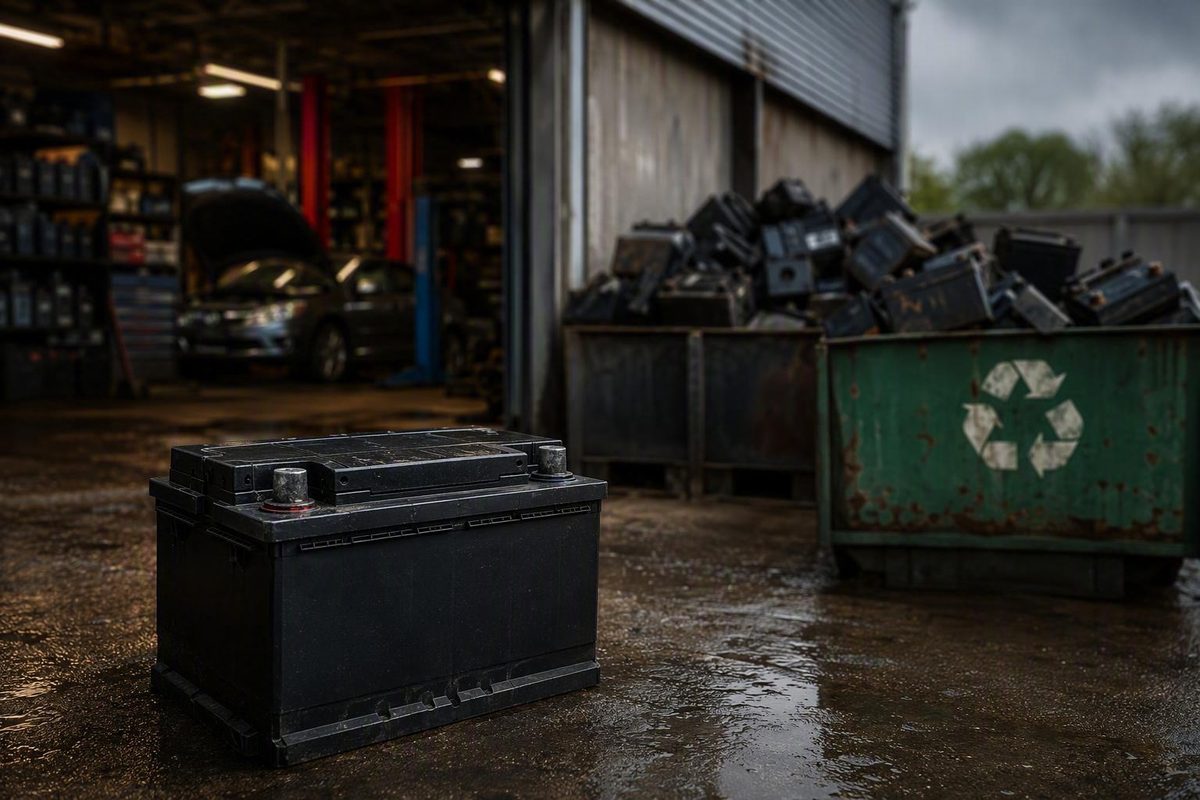
Take a conventional lead-acid car battery to the seller providing its replacement, a participating battery or auto-parts retailer, a dealership or repair shop, a licensed metal recycler, or a municipal household hazardous-waste program. Do not place it in household trash or curbside recycling. Call the specific location before traveling to confirm that it accepts your battery’s type and condition, then transport an intact battery upright and secured.
Where to take an old car battery
Check these options in roughly this order:
- The seller providing your replacement battery. This is usually the simplest option when buying a new battery. Ask whether you can surrender the old battery at purchase or must return it later with a receipt.
- A battery retailer or auto-parts store. Many locations collect lead-acid automotive batteries, but acceptance of batteries purchased elsewhere can vary.
- A dealership or repair shop. Businesses that replace automotive batteries may accept old units, although some limit collection to customers.
- A licensed metal recycler. Some recyclers accept lead-acid batteries and may pay for them as scrap. Confirm household drop-off rules and current compensation before visiting.
- A municipal household hazardous-waste program. This is a useful route when retailers refuse the battery, no replacement is being purchased, or the battery needs special handling.
Lead-acid battery collection is broadly available through U.S. retailers, dealerships, repair businesses, recyclers, and municipal programs, but eligibility and convenience vary by community.
If a seller assesses a core charge on a replacement battery, you pay it with the purchase and may recover it by returning an eligible old battery under the seller’s terms. Bring any receipt or other documentation the seller requires.
These routes apply to conventional lead-acid starter batteries. Large hybrid and electric-vehicle traction batteries require specialist handling and should not be taken to an ordinary consumer battery drop-off.
Find a verified drop-off point near you
The closest verified option depends on your ZIP code or municipality. Use this process to find a location that will actually accept the battery:
- Search your city or county waste website for “automotive battery,” “lead-acid battery,” or “household hazardous waste.”
- Check store locators for nearby battery retailers and auto-parts stores.
- Use Earth911 or Call2Recycle for additional leads; the EPA lists both as battery-recycling location tools (EPA battery recycling and locator guidance).
- Call the specific branch or facility—not only a national customer-service number—before loading the battery.
Do not assume that a listing for generic “batteries” includes automotive lead-acid batteries.
Use this call-ahead checklist:
- Do you accept automotive lead-acid batteries?
- Do you accept this specific type, such as flooded lead-acid or AGM?
- Will you accept it if it is cracked, swollen, leaking, dented, or heavily corroded?
- Can I bring a battery purchased elsewhere?
- Is there a fee, core refund, scrap payment, store credit, or current incentive?
- Do I need an appointment, identification, proof of residency, or a utility bill?
- Are there household, business, or quantity restrictions?
- How should the terminals and battery be packaged for transport?
Municipal programs may serve only eligible residents, operate on scheduled dates, require appointments, or impose documentation and quantity rules. Retail policies can also differ by branch, so a national locator result is only a lead until the receiving location confirms acceptance.
Choose the best option for your situation
The right destination depends on whether you are buying a replacement, whether the battery is intact, and whether it is an ordinary starter battery or a large traction battery.
| Your situation | Best place to start | What to confirm |
|---|---|---|
| Buying a replacement now | Replacement seller | Whether you can surrender the old battery immediately and what documentation is required to recover any core charge |
| Disposing without a purchase | Battery retailer, auto-parts store, repair shop, metal recycler, or household hazardous-waste program | Acceptance of batteries purchased elsewhere, fees, possible compensation, and quantity limits |
| Returning a damaged or leaking battery | Household hazardous-waste authority or another facility that has explicitly approved its condition | Whether the facility accepts that damage and exactly what containment or packaging it requires |
| Handling a large hybrid or EV traction battery | Vehicle manufacturer, dealer, qualified repair shop, or associated salvage facility | Battery identification, removal arrangements, transport requirements, and authorized handling |
A core charge is tied to a qualifying replacement-battery purchase. It is different from scrap payment, store credit, or a temporary promotional incentive.
No form of compensation is universal. A recycler may offer scrap payment, a retailer may have a separate incentive, or a facility may simply accept the battery without compensation. Fees and acceptance rules can also vary, so verify the current terms before traveling (retailer guidance on core charges, recycling, and possible compensation).
Transport an intact battery safely
Follow every warning and handling instruction printed on the battery. Do not treat a battery as intact if it is cracked, leaking, swollen, dented, or otherwise visibly damaged.
Keep an intact battery upright in suitable acid-resistant containment or on a compatible tray. Secure it so it cannot tip, slide, strike other cargo, or leak during braking and turning. Protect the terminals from tools, vehicle hardware, jewelry, and other metal objects. Ask the receiving facility whether it requires terminal covers and what material it permits.
Keep the battery away from passengers, flames, sparks, smoking, and loose metal objects. Take it directly to the receiving location rather than storing it in a vehicle for an extended period. EPA handling guidance calls for preventing movement, short circuits, and leakage during storage and transport (EPA lead-acid battery handling guidance).
Before leaving, confirm that you have:
- A destination that has agreed to accept an automotive battery
- Upright, acid-resistant containment
- A load secured against tipping or sliding
- Terminals protected as directed by the facility
- Any required receipt, identification, appointment confirmation, or proof of residency
What to do with a leaking, cracked, or swollen battery
Treat a battery as damaged if it is leaking, bloated or swollen, cracked, dented, or heavily corroded. An ordinary retailer or recycling drop-off may refuse it even if that location accepts intact car batteries.
Before moving it, call your city or county household hazardous-waste authority or another receiving facility that has specifically approved damaged batteries. Describe the condition accurately and request packaging instructions. Some collection sites accept only undamaged lead-acid car batteries and direct damaged units to a hazardous-waste program for advance approval (local car-battery acceptance and packaging guidance).
A cracked or leaking battery requires compatible acid-resistant, leak-proof containment. Do not assume that a shopping bag, cardboard box, or uncovered tray is adequate. Follow the receiving facility’s instructions rather than improvising a container.
Hybrid and electric-vehicle batteries need specialist handling
An ordinary starter battery and an EV traction battery are different products.
Do not take a large traction battery to a standard retail battery drop-off unless the facility has expressly arranged to receive it. Its size, chemistry, voltage, and construction may make consumer removal and ordinary transport inappropriate.
The EPA directs owners of medium- and large-format lithium-ion vehicle batteries to contact the vehicle manufacturer, automobile dealer, qualified repair shop, or salvage yard associated with the battery. Some of these batteries are not intended to be removed by consumers (EPA guidance for automotive and large-format batteries).
Identify the battery before choosing a disposal route. If you are unsure what you have, provide the vehicle’s year, make, model, and battery location to a dealer or qualified repair shop.
Can I recycle a car battery if I did not buy a replacement?
Often, yes. Contact a participating retailer, repair shop, metal recycler, or municipal hazardous-waste program and ask whether it accepts batteries purchased elsewhere.
A core refund generally depends on a qualifying replacement purchase and the seller’s documentation requirements. Without that purchase, the location may offer separate compensation, accept the battery without payment, charge a fee, or decline it.
Is it illegal to put a car battery in the trash?
State and local rules determine the legal prohibition and penalties. The EPA directs consumers to return lead-acid batteries to retailers or household hazardous-waste programs and not put them in trash or municipal recycling bins.
Regardless of jurisdiction, do not put a conventional lead-acid car battery in household trash or a curbside recycling cart. Use an established automotive-battery collection channel.
Do AGM car batteries use the same disposal route as conventional lead-acid starter batteries?
AGM starter batteries are a type of lead-acid battery, so start with automotive lead-acid collection channels. Tell the facility that the battery is AGM, describe its condition, and follow its packaging instructions. Do not assume every site that accepts flooded lead-acid batteries follows an identical policy for AGM units.
Identify the battery first, then start with the replacement seller or search a local waste directory or recycling locator. Call to confirm automotive-battery acceptance and requirements, and transport an intact battery upright and secured. If it is damaged or is a large hybrid or EV traction battery, arrange the appropriate specialist route before moving it.