
21 min read ·
RV Battery Lifespan: What to Expect and How to Avoid Early Failure
Plan on about 3-5 years for flooded lead-acid, 5-7 for AGM and 10+ for LiFePO4 when each is charged, used and stored appropriately.
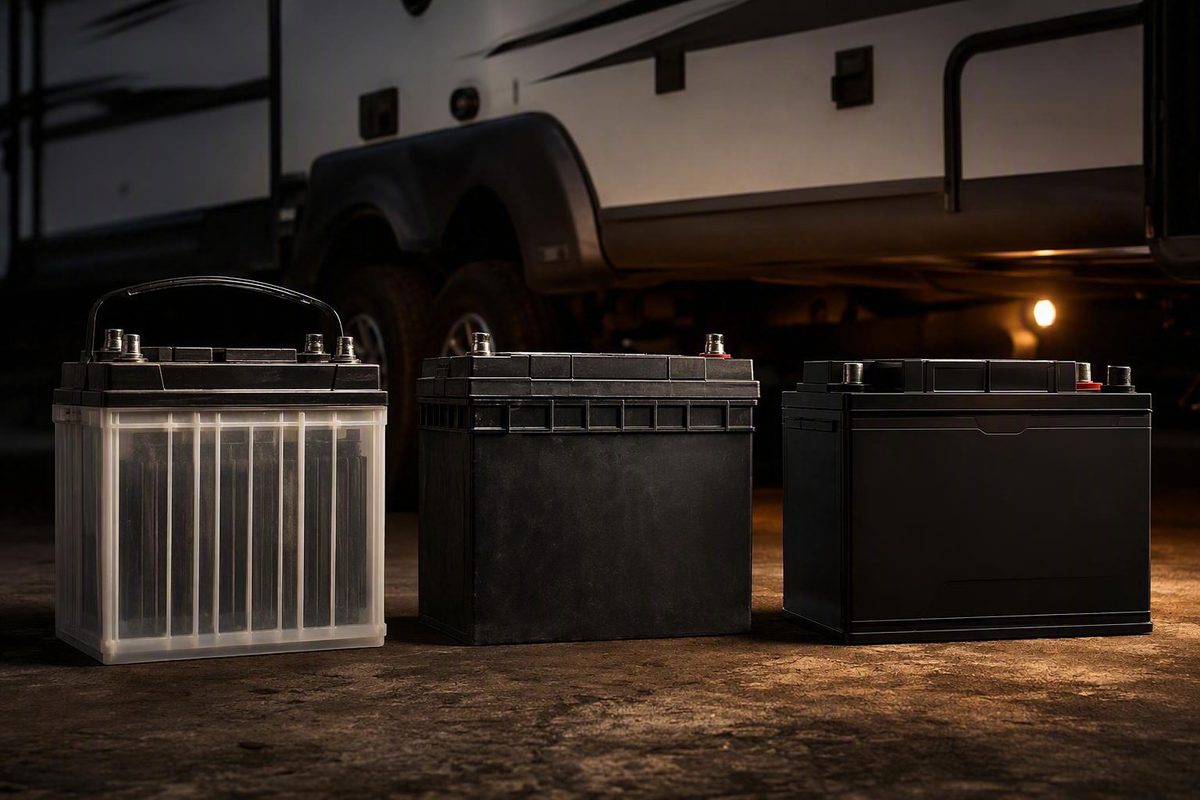
The short answer: typical RV battery lifespan by type
For planning purposes, expect approximately 3–5 years from a flooded lead-acid RV house battery, 5–7 years from an AGM battery, and 10 years or more from a lithium iron phosphate (LiFePO4) battery when it is charged, used, and stored appropriately. These are cautious estimates, not guaranteed replacement intervals; RV.com reports the same broad service-life ranges and notes that care and operating conditions affect the result in its comparison of common RV battery types.
The generalized cycle estimates below—approximately 300–500 cycles for flooded lead-acid, 500–800 for AGM, and 3,000–5,000 or more for lithium—come from commercial guidance rather than standardized, independent testing. Treat them as comparison figures, not model-specific promises, as explained in this RV house and chassis battery guide.
| Battery type | Cautious service-life estimate | Broad cycle estimate | Commonly usable share of rated capacity | Routine maintenance |
|---|---|---|---|---|
| Flooded lead-acid | About 3–5 years | About 300–500 cycles | Commonly planned around 50% | Check electrolyte; add distilled water when required; clean terminals and inspect connections |
| AGM lead-acid | About 5–7 years | About 500–800 cycles | Commonly planned around 50% | No water additions; inspect charging, terminals, connections, and state of charge |
| LiFePO4 | 10 years or more | About 3,000–5,000 or more cycles | Often about 80–90%, subject to the battery’s specifications | No electrolyte service; verify compatible charging, battery-management-system operation, connections, and temperature protection |
The table combines broad figures reported across RV battery guidance. Published material rarely specifies a consistent depth of discharge, temperature, charge rate, end-of-life threshold, or exact battery model. A cycle rating obtained under controlled conditions may not predict performance in a hot compartment, during winter storage, or under heavy inverter use.
Published calendar-life estimates also vary. Some commercial sources quote 6–8 years for flooded batteries, 8–10 years for AGM, and as much as 10–15 years for lithium. Those outcomes may be possible under favorable conditions, but the supplied evidence does not independently validate them with model-level test data. Continental Battery publishes average lifespans of 6–8 years for flooded lead-acid batteries, 8–10 years for AGM batteries, and up to 15 years for lithium-ion batteries How Long Do RV Batteries Last? (Plus 5 Signs Yours Needs Replacing) | Continental Battery Systems.
Battery construction and quality can move an individual battery outside any general range. So can climate, discharge depth, time spent partially charged, charger settings, vibration, connection quality, maintenance, and whether the bank is large enough for the RV’s loads. Two batteries of the same nominal type can therefore reach replacement time years apart.
In this article, “lithium” principally means LiFePO4, the lithium chemistry commonly discussed for RV house banks. Do not apply its cycle-life, usable-capacity, charging, or temperature guidance automatically to every product labeled lithium-ion. The battery label, manual, and battery-management-system specifications should control.
First identify which RV battery you mean
An RV may have more than one battery system, and the relevant lifespan depends on which system you are discussing.
A chassis battery, also called a starting battery, delivers a short burst of current to start a motorhome’s engine. It also supports driving-related equipment such as exterior lights and windshield wipers. Once the engine is running, the vehicle’s charging system normally replenishes it.
A house battery bank supplies energy over a longer period. Depending on the RV, it may power lights, vent fans, water pumps, refrigerator controls, furnace blowers, detectors, slide controls, electronics, and appliances connected through an inverter. House batteries are generally deep-cycle batteries intended to be discharged and recharged repeatedly.
Motorhomes commonly have both systems. Travel trailers, fifth wheels, and other towable RVs have house batteries but no motorhome-style engine-starting battery of their own; the tow vehicle has a separate starting battery.
The chemistry comparisons and service-life estimates in this article principally concern deep-cycle house batteries. Starting batteries operate under a different duty pattern and should not be judged by house-bank cycle ratings.
Evidence for chassis-battery lifespan is thinner. One charger manufacturer estimates approximately 4–7 years for a maintained lead-acid RV chassis battery, but that is a commercial planning estimate rather than a universal replacement interval.
Before using any estimate, inspect the battery label and documentation. Confirm whether the battery is:
- Flooded lead-acid
- AGM, or absorbed glass mat
- Gel lead-acid
- LiFePO4
- Another chemistry or specialized design
Do not infer chemistry from case color, shape, terminal arrangement, or the fact that a battery is sealed. AGM and gel are both sealed lead-acid designs, but their charging instructions are not necessarily interchangeable.
Keep gel batteries as a separate category in maintenance records and charger settings. The available evidence does not establish a dependable gel-specific lifespan range, so assigning them the AGM estimate merely because both are sealed would be misleading.
If the label is unreadable, check the invoice, model number, RV documentation, or charger configuration. Correct identification is more useful than guessing chemistry or remaining life from appearance.
Years, charge cycles, and runtime are three different answers
The question “How long do RV batteries last?” can mean three separate things:
- How many calendar years the battery remains useful
- How many charge cycles it can deliver
- How many hours it can power the RV on one charge
These measurements are related but not interchangeable.
Calendar service life is the elapsed time from installation until the battery can no longer meet the owner’s needs. A battery does not have to be completely inert to reach this point. It may still accept a charge but deliver too little runtime, sag excessively under load, or become too unreliable for the intended trip.
Cycle life is the number of discharge-and-recharge cycles delivered under defined conditions. Meaningful test conditions include depth of discharge, temperature, charging method, load, and the remaining capacity used to define the end of the test.
A partial discharge is not automatically equivalent to a complete cycle. Using a small portion of the bank each evening differs from deeply discharging it every day.
Runtime is the number of hours a charged bank can support a specific electrical load before reaching the chosen discharge limit. Runtime can vary from one trip to another even when the battery’s age and rated capacity are unchanged. A furnace operating frequently on a cold night creates a different load profile from a mild night with only lights and refrigerator controls running.
This distinction is why an advertised cycle count cannot simply be divided by 365 to guarantee a number of years. Calendar aging continues while the battery sits, and real-life results remain sensitive to heat, charging conditions, storage state of charge, depth of discharge, and cycling patterns.
A lightly used seasonal RV may consume relatively few cycles and lose useful performance through calendar aging or poor storage. A full-time off-grid RV may accumulate cycles much faster. Neither pattern supports a fixed replacement date without considering measured performance and operating history.
Depth of discharge is especially important for lead-acid batteries. Repeated deep discharge generally shortens cycle life, which is why owners commonly plan around using approximately half the rated capacity. That 50% figure is a conservative planning convention, not a universal electronic cutoff.
Many LiFePO4 designs permit use of approximately 80–90% of rated capacity, but the allowable range depends on the cells, battery-management system, temperature, and manufacturer’s limits. RV.com reports these broader lead-acid and LiFePO4 usable-capacity distinctions alongside its lifespan guidance, but the installed battery’s documentation should take precedence.
The broad cycle figures are similarly limited. A lithium seller, for example, publishes substantially higher figures—5,000–10,000 lithium cycles at stated discharge assumptions and 400–1,000 AGM cycles depending on conditions—which illustrates how test assumptions and commercial framing can change the result. These are vendor claims, not proof that every RV battery will reach them, as the seller’s AGM-versus-lithium comparison makes clear.
A separate estimate of 50–80 full cycles is insufficiently specified and unsuitable as a general expectation across flooded, AGM, gel, and LiFePO4 batteries. It lacks the chemistry, model, discharge-depth, temperature, and testing context needed for a cross-chemistry comparison.
When evaluating a cycle claim, ask:
- At what depth of discharge was the battery cycled?
- At what temperature?
- At what charge and discharge rates?
- Which charging profile was used?
- What remaining capacity defined the end of the test?
- Does the number apply to the exact model?
- Is it based on testing, a warranty term, or marketing material?
A large cycle number can indicate useful potential, but it does not eliminate calendar aging or prove that an RV installation will reproduce the stated conditions.
How to estimate runtime on one charge
Battery chemistry alone cannot tell you whether an RV will run overnight. You need the bank voltage, rated amp-hours, usable discharge fraction, average load, expected losses, battery condition, temperature, and incoming charging.
A practical planning formula is:
Runtime in hours ≈ battery voltage × amp-hours × usable fraction × system-efficiency factor ÷ average load in watts
The first two terms convert the nominal battery rating to watt-hours:
Watt-hours = volts × amp-hours
The usable fraction accounts for the discharge limit you plan to observe. An efficiency factor then allows for inverter and other system losses. The result remains an estimate because voltage, load, battery output, and conversion efficiency change during operation.
Consider a transparent pre-loss example:
- Battery voltage: 12 volts
- Rated capacity: 100 Ah
- Chemistry: lead-acid
- Planned usable fraction: 50%
- Average load: 25 watts
The theoretical usable energy is:
12 V × 100 Ah × 0.50 = 600 Wh
At a steady 25-watt average load:
600 Wh ÷ 25 W = 24 hours
That means about 24 theoretical hours before system losses and changing conditions. It is not a promise that every 100-Ah battery will power every RV overnight. A battery manufacturer’s overnight RV power guide likewise explains that runtime varies with capacity, battery condition, temperature, and the combination of loads.
Build a realistic load list
List every material load rather than estimating from the largest appliance alone. Depending on the RV, these may include:
- Interior and exterior lights
- Water pump
- Furnace blower
- Roof and ventilation fans
- Refrigerator controls
- A compressor refrigerator, if fitted
- Propane and carbon-monoxide detectors
- Routers and cellular equipment
- Satellite internet equipment
- Television and audio equipment
- Device chargers
- Inverter standby consumption
- Control boards and displays
- Tank heaters and other cold-weather equipment
- Appliances powered through an inverter
Small continuous loads can consume meaningful energy over many hours. Detectors, displays, and control circuits may remain active when the RV otherwise appears off. An inverter can also consume energy while waiting to supply an AC load.
Convert cycling appliances into average watts
Many appliances do not run continuously. A furnace blower may operate for several minutes, stop, and restart. A compressor refrigerator cycles according to temperature, ventilation, door openings, and ambient conditions.
For planning purposes:
Average watts = operating watts × fraction of time operating
If a device draws 60 watts while running and operates one-quarter of the time, its simplified average load is 15 watts. Add that figure to the continuous loads. Because duty cycles change with weather and use, measurements from a representative trip are generally more useful than assumptions.
Account for losses, condition, and incoming energy
Loads powered directly by the DC system avoid the inverter stage. AC appliances require conversion, and the inverter consumes energy while operating.
Cold conditions can reduce output, while an aging battery may deliver less energy than its label suggests. Air conditioners, microwaves, and electric resistance heaters are high-demand loads that can drain a modest bank quickly, according to RV battery-care guidance.
Solar, alternator, generator, or shore-power input can extend runtime, but count only energy likely to arrive during the modeled period. Daytime solar does not directly correct an overnight shortfall unless enough energy was stored before sunset.
Calculate the bank, not one battery in isolation
Multiple batteries may be connected in series, parallel, or a combination:
- Series wiring changes total bank voltage.
- Parallel wiring changes total amp-hour capacity.
- Series-parallel arrangements can change both.
Determine the actual bank voltage and total amp-hour capacity from the installed arrangement before applying the runtime formula. If the configuration or system documentation is unclear, have a qualified service provider identify the bank rather than changing the wiring experimentally.
The best runtime estimate combines a correct bank calculation with measured average consumption. A battery monitor can help identify loads and energy use that appliance labels or intuition miss.
What shortens an RV battery’s life
Early failure usually results from discharge behavior, charging, temperature, storage, load demands, or maintenance—not the calendar alone.
Discharge behavior
Repeated deep discharge is particularly hard on lead-acid batteries. A common planning practice is to treat roughly 50% of rated capacity as usable, leaving the remainder as reserve. The battery manual and the owner’s performance goals should determine the actual limit.
Many LiFePO4 batteries permit approximately 80–90% usable capacity, but the exact limit comes from the manufacturer and battery-management-system specifications rather than a generic rule.
An undersized bank must discharge more deeply or cycle more frequently to support the same loads. If an RV repeatedly reaches its chosen discharge limit overnight, replacing the battery with another of the same capacity may reproduce the problem.
Charging problems
Lead-acid batteries should not remain discharged or chronically undercharged. Prolonged partial charge can contribute to sulfation and lost usable capacity. Overcharging and excessive heat can also accelerate deterioration and increase water loss in flooded batteries.
Flooded lead-acid, AGM, gel, and LiFePO4 batteries do not share one universal charging profile. Charging problems may originate in the shore-power converter, solar controller, alternator charging arrangement, external charger, or configuration settings.
Temperature
Heat can accelerate deterioration and compound charging problems. A battery kept in a hot compartment may not match service-life estimates based on moderate conditions.
Cold can reduce practical performance, causing shorter runtime or greater voltage sag under loads that were manageable in warmer weather.
Low-temperature lithium charging requires particular attention. One charger manufacturer broadly warns against charging lithium below 32°F, but also notes that storage and charging requirements differ by battery design. Treat that as a prompt to follow the exact battery and battery-management-system limits—not as a universal rule for every lithium product. Charge below freezing only when the manufacturer expressly permits it through the battery design, protection system, or an approved temperature-management arrangement.
Do not assume that permission to discharge a battery in cold weather also means it may be charged at the same temperature.
Storage
An RV can continue consuming energy while parked. Detectors, control boards, displays, stereos, inverter standby circuits, and other electronics may remain active. Over weeks or months, these parasitic loads can deeply discharge a bank that appeared adequately charged at the start of storage.
Verify what the installed switch controls rather than assuming that its position proves the bank has no load.
Storage becomes especially damaging when a lead-acid battery remains at a low state of charge until the next travel season. Periodic checks can reveal unexpected draw before the bank becomes severely discharged.
Electrical loads and bank sizing
Every load consumes part of the bank’s usable energy. A bank selected only by advertised amp-hours may become inadequate after adding an inverter, compressor refrigerator, communications equipment, or cold-weather accessories.
High loads can also expose poor connections and cause voltage to fall sooner than expected. Sizing should account for both total energy use and the system’s ability to support the anticipated loads.
Maintenance and connections
Flooded batteries can fail early when electrolyte falls too low, terminals corrode, or connections loosen. AGM and LiFePO4 batteries eliminate water additions, but their installations still require clean and secure connections.
The central rule is chemistry-specific care. Do not apply one charging, discharge, storage, or temperature instruction to flooded lead-acid, AGM, gel, and lithium batteries as if they were interchangeable.
Charging, maintenance, and storage practices that support longer life
Good care starts with compatible charging equipment. The converter or charger, solar controller, and alternator charging arrangement should support the exact battery chemistry and manufacturer’s specifications.
A conventional multistage lead-acid charging process may include:
- Bulk: The charger supplies substantial current to restore energy.
- Absorption: Charging continues under controlled voltage while current tapers.
- Float: A lower maintenance level helps keep a charged battery ready.
These stages explain the purpose of a multistage charger; they do not establish universal voltage settings. Flooded, AGM, and gel batteries can require different limits, while LiFePO4 charging differs again. Use the battery and charger instructions together.
Monitor the bank before it becomes deeply discharged
A battery monitor is more useful than repeatedly discovering a dead bank. Track state of charge or energy consumption, establish the RV’s normal overnight use, and investigate unexplained changes.
Control avoidable parasitic loads during camping and storage. Turning off an unneeded inverter or optional electronics can preserve meaningful capacity over time.
Prompt recharging is particularly important for lead-acid batteries. Avoid routinely leaving them partially or deeply discharged after a trip.
Maintain flooded lead-acid batteries
Flooded batteries require direct attention:
- Inspect electrolyte levels on the schedule specified by the manufacturer.
- Add distilled water when required.
- Do not substitute tap water.
- Keep the battery top and terminals clean.
- Check cable connections and hold-downs.
- Look for corrosion, leakage, case distortion, or heat damage.
Flooded batteries contain electrolyte and can release gas while charging, so follow the battery manufacturer’s handling precautions. RV.com’s battery maintenance guide recommends distilled water, clean connections, suitable charging, and regular storage checks while distinguishing flooded batteries from sealed AGM and gel designs.
Do not add water to AGM or gel batteries. They are sealed designs and are not serviced like flooded cells.
Care for AGM batteries
AGM batteries require no water additions, but they still need:
- A compatible charging profile
- Prompt recharging after use
- Protection from chronic undercharging and excessive charging
- Clean, secure connections
- Appropriate discharge management
- Periodic inspection for damage or unusual heat
AGM remains a lead-acid chemistry, so conservative lead-acid discharge and storage principles remain relevant unless the manufacturer specifies otherwise.
Care for LiFePO4 batteries
LiFePO4 usually requires less routine maintenance because there is no electrolyte level to check. Long service still depends on:
- Compatible charging
- A functioning battery-management system
- Operation within specified charge and discharge limits
- Manufacturer-approved temperature protection
- Clean, secure connections
- The storage state of charge specified for that model
Store according to chemistry
Before storage:
- Identify the battery chemistry.
- Inspect the battery for physical damage or abnormal heat.
- Turn off or disconnect avoidable loads.
- Confirm whether any safety or control circuits must remain powered.
- Bring the battery to the storage state of charge specified in its manual.
- Use a suitable cool, dry location when removal is appropriate.
- Check the battery periodically.
General guidance commonly calls for storing lead-acid batteries fully charged. One commercial storage guide recommends approximately 60–80% charge for lithium storage, illustrating why lead-acid instructions should not automatically be applied to LiFePO4. Follow the battery manual if it specifies another target.
Continuous float or trickle charging is neither universally safe nor universally harmful. A properly designed maintenance mode may suit a particular lead-acid battery, while an incompatible or poorly regulated charger may overcharge it. Lithium batteries may have different storage requirements and may not require continuous charging.
How to tell whether the battery is failing or the RV has another problem
Possible warning signs include:
- Sharply reduced runtime under a familiar load
- Poor charge retention
- Noticeably diminished output
- Voltage collapse when a normal load is applied
- Swelling or case deformation
- Leakage
- Abnormal or excessive heat
- Cracks, damaged terminals, or other physical damage
Age provides context but does not prove failure. A battery may remain useful beyond a planning range, while a newer battery may be damaged by deep discharge, heat, incompatible charging, or poor storage.
Reduced runtime alone also does not isolate the battery as the cause. A charging fault, new load, colder weather, malfunctioning appliance, loose connection, persistent parasitic draw, or undersized bank can produce similar symptoms.
Use this diagnostic order:
- Screen for hazards before charging. Check for swelling, leakage, cracks, damaged terminals, unusual odor, smoke, or abnormal heat. Do not continue routine charging or testing when these signs are present; follow the battery manufacturer’s instructions or seek qualified service. Swelling, leakage, heat, poor charge retention, and voltage collapse are among the warning signs identified in Continental Battery’s replacement guidance.
- Identify the chemistry and specifications. Confirm that the charger and test equipment are suitable.
- Inspect the installation. Check for loose, dirty, or corroded terminals, damaged cables, and signs of overheating.
- Fully charge an undamaged battery with compatible equipment. A partially charged battery will naturally appear weak.
- Verify the charging source. Confirm that the converter, charger, solar controller, or alternator arrangement is restoring energy.
- Check for unexpected draw. Determine whether electronics, detectors, an inverter, or another load continues consuming power.
- Observe performance under a representative load. Compare runtime with an established baseline.
- Arrange professional capacity or load testing if the cause remains unclear.
Do not use one resting-voltage threshold as a universal health test. Voltage behavior varies with chemistry, temperature, recent charging, surface charge, load, and battery-management-system state.
A battery that seems weak may simply be undercharged because of poor converter output. Loose or corroded connections may prevent it from delivering current. Cold conditions can reduce output, and a healthy bank may still be too small for the installed loads.
When a longer-lasting battery or lithium upgrade makes sense
Choosing a replacement involves more than selecting the chemistry with the largest advertised cycle count. Compare:
- Expected cycling frequency
- Usable capacity
- Routine maintenance
- Weight and available installation space
- Charging compatibility
- Temperature requirements
- Expected loads
- Initial cost
- Planned ownership period
- Manufacturer documentation and support
When flooded lead-acid makes sense
Flooded lead-acid can be appropriate when low upfront cost is the priority and the owner is willing to perform electrolyte and terminal maintenance. It may suit an RV that spends much of its time connected to compatible charging and does not routinely require deep off-grid discharge.
Its disadvantages include water maintenance, a more conservative usable-capacity plan, and sensitivity to being left discharged. If the bank is repeatedly depleted overnight, load demand or bank size may be the underlying problem.
When AGM makes sense
AGM can suit owners who want sealed lead-acid construction without water additions while retaining a lead-acid-based system. Its cautious estimated service life falls between flooded lead-acid and LiFePO4.
Commercial claims of 8–10 years represent favorable-condition estimates rather than expected results for every AGM battery. AGM still needs compatible charging and should not be assumed to tolerate chronic deep discharge merely because it is sealed.
When LiFePO4 makes sense
LiFePO4 can be attractive for frequent off-grid use, repeated cycling, a larger usable share of rated capacity, and reduced routine maintenance. Its generalized cycle advantage may be valuable to owners who regularly use and recharge their banks.
That does not justify a fixed payback promise or a claim that lithium always lasts ten times longer. Economic value depends on initial cost, annual cycling, calendar aging, charging quality, climate, installation needs, and how long the owner keeps the RV.
Use qualified assistance when the charging architecture or installation requirements are unclear.
Match the bank to expected loads and cycling frequency. A weekend camper using modest lighting and pump loads has different priorities from a full-time boondocker operating communications equipment and inverter-fed appliances every day. Advertised amp-hours, warranty length, and headline cycle count are comparison inputs—not complete purchasing decisions.
Frequently asked questions
How long will a 12-volt RV battery last overnight?
There is no single runtime for a 12-volt battery. You need its amp-hour capacity, usable discharge fraction, average load, condition, temperature, system losses, and incoming charging.
For a 12-volt, 100-Ah lead-acid battery planned around 50% usable capacity, the pre-loss calculation is:
12 V × 100 Ah × 0.50 = 600 Wh
At a steady average load of 25 watts:
600 Wh ÷ 25 W = 24 theoretical hours
That result is arithmetic based on stated assumptions, not a guaranteed overnight runtime. Furnace operation, refrigeration, inverter standby consumption, electronics, battery age, and cold conditions can all change it.
How long does an RV chassis battery last?
One commercial charger source estimates approximately 4–7 years for a maintained lead-acid RV chassis battery, but the available evidence is limited. Treat this as a planning range rather than a replacement deadline.
Climate, storage, starting frequency, charging-system condition, parasitic draw, and battery quality can move the result outside that range. Judge the battery by starting performance and measured condition, not age alone.
Can I leave my RV battery on a charger during storage?
Sometimes. The charger’s maintenance mode must be compatible with the exact battery chemistry, and the battery manufacturer must permit that storage method.
A suitable float or maintenance charger may keep an appropriate lead-acid battery charged. An incompatible or poorly regulated charger may overcharge it. Lithium instructions may instead specify partial-charge storage without continuous charging.
Control parasitic loads, follow the battery’s storage guidance, confirm the charger setting, and inspect the system periodically.
Can an RV lithium battery be charged below freezing?
Many lithium batteries should not be charged below freezing unless the manufacturer expressly permits it through the battery specifications, battery-management system, or an approved internal heating system.
Charging and discharging temperature limits may differ. Follow the exact battery manual and do not override its temperature protection. If the documentation does not authorize cold charging, wait until the battery is within its permitted charging range or use the manufacturer-approved temperature-management method.
How can I tell whether an RV battery is dead or simply discharged?
Begin with a hazard check. If the battery is swollen, leaking, cracked, smoking, unusually hot, or otherwise physically damaged, do not proceed as though it is merely discharged; follow the manufacturer’s safety instructions or seek qualified service.
For an undamaged battery, identify the chemistry, inspect and clean the connections, then charge it fully with compatible equipment. Verify that the charging source works and check for unexpected loads before observing performance under a normal load.
A discharged but serviceable battery may recover normal runtime once the charging or parasitic-draw problem is corrected. A deteriorated battery may show poor charge retention, substantial voltage collapse under load, or much less runtime than its established baseline. If the cause remains uncertain, arrange an appropriate capacity or load test.
As a practical decision rule, plan around 3–5 years for flooded lead-acid, 5–7 years for AGM, and 10 years or more for LiFePO4, while judging the individual battery by measured performance and operating conditions rather than age alone. Identify the battery system and chemistry, calculate runtime from usable watt-hours and actual loads, correct charging or parasitic-draw problems before replacing the bank, and let battery-specific instructions control discharge, charging, storage, and temperature limits.