
15 min read ·
When to Test or Replace Your Accord’s 12-Volt Battery
Expect about 3-5 years from the 12-volt battery. At three years, start annual testing rather than replacing it automatically.
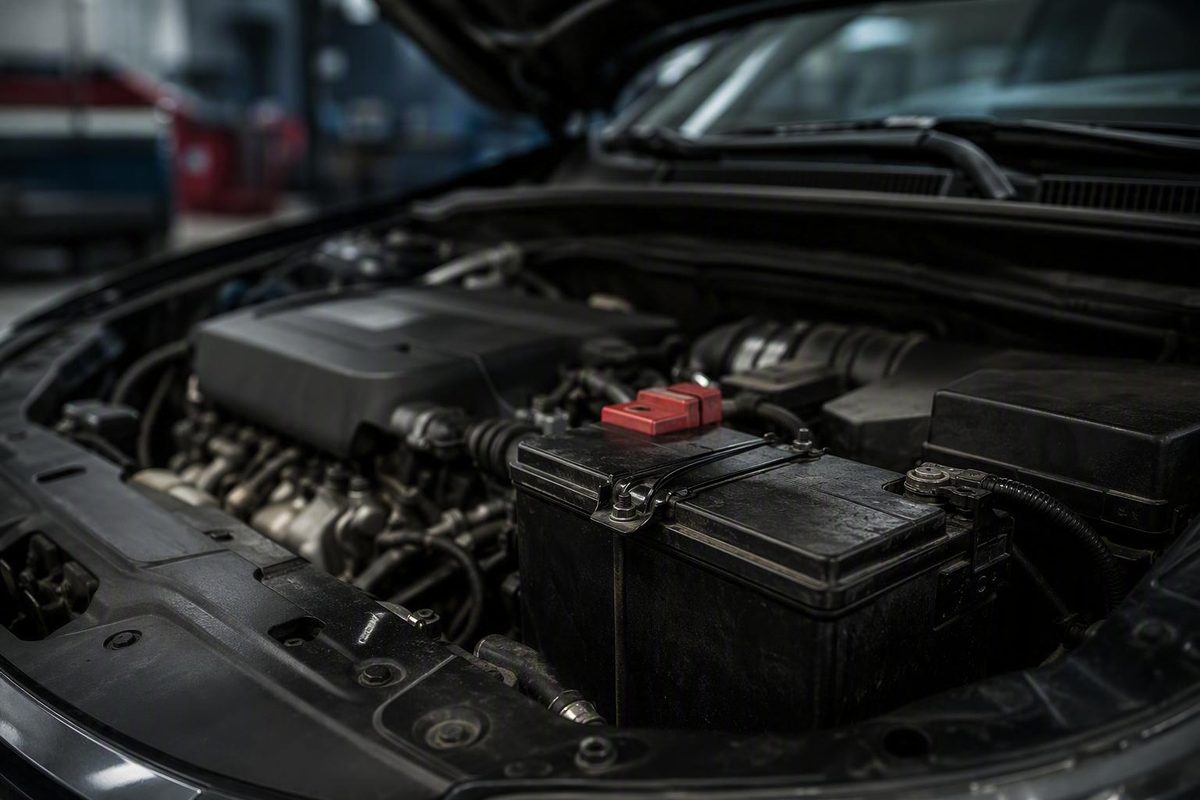
The short answer: plan for about three to five years
A practical answer to “how long does a Honda Accord battery last?” is about three to five years. That range applies to the conventional 12-volt starting battery, or the 12-volt auxiliary battery in an Accord Hybrid—not the hybrid model’s separate high-voltage propulsion battery. AAA gives flooded and AGM automotive batteries the same typical three-to-five-year range under appropriate use and care, although actual service life varies with conditions. AAA explains the typical lifespan and variables for both battery designs.
Treat three to five years as a planning range, not an expiration date or Honda-mandated replacement interval. Some Honda dealership guidance publishes a broader estimate of two to five years, with climate, driving conditions, driving style, and maintenance among the variables. Norm Reeves Honda gives the broader two-to-five-year estimate.
None of the available evidence provides a controlled, Accord-specific lifespan study. It therefore cannot establish that every Accord battery should last a particular number of years, or that every battery must be replaced at a fixed age.
Owner experiences illustrate the variation without defining a dependable average. In one self-selected Accord forum discussion, several owners described replacing 12-volt batteries around the third or fourth year. Another reported that a battery remained functional after four years and eight months. The vehicles, climates, powertrains, mileage, and driving patterns differed, so the reports offer context rather than proof of normal Accord battery life. The owner discussion includes reports spanning roughly three years to more than four and a half years.
Mileage alone is not a dependable battery-life clock. An Accord driven many highway miles may receive regular charging opportunities, while a low-mileage car used for brief errands may repeatedly consume starting energy without enough driving time to restore it.
The most useful rule is simple: begin paying closer attention as the battery approaches the typical lifespan range, but base the replacement decision on age, operating conditions, symptoms, and test results together.
Why one Accord battery may fail sooner than another
A battery’s working environment can matter as much as the name on its label. Two otherwise similar Accords can have different outcomes because their batteries experience different temperatures, charging patterns, electrical loads, and physical conditions.
High temperatures can accelerate deterioration. Heat can increase fluid loss in a conventional flooded battery and contribute to internal damage. Cold weather presents a different challenge: starting demands rise, which can expose a battery that has already lost capacity. A battery may appear adequate in moderate weather and then crank slowly during the first severe cold spell.
Frequent short trips can leave the battery undercharged. Starting the engine removes stored energy. The charging system begins replacing that energy while the vehicle runs, but a series of brief drives may not provide enough charging time—especially when lights, climate controls, defrosters, and other equipment are operating.
Prolonged parking allows charge to decline.
Engine-off accessory use draws from the battery. Leaving exterior or interior lights on, listening to audio with the engine off, or operating other electrical accessories can discharge it. Temperature extremes, short trips, unused vehicles, and accessories left on with the engine off are all identified as battery-life factors in Honda-oriented guidance. Marthaler Honda also recommends annual testing once a battery reaches three years.
Other relevant variables include:
- Battery construction and overall quality
- How often the battery is discharged and recharged
- Whether it is securely clamped in place
- Vibration from rough roads or a loose hold-down
- Corrosion or looseness at the terminals
- The vehicle’s total electrical demand
- Charging-system condition
- An unintended electrical draw while the vehicle is off
- Long-term exposure to heat or cold
Repeated jump-starting deserves prompt attention, but it does not prove that the battery is the only defective component. A deteriorated battery is one possibility; others include a poor terminal connection, inadequate alternator output, a starter problem, or an electrical drain.
Consider two contrasting situations:
- A three-year-old battery in a hot climate, installed in an Accord used mainly for ten-minute errands, faces both heat-related deterioration and limited charging opportunities. Testing before severe weather or an important trip would be prudent even if the car currently starts.
- A regularly driven Accord whose battery receives longer charging runs, remains securely mounted, and shows no symptoms may continue operating reliably at the same age. Its age still justifies periodic testing as it enters the usual lifespan range.
Operating conditions change the level of risk, but they cannot calculate an exact failure date. Testing turns those risk factors into a more informed replacement decision.
Use age, conditions, symptoms, and test results together
Replacing a battery based only on its birthday can discard useful service life. Waiting until the Accord will not start creates the opposite problem. A practical decision uses four inputs:
- Battery age: How long has the current battery been installed?
- Operating conditions: Does the car face severe heat or cold, short trips, infrequent use, or high accessory demand?
- Observable symptoms: Has starting slowed, have electrical features become erratic, or has the car needed a jump?
- Health-test results: Can the battery still perform adequately, and is the charging system operating correctly?
Look for an installation or manufacturing date on the battery label, receipt, service record, or warranty paperwork. If the age is unknown, treat that uncertainty as a reason to inspect and test rather than guessing.
For a battery under about three years old, symptoms should drive the investigation.
From approximately year three onward, arrange at least annual testing. Additional checks are sensible before extreme weather, long-distance travel, or any situation in which reliable starting is particularly important. A passing result on an aging battery is reassuring, but it does not guarantee long-term reliability. Honda North recommends annual testing after three years and additional testing before extreme weather or long trips.
Between three and five years, monitor more closely if the Accord experiences severe temperatures, sits for long periods, or is used mainly for short trips. For a battery older than five years, proactive replacement becomes a risk-management choice rather than an automatic technical requirement. An older battery that passes testing and causes no symptoms has not been proven defective, but replacement may still be reasonable when an unexpected no-start would create a serious problem.
The following table applies those age and testing benchmarks to common situations:
| Age and situation | Symptoms | Test result | Practical response |
|---|---|---|---|
| Under about three years, normal use | None | Pass | Continue routine inspection; do not replace for age alone |
| Under about three years | Slow crank, discharge, or repeated jump-start | Pass or unclear | Check terminals, charging system, starter, and possible electrical drain |
| Around three years or older | None | Not recently tested | Arrange a baseline test and repeat at least annually |
| Three to five years, severe climate or mostly short trips | None | Pass | Continue monitoring and test before severe weather or important travel |
| Any age | Starting or electrical symptoms | Weak or failed | Confirm charging-system condition and replace the battery if diagnosis supports it |
| Any age | Symptoms continue after a passing battery test | Pass | Investigate connections, alternator output, starter, and key-off drain |
| More than five years | None | Pass | Choose between close monitoring and proactive replacement based on reliability needs |
| Any age | Swelling, cracking, leakage, smoke, or unusual odor | Testing is not the priority | Stop routine handling and seek qualified assistance |
A passing result means the battery met the test criteria at that moment. It is not a promise that the battery will remain dependable for another season. Conversely, age alone does not prove that a battery can no longer start the vehicle.
Warning signs that call for a battery check
A weakening battery often produces clues before a complete no-start, but no single clue conclusively identifies the battery as the cause. Pay attention to changes from your Accord’s normal behavior.
Starting symptoms include:
- Slower-than-normal engine cranking
- Clicking during a start attempt
- Intermittent no-start events
- A need for a jump-start
- Starting after a jump, followed by another no-start later
A single no-start may follow an accidentally left-on light. Repeated no-starts or jump-starts are more significant because they suggest that the battery is not retaining adequate charge or that another part of the starting and charging system needs diagnosis.
Electrical symptoms include:
- Dim or flickering headlights or interior lights
- Power windows or other accessories operating weakly or erratically
- Electronics resetting unexpectedly
- A battery-related warning indicator on the instrument panel
If charging-system output is inadequate, the battery may become discharged even when it was not the original cause.
Visible warning signs include:
- Heavy corrosion around the terminals
- Loose or damaged cable connections
- A swollen, bulging, cracked, or deformed case
- Wetness or apparent leakage around the battery
- A battery that is not securely held down
These are reasons to inspect the complete installation rather than replacing the battery blindly.
These signs are associated with serious battery damage and warrant qualified assistance. Honda of New Rochelle identifies deformation, leakage, corrosion, and sulfur-like odor as warning signs.
Even ordinary symptoms require diagnosis. Dim lights may reflect low system voltage without identifying the failed component.
The useful takeaway is not “one symptom equals one failed battery.” It is: a new or recurring symptom is a reason to inspect and test the battery, its connections, and the charging system.
What a voltage check can—and cannot—tell you
A multimeter can provide useful information, but it cannot answer every question about battery health.
The essential distinction is between state of charge and state of health:
- State of charge describes how charged the battery is at the time of measurement.
- State of health describes how much useful starting performance and capacity remain.
Resting voltage primarily helps estimate current charge. About 12.6 volts or higher is commonly associated with a fully charged 12-volt automotive battery. Honda of Cleveland Heights gives approximately 12.6 volts as a fully charged reading.
Voltage without a meaningful load does not fully reveal available capacity or cold-cranking performance.
It may reflect:
- Incomplete charging
- Recent engine-off accessory use
- Prolonged parking
- Internal battery deterioration
- Insufficient charging-system output
- An unintended electrical drain
- A poor connection or measurement problem
If it becomes discharged again, investigate the cause rather than relying on repeated charging or jump-starting.
For a basic voltage check:
- Park safely, switch the vehicle off, and turn off accessories.
- Follow the multimeter manufacturer’s instructions.
- Connect the meter using the polarity specified in those instructions.
- Record the reading, accounting for recent charging or driving.
- If the result is low or symptoms persist, arrange a more complete test instead of deciding on replacement from that reading alone.
Keep this procedure at a basic screening level. If the battery is leaking, swollen, cracked, smoking, unusually hot, or producing a sulfur-like odor, do not proceed with routine testing.
A professional evaluation may assess battery capacity or cold-cranking performance and check charging-system performance and alternator output. Those results are more informative than one resting-voltage reading.
A headlight test—watching for obvious dimming—is only an imprecise screening method. It is not a substitute for a multimeter, an appropriate battery-health test, or charging-system diagnosis.
Voltage can help answer, “How charged does this battery appear right now?” By itself, it generally cannot answer, “How many months of dependable service remain?”
Habits that may reduce premature battery failure
Maintenance cannot reverse established internal deterioration, and no routine can guarantee a particular lifespan. It can reduce avoidable discharge and help reveal developing trouble before the Accord fails to start.
Turn off lights and accessories when the engine is off. Before leaving the car, check exterior lights, interior lamps, chargers, and other devices. Limit extended engine-off use of the audio system or powered accessories.
Avoid a pattern consisting only of very short trips when practical. Each start consumes energy, and adequate driving time gives the charging system more opportunity to replace it.
Keep the battery properly secured. A loose battery can experience excess movement and strain at its connections. The hold-down should keep it stable without damaging the case.
Inspect the terminals and cables. Look for corrosion, looseness, damaged insulation, or other visible problems. Follow the vehicle’s service information and appropriate battery-safety procedures before cleaning or disconnecting terminals.
Test regularly as the battery ages. Begin annual testing at about three years, with additional checks before severe weather or long-distance travel. Test sooner whenever starting behavior changes. Honda-oriented guidance recommends annual testing from the three-year mark.
Plan for extended inactivity. Verify compatibility with the installed battery type, follow the maintainer manufacturer’s instructions, and use it only in a suitable environment.
Respond to repeated discharge rather than normalizing it. Frequent jump-starts are not a maintenance strategy. They show that the battery is not remaining ready for service, whether because of the battery itself, the connections, the charging system, the driving pattern, or an electrical drain.
Good habits may reduce premature failure, but they cannot assign an exact lifespan. Their real value lies in avoiding unnecessary discharge, maintaining sound connections, and identifying when diagnosis is warranted.
Choosing an AGM or flooded replacement battery
AGM and conventional flooded batteries are both lead-acid automotive batteries, but they contain electrolyte differently. A flooded battery uses freely flowing liquid electrolyte. In an absorbed glass mat, or AGM, battery, the electrolyte is retained in glass-mat separators.
AGM batteries are generally sealed, low-maintenance, spill-resistant, and resistant to vibration. They also tend to cost more. Those characteristics can make AGM suitable for certain applications, but they do not make it automatically superior for every Honda Accord.
AAA gives both flooded and AGM automotive batteries a typical lifespan of three to five years under proper use. Actual results vary with application, battery quality, cycling frequency, temperature, and environmental conditions. AAA’s comparison gives both designs the same typical three-to-five-year range.
When replacing an Accord battery, match the requirements for the exact model year, engine, trim, and powertrain. Check:
- Required battery technology
- Physical dimensions and terminal layout
- Battery group number
- Cold-cranking amps
- Reserve capacity
- Hold-down arrangement
- Any model-specific installation requirements
Do not select a replacement solely because a generic catalog says it fits, it promises longer life, or it has the highest number printed on the label. Physical fit is only one requirement. The battery must also provide the correct electrical performance and use the technology specified for the vehicle.
External chargers and maintainers must also be compatible with the installed battery type. Some older charging equipment may not support AGM batteries, so follow the battery and equipment instructions rather than assuming one charging mode is suitable for every design.
The best replacement is not necessarily the most expensive option. It is a correctly specified battery from a dependable source, installed securely with clean, sound connections.
Hybrid batteries, warranties, and other common sources of confusion
An Accord Hybrid has two distinct battery systems:
- A 12-volt auxiliary battery, which supports low-voltage vehicle functions
- A separate high-voltage propulsion battery, which is part of the hybrid drive system
The lifespan guidance in this article applies only to the 12-volt battery. It should not be used to estimate the life of the high-voltage propulsion battery. Owner reports concerning an Accord Hybrid’s 12-volt battery further illustrate why the battery must be identified before discussing lifespan; they do not establish a traction-battery replacement schedule.
Warranty duration is another common source of confusion. A warranty describes possible coverage under specified terms. It does not predict how long a battery will remain usable. A battery can fail after its warranty expires, while a long warranty does not guarantee uninterrupted operation for the full stated period.
One Honda dealership page says an original battery in a new Honda is covered for three years or 36,000 miles. It also describes a 100-month warranty program for certain replacement batteries purchased from authorized Honda dealers, including an initial full-replacement period followed by prorated credit. Apple Tree Honda describes these original- and replacement-battery warranty terms.
Those figures are claims on a dealership page, not official Honda corporate warranty documentation establishing universal or current coverage. Terms may depend on the vehicle, battery, purchase channel, defect determination, and current program rules.
Before relying on coverage, verify:
- The vehicle identification number
- Whether the battery is original equipment or a separate replacement
- The purchase and installation date
- The seller and installation channel
- Whether proof of purchase is required
- How a covered defect is determined
- Whether coverage is full or prorated
- Whether labor is included
- Current Honda warranty documents and exclusions
If your Accord’s battery age or condition is uncertain, start with three facts: identify its installation date, determine whether it is flooded or AGM, and note any recent starting or electrical symptoms. When the evidence is mixed, request both a battery-health test and a charging-system check. That approach is more reliable than replacing solely by age—or waiting for another no-start.
Should I replace my Honda Accord battery after three years?
Not automatically. Three years is a sensible point to begin annual testing, not a universal replacement deadline. If the battery starts the car normally, has no visible damage, and passes an appropriate test, continued monitoring may be reasonable.
Replace it sooner if testing shows inadequate performance or diagnosis confirms failure. Proactive replacement may also be reasonable when severe temperatures, critical travel, slow cranking, or repeated discharge make an unexpected no-start especially costly.
Can a Honda Accord battery last longer than five years?
Yes. A 12-volt battery can remain functional beyond five years, but that is not guaranteed. Climate, trip pattern, charging opportunities, battery construction, electrical demand, and condition all influence the outcome. Honda-oriented guidance treats a battery older than five years as a replacement consideration rather than proof of failure. Honda of New Rochelle discusses replacement consideration after five years.
An older battery that passes testing is not automatically defective. Decide between close monitoring and proactive replacement according to test results and the consequences of an unexpected no-start.
Do short trips and leaving an Accord parked shorten battery life?
They can. Repeated short trips may consume starting energy without providing enough driving time to replenish it. Extended parking also allows charge to decline and can be especially troublesome when the battery is old, partly discharged, or affected by an abnormal electrical draw.
Neither pattern proves permanent battery damage. If the battery repeatedly becomes discharged, recharge and test it as appropriate, then investigate the charging system and possible key-off drain.
Is the Accord Hybrid’s 12-volt battery the same as its hybrid propulsion battery?
No. The 12-volt auxiliary battery and high-voltage propulsion battery are separate systems with different roles. The planning range discussed here concerns the 12-volt battery only and does not estimate the high-voltage battery’s lifespan. An Accord owner discussion includes a hybrid-specific report concerning the 12-volt battery, not the propulsion battery. The forum discussion distinguishes the reported hybrid 12-volt battery experience.
Before arranging testing or replacement, confirm which battery is involved.
Does repeated jump-starting mean the battery must be replaced?
No.
Have both the battery and charging system checked. If the battery fails an appropriate health test, replace it with the exact type and specification required for the Accord. If it passes, continue diagnosis rather than assuming another jump-start has resolved the underlying fault.