
8 min read ·
Repeated Dead Batteries Need Diagnosis, Not Another Battery
A 2026 lawsuit alleges parasitic drain in 2020–2026 Tellurides. Learn the recall distinction, symptoms to document, and tests to request.
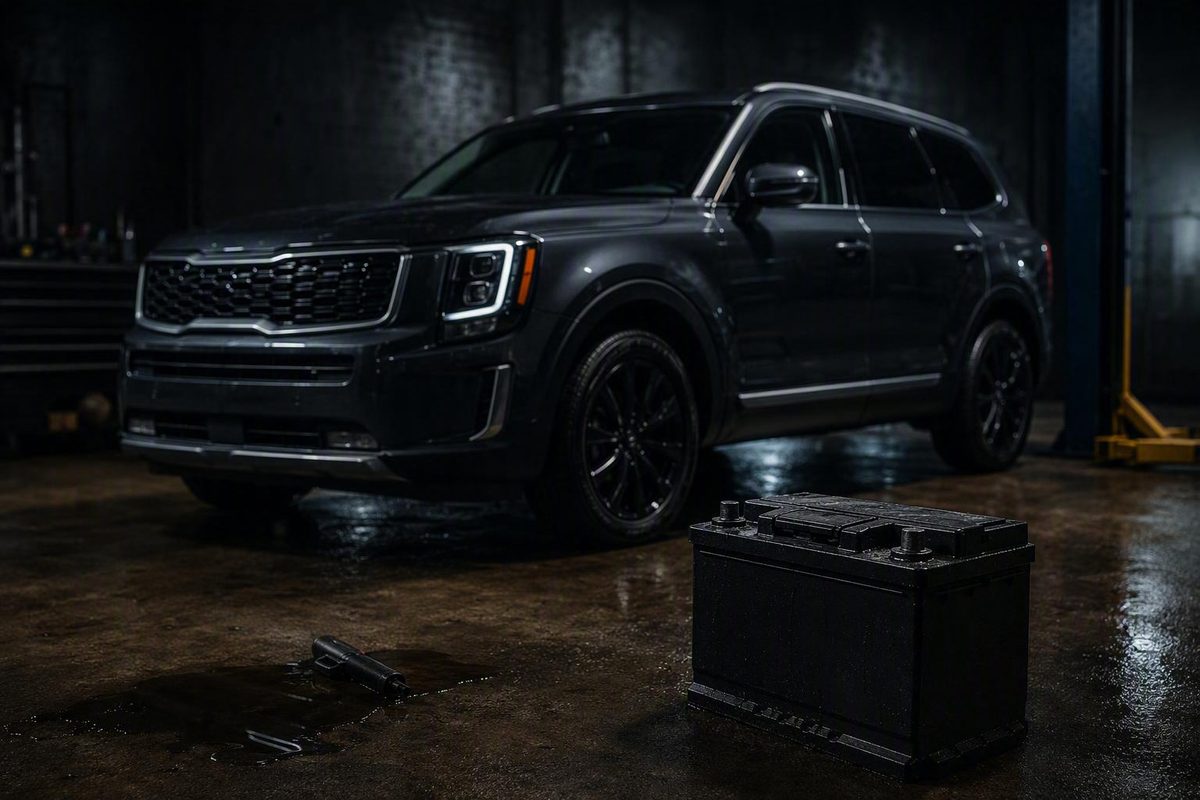
There is no identified Kia or NHTSA recall specifically for general Kia Telluride battery drain as of late August 2026. A proposed class action filed June 3, 2026, alleges parasitic drain across 2020–2026 Tellurides, but that is not a recall or a proven defect. If a replacement battery also dies, stop treating replacement alone as the repair: the plaintiff says his discharge continued after a new battery, while the complaint alleges control modules fail to enter a low-power sleep state.
Recall status can change. Check the specific vehicle through NHTSA’s official recall lookup and ask Kia or an authorized dealer to search the VIN.
Why Replacing The Battery Seems Like The Obvious Fix
The conventional response to a dead Telluride is reasonable: test the 12-volt battery and replace it if it fails. Batteries deteriorate, cold weather and short trips reduce available charge, bad connections cause trouble, and added electronics can consume power. One dead battery does not prove a vehicle has the defect alleged in a lawsuit.
A replacement is appropriate when testing shows internal battery deterioration. Nor should every 2020–2026 Telluride be presumed defective merely because its model year falls within a proposed legal class.
The limitation appears when discharge recurs. A new battery restores reserve capacity but does not remove an off-state electrical load. According to CarComplaints’ account of Marc Brenman’s allegations, his certified used 2021 Telluride displayed a battery-discharge warning in 2025. He replaced the battery, but says the discharge continued. In a later incident, the key fob would not unlock the parked SUV, it would not start, and it needed an external jump.
The report says a dealer subsequently found the battery, alternator, starter, and drive belts in good condition. Brenman reports paying $184.49 for labor and $44.96 in other fees. That is one owner’s allegation, not proof of a fleet-wide fault. It does show why another battery is not a complete diagnosis when a supposedly resolved discharge returns.
Your Symptoms Determine The Next Useful Step
Choose the model year, symptoms, replacement history, and warranty status; the checker identifies whether the alleged class matches and what to document next.
This checker separates the lawsuit’s proposed model-year range from recall status and turns recurring symptoms into a documentation plan. It is not a diagnosis or legal determination.
- Check the VIN through NHTSA and Kia; model year alone does not establish recall coverage.
- Ask for the Kia sleep-state specification applicable to this VIN and the measured parasitic draw.
- Submit the complaint under warranty in writing and preserve the repair order.
- Save the battery receipt plus any towing, roadside, and diagnostic bills.
| Item | Vehicles | Status | What It Means |
|---|---|---|---|
| Brenman lawsuit | 2020–2026, proposed | Filed June 3, 2026 | Allegations; no certified class or universal fix documented |
| 24V407 / SC316 | Certain 2020–2024 | Official recall | Power-seat fire risk, not a general drain remedy |
| Terminal campaign | Certain 2023 | Reported voluntary campaign | Loose positive-terminal nut; no confirmed broader-drain connection |
| Draw target | VIN-specific | — | Ask the shop for the applicable Kia specification; no universal figure was found |
Safety: If driving functions are affected, move to safety and seek assistance. Owners covered by 24V407/SC316 should follow NHTSA’s instruction to park outside and away from vehicles and structures until repaired.
Sources: NHTSA recall 24V407/SC316; reporting on Brenman v. Kia America, Inc. by ClassAction.org and CarComplaints. “Alleged class” is not recall coverage, class certification, or a defect finding.
A “matches alleged class” result does not establish eligibility for damages, class membership, a defect, or recall coverage. It means only that the selected model year falls within the complaint’s proposed 2020–2026 range. The court has not been reported to have certified that class.
The Lawsuit Alleges Modules Stay Awake
Marc Brenman v. Kia America, Inc. was filed June 3, 2026, in the U.S. District Court for the Central District of California, according to ClassAction.org’s report on the proposed class action. It seeks to represent current and former U.S. purchasers and lessees of 2020–2026 Kia Tellurides.
The complaint alleges that an electronic control module or related subsystem fails to enter, or remain in, a low-power sleep state after shutdown. The resulting off-state load allegedly drains the 12-volt battery while the SUV is parked. Reported symptoms include dashboard flickering, no-starts, dead remote key-fob entry, and a message that the battery is discharging due to external electrical devices.
The suit further alleges that Kia has known about the issue since 2019, has not provided a fix or recall, and has left owners paying for repeat batteries, towing, and roadside assistance. It also makes allegations about concealment and possible effects involving the speedometer, alternator, power steering, or stalling. Those are disputed, unproven allegations—not regulator findings or established systemwide safety outcomes.
The reviewed sources do not document class certification, a merits ruling, Kia liability, or a court-ordered remedy. The 2020–2026 range is a proposed legal class definition. It does not mean every Telluride in those years has a draw, every dead battery has one cause, or Kia and NHTSA have accepted that range.
The Existing Telluride Recall Addresses A Different Hazard
The reviewed evidence contains no NHTSA recall number, official affected-vehicle count, production range, notification schedule, or prescribed remedy for general Telluride parasitic drain. The lawsuit reportedly says a recall is needed; that does not mean one has been issued.
Three actions are being conflated:
| Action | Vehicles | Issue | Status |
|---|---|---|---|
| Brenman lawsuit | 2020–2026, as proposed | Alleged parasitic drain | Proposed class action |
| 24V407 / SC316 | Certain 2020–2024 | Power-seat fire risk | Official recall |
| Terminal campaign | Certain 2023 | Loose positive-terminal nut | Reported campaign |
NHTSA recall 24V407, identified by Kia as SC316, covers certain 2020–2024 Tellurides. The front power-seat motor may overheat because of a stuck seat-slide knob, creating a fire risk while parked or driving. Dealers install brackets for the power-seat switch back covers and replace the seat-slide knobs at no charge.
Owners whose VINs are covered should follow NHTSA’s direction to park outside and away from vehicles and structures until the repair is complete. NHTSA’s consumer alert states the hazard, instructions, and remedy. The battery-drain dispute does not change or weaken that safety instruction.
Finding 24V407/SC316 open on a Telluride does not show the seat defect caused its dead battery. Completing the recall is likewise not an approved universal repair for recurring 12-volt discharge.
A separate reported voluntary service campaign concerns a potentially loose positive battery-terminal nut on certain 2023 Tellurides, which could illuminate the Charging System Warning light. Third-party reporting does not establish that this narrower campaign causes or fixes the parasitic drain alleged in the suit.
Recurring Discharge Calls For A Parasitic-Draw Test
Battery health and state of charge are different. A serviceable battery can become discharged if something keeps drawing current—or wakes intermittently—while the vehicle is parked. Conversely, a deeply discharged battery may also sustain damage and eventually require replacement.
Possible causes include battery deterioration, inadequate charging from frequent short trips, infrequent use, cold weather, loose or damaged terminals and grounds, charging-system faults, plugged-in devices, dash cameras, trackers, aftermarket remote starts, trailer wiring, or a factory module that does not power down consistently.
No official Telluride-wide current threshold or sleep period appears in the reviewed evidence. The target should therefore be the Kia service specification applicable to the specific VIN, not an unsupported number copied from a forum. Ask the dealer or qualified electrical technician to state that specification and record the measured draw after the vehicle has had the prescribed time to sleep.
Request written results for the battery’s charge and condition, charging-system operation, starter when relevant, terminals and grounds, current and history diagnostic codes, and parasitic current after sleep. If the failure usually takes a particular number of hours or days, put that parked duration on the repair order and ask whether observation can reproduce it.
Intermittency matters. One test that finds no excessive draw may not recreate the conditions of the failure; one unexplained discharge does not prove an intermittent module fault. Disclose every nonfactory device and recent electrical repair so circuits can be isolated based on measurements rather than assumptions.
If a shop proposes a module or another battery, ask what was measured, why that result implicates the part, and how the repair will be verified. The reviewed evidence does not identify a universal module, software update, technical bulletin, or repair that resolves all Telluride drain complaints.
Put The Warranty Claim In Writing
Tell the service adviser the exact warning, parked duration, no-start behavior, jump history, and number and dates of battery replacements. Ask that these facts remain on the repair order even if the shop cannot duplicate the condition.
No reviewed evidence establishes that Kia’s warranty covers every battery, tow, diagnostic fee, or electrical repair. Coverage can depend on vehicle age, mileage, component, diagnosis, maintenance, modifications, and warranty terms. Request coverage before authorizing work when practical, and ask for any denial or limitation in writing.
Preserve battery purchase and installation receipts, towing and roadside-assistance bills, diagnostic reports, recall paperwork, warranty correspondence, and every repair order. Photograph the discharge warning when safe. Record the mileage, parked duration, ambient conditions, recent trip pattern, whether remote unlocking worked, electrical flicker or clicking, and whether a jump succeeded.
After a repair, record what changed, the measurement supporting it, whether the vehicle was observed afterward, and how long it operated before symptoms returned. This history helps the next technician distinguish a failed battery from a battery repeatedly discharged by another fault. It may also support a warranty request, consumer complaint, or legal consultation, though it guarantees none of them.
If electrical power, steering assistance, instrumentation, or propulsion is affected while driving, prioritize reaching a safe location and obtaining emergency or roadside help. Once safe, document the event and report the safety concern through Kia and NHTSA’s complaint process. Do not attempt roadside electrical diagnosis in an unsafe location.
Check The VIN, Not Just The Model Year
A model year cannot establish recall coverage. Locate the 17-digit VIN, enter it or the license plate into NHTSA’s recall lookup, and confirm that the returned vehicle matches. Read each action by number and defect description rather than treating any electrical recall as a battery-drain recall.
Save a dated copy of the lookup. Then give the VIN to Kia or an authorized dealer and request a search for open safety recalls, voluntary service campaigns, software updates, and applicable technical service information. Ask for the number and VIN applicability of anything the dealer recommends.
An empty NHTSA result does not invalidate a battery complaint; it means the search did not display an open safety recall for that vehicle at that time. An open 24V407/SC316 result does not prove the power-seat issue caused the discharge, but owners must still follow its fire-risk instructions. Check periodically because official records can change.
Kia Telluride Battery-Drain Recall FAQ
Is There An Official Kia Telluride Battery-Drain Recall?
The reviewed evidence identifies no official Kia or NHTSA recall specifically for general Telluride parasitic battery drain as of late August 2026. Current reports concern a proposed class action and owner complaints. Verify the latest status by VIN through NHTSA and Kia.
Which Tellurides Does The Lawsuit Cover?
The proposed class includes current and former U.S. purchasers and lessees of 2020–2026 Tellurides. That range is an allegation and proposed class definition, not a certified class, recall range, or finding that every vehicle is defective.
Does Recall 24V407/SC316 Fix Battery Drain?
No. It addresses an overheating front power-seat motor caused by a stuck seat-slide knob in certain 2020–2024 Tellurides. Covered owners should park outside and away from vehicles and structures until the free recall repair is complete.
Why Can A New Battery Die Again?
A new battery restores capacity but cannot remove an off-state load. If a module, accessory, wiring fault, or other circuit stays awake, it can discharge the replacement while parked. Battery failure, charging problems, connections, use patterns, and weather still need to be tested rather than ruled out by assumption.
What Should An Owner Do Before Paying For Another Battery?
Run a VIN recall check, request the applicable sleep-state parasitic-draw specification and measured result, submit the warranty request in writing, and save all battery, towing, roadside-assistance, and diagnostic receipts. Replace a failed battery when testing supports it, but do not accept replacement alone as proof that recurring drain has been repaired.