
8 min read ·
Know When Charging Is Enough and Replacement Is Warranted
A jump-start alone does not mean you need a new car battery. Compare test results, damage and charging warnings to choose a recharge, replacement or diagnosis.
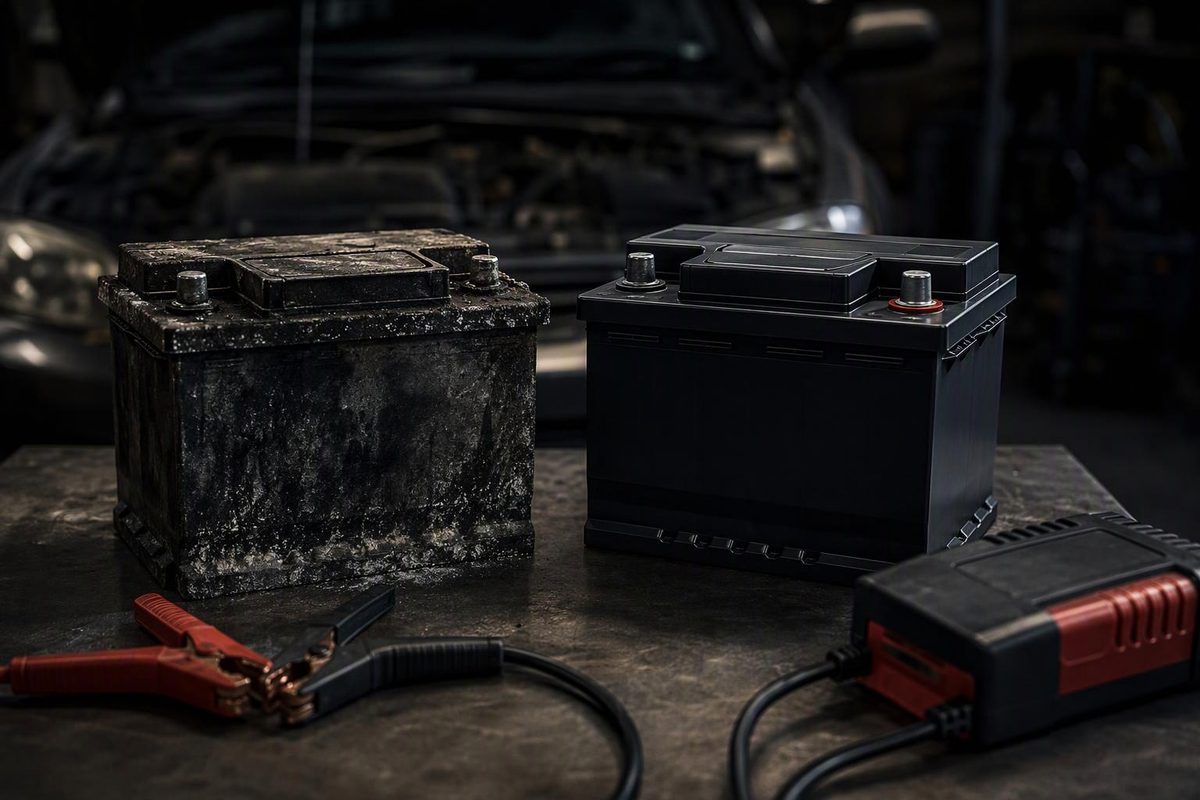
Replace the battery when physical damage or a confirmed battery-health test failure warrants it—not simply because the car needed a jump-start. Recharge first when a reliable test calls for charging, then retest if instructed. If the battery-shaped warning light stays on with the engine running, arrange charging-system diagnosis rather than assuming a new battery will fix the problem. A discharged battery may recover; a failed battery needs replacement; an unresolved charging fault can leave a replacement flat too.
This guidance covers 12-volt lead-acid car batteries, including AGM and EFB, not key-fob cells, low-voltage lithium batteries or hybrid/EV traction packs. The decision depends on battery condition and a valid test, not a universal age, voltage or replacement-price threshold. The sources below do not supply one threshold that applies to every vehicle.
Select the battery condition, warning-light status and test result to find your next step.
Battery Next-Step Selector
Your Next Step
Check battery condition first.
Do not assume charging or jump-starting is safe until damage and suspected freezing have been ruled out. Arrange inspection if you cannot check safely.
A jump-start alone does not establish that replacement is needed.
How Test Results Change the Decision
| Result | Next Step |
|---|---|
| Good battery | Keep in service; investigate unexplained discharge. |
| Good—recharge | Charge using the appropriate procedure. |
| Charge and retest | Fully charge and repeat the test before deciding. |
| Replace battery | Confirm connections and failure, then replace; check charging too. |
| Unable to rate | Correct the test condition and retest. |
For Mazda's October 22, 2025 DCA-8000 warranty procedure, a repeated “charge and retest” result after a full charge directs replacement. Other vehicles and testers require their applicable procedure.
Sources: AAA safety and charging-warning guidance; Midtronics testing guidance; Mazda DCA-8000 bulletin. For 12-volt lead-acid batteries, including AGM and EFB.
Damage Comes Before Charging or Testing
Before attempting a jump-start, look for a cracked case, bulging sides or leakage. Do not jump-start a damaged battery. Arrange professional help for replacement and inspection instead. AAA’s battery safety guidance identifies case damage and bulging as reasons to stop.
Do not try to recharge a damaged or frozen battery either. Suspected freezing is a reason to stop and have the battery assessed, not proof by itself that replacement is necessary. Charging requires ventilation and a charger appropriate for the battery; follow the battery, vehicle and charger instructions. CTEK’s charger manual sets out these precautions for its equipment.
Remove metal jewelry, wear protective eyewear and keep sparks and flames away. A visible safety problem takes priority over a test report: a result saying “good—recharge” is not permission to charge a battery whose case is damaged.
If the battery is difficult to access or you cannot inspect it safely, tell the technician that its physical condition has not been checked. Do not turn an unknown condition into an assumed pass. The shop needs to establish whether testing or charging is appropriate before proceeding.
A Warning Light While Driving Calls for Charging-System Diagnosis
A battery-shaped warning light that stays on while the engine is running is not a battery-replacement verdict. It can indicate a problem involving the alternator, wiring, voltage regulator or drive belt. Stop somewhere safe and arrange diagnosis or roadside assistance rather than assuming a battery purchase will solve it. The vehicle may exhaust its stored battery power and shut down. AAA explains the charging warning and possible causes.
Tell the shop whether the warning appeared while driving or whether the problem was simply a failure to start after parking. Those are different observations. A car that starts after a jump still needs charging-system attention if the warning remains on with the engine running.
Battery replacement and charging-system repair are not mutually exclusive. A battery can need replacement while another fault also needs repair. Ask for both findings rather than accepting “it started with a new battery” as the entire diagnosis. That observation alone does not establish that the charging problem has been resolved.
A Valid Battery-Health Test Determines the Next Step
Tell the technician what happened before the failure: lights left on, several weeks parked, slow cranking, repeated jumps or a warning while driving. Ask for the battery result, a connection check and a charging-system check. These checks answer different parts of the problem.
A simple voltage measurement is not enough to establish battery health, according to VARTA’s testing guidance. A voltage reading should not be treated as a substitute for the battery-health assessment needed to decide whether replacement is justified.
Nor does every tester error mean the battery has failed. Poor clamp contact, corrosion, low charge and electrical interference can prevent a reliable result. Midtronics explains these testing errors and the need for proper checks. If the tester cannot rate the battery, the next step is to resolve the test condition—not to reinterpret an error as “replace.”
Use the report to choose the next action. Exact wording and follow-up vary by tester and vehicle. The distinctions below draw on Midtronics’ guidance and Mazda’s October 22, 2025 warranty-testing bulletin for the DCA-8000. Mazda’s instructions apply to that bulletin and testing procedure; they are not a universal rule for every tester.
| Test Wording | Next Step | Replacement Decision |
|---|---|---|
| Good battery | Keep in service; investigate unexplained discharge. | Not supported by this result alone. |
| Good—recharge | Charge with the appropriate equipment and procedure. | Recharge is indicated. |
| Charge and retest | Complete the charge, then repeat the test. | Not yet a confirmed failure. |
| Replace battery | Confirm connections and the result; check charging too. | Replace once failure is confirmed. |
| Connection error / unable to rate | Correct the test condition and retest. | No valid verdict yet. |
Ask to see the actual result rather than relying on a summary such as “the battery is low.” Low charge, an unreadable test and a confirmed failure lead to different decisions. If the report calls for another step, ask whether that step has been completed.
Mazda specifically warns that poor connections can produce a “replace battery” result. Its bulletin also directs replacement if “charge and retest” appears again after a full charge. Have the technician follow the applicable vehicle and tester instructions rather than applying Mazda’s procedure to unrelated equipment or repeatedly charging without reaching a decision.
Recharge When the Test Calls for It, Then Complete the Follow-Up
“Good—recharge” means charging is the next action. “Charge and retest” leaves the replacement decision open until charging and the repeat test are complete. Neither result should be presented as a confirmed battery failure before the required follow-up.
Use an appropriate charger and follow the vehicle, battery and charger instructions. Do not assume that any charger setting suits every flooded, AGM or EFB battery. The draft sources do not establish one charging duration or setting for all these batteries, so a fixed number of hours would be misleading.
A jump-start gets the engine running; it does not supply a battery-health verdict. Likewise, successfully starting once after charging does not explain why the battery discharged. Keep the charging result and the health-test result separate when discussing the repair with the shop.
The useful endpoint is a documented decision: the battery passes and stays in service, the test confirms replacement, or another condition must be corrected before a reliable result is possible. If the shop recommends replacement after initially recommending charging, ask what the completed follow-up showed.
Repeated Discharge Needs a Cause, Even if the Battery Passes
A battery that passes after charging may have been discharged rather than worn out. If lights were left on, give the technician that history. If the cause is unclear or the battery keeps going flat, investigate rather than continuing a cycle of jump-starts.
Vehicles use some battery power while parked. An abnormal draw from a light, relay or module that remains energized can cause repeated discharge. UTI explains parasitic battery drain. A passing battery test does not rule out that separate problem.
Give the shop a timeline: how long the car sits before failing, whether the problem began after an accessory installation and whether the battery has already been replaced. Describe what actually happened rather than labeling it “a bad battery.” A repeat failure after replacement is especially relevant to finding a cause beyond the battery itself.
If the battery fails after proper charging and retesting, replacement is warranted. If the charging system or an excessive drain is also faulty, include that repair in the plan. Replacing the battery alone leaves the cause unresolved; fixing a drain alone does not reverse a confirmed battery failure.
Replacement Must Match the Vehicle, Not Just the Available Space
Once replacement is justified, supply the model year, make, model, engine, variant and VIN. Ask the installer to confirm the specified battery rather than choosing solely by appearance or by the battery currently fitted.
The quote should identify the group size, dimensions, terminal layout and hold-down fit. AutoZone’s fitment guidance explains why dimensions, terminal placement and secure mounting matter. A battery that can be placed in the compartment is not necessarily the correct fit.
Confirm the required technology and electrical ratings too. Do not downgrade an AGM-required application to a conventional flooded battery. VARTA’s guidance also addresses technology matching and registration requirements on vehicles with advanced energy management. Those requirements are vehicle-specific, not a reason to assume every replacement needs coding.
Ask whether the job requires battery registration, coding, a sensor reset or a relearn procedure. Also confirm the battery location and any access work. Have the installer state which procedures apply to your vehicle and whether they are included, rather than adding every possible procedure to every quote.
This fitment check belongs after the replacement decision but before purchase. A valid failure result establishes the need for a battery; it does not establish which replacement is correct or what installation work the vehicle requires.
Compare the Installed Total, Not a Battery-Only Price
Request a written installed total separating the battery, diagnosis, access labor, electronic setup, tax, any refundable core deposit and old-battery recycling. Ask what the warranty covers and whether any required follow-up work remains outside the quote.
The sources here do not provide a replacement price for your vehicle. Without the fitment and service requirements, there is no supported figure to quote. Use our car battery replacement cost guide to compare estimates on the same basis—not a battery-only shelf price against a complete service visit.
Keep the diagnosis visible in that comparison. A lower replacement quote does not answer whether the battery actually failed, and a higher total may include investigation or vehicle-specific access work that another quote excludes. Ask each shop to identify the work, not just the final amount.
The decision should leave you with two clear answers: why the battery needs charging or replacement, and what will prevent the same failure from recurring. Physical damage or confirmed failure supports replacement. A recharge instruction supports charging and any specified retest. A charging warning, test error or unexplained repeat discharge supports further diagnosis—not an automatic battery purchase.