
19 min read ·
What Your Kia’s Battery Warning Is Telling You—and What to Check Next
The most useful first clue is when the warning appeared:
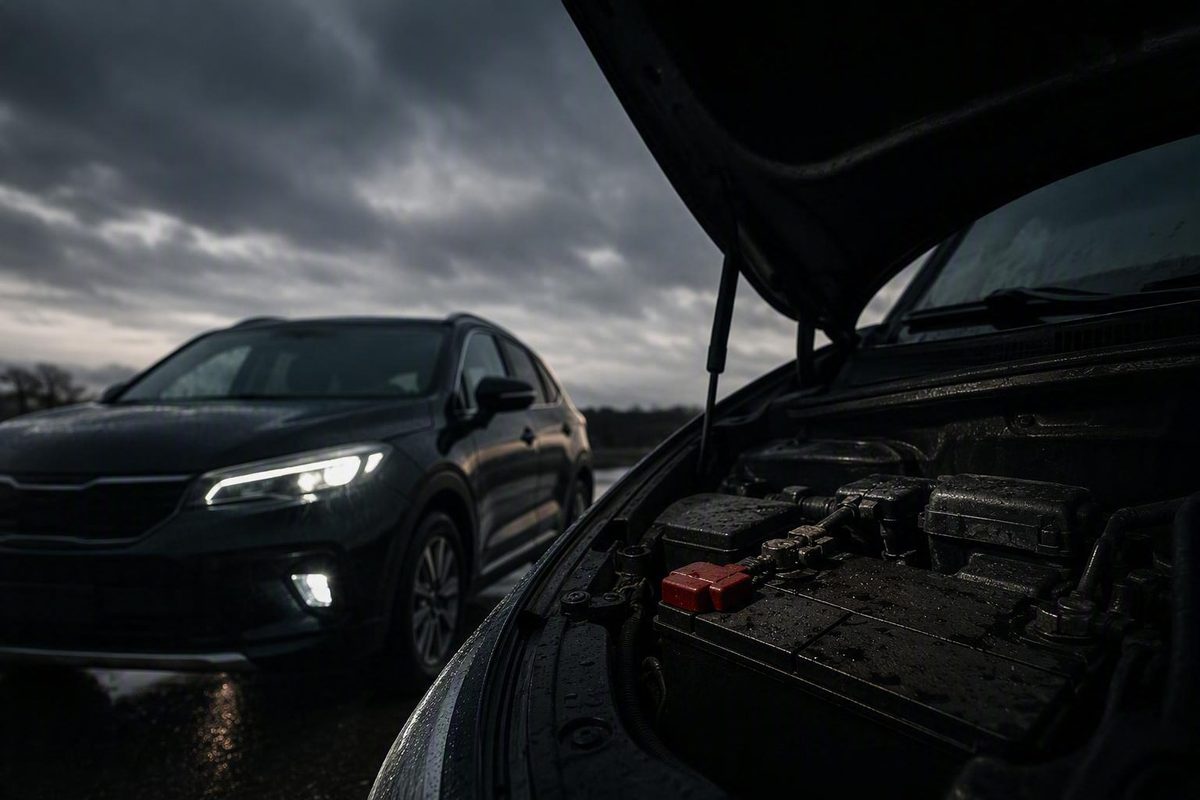
The most useful first clue is when the warning appeared:
- With the engine off or in accessory mode
- While idling
- While driving
- After the vehicle repeatedly lost charge while parked
Each situation suggests a different diagnostic path. Before replacing parts, establish the 12-volt battery’s charge and health, test cranking and charging performance, inspect accessible connections and the drive belt where applicable, scan for stored faults, and investigate key-off current draw if the battery goes flat while parked.
This is necessarily general guidance. The available evidence does not establish one official meaning or procedure for every Kia model year, market, infotainment system, and powertrain. Consult the owner’s manual supplied for your exact vehicle, use Kia’s official manual resources for your market where available, or ask a Kia service department for the applicable model-specific instructions.
What the battery discharge warning can—and cannot—tell you
It does not identify the failed component or even prove that a component has failed.
Similar wording may function as an accessory-use reminder in one operating state and accompany a charging, connection, or monitoring problem in another. The exact wording, display location, model, market, and powertrain therefore matter.
It is an alert, not a component diagnosis
Possible categories include:
- Low battery state of charge
- Deteriorated battery health
- Inadequate charging
- A loose, corroded, or high-resistance connection
- Abnormal electrical draw after shutdown
- A battery-monitoring or sensor error
- Infotainment or control-software behavior
Kia’s general battery-drain guidance lists active electrical devices, charging-system problems, alternator faults, and battery deterioration among possible causes. These are categories to investigate, not conclusions about an individual vehicle. It also notes that electrical loads left active after shutdown can discharge the battery. Kia’s overview of common battery-drain causes
Charge, health, and charging performance are different
Three concepts are often conflated:
- State of charge: How much usable energy the battery holds now.
- State of health: How much capacity and current-delivery ability remain compared with a healthy battery of the correct specification.
- Charging-system performance: Whether the vehicle can replenish the battery and support its electrical loads under the relevant conditions.
A battery can be undercharged but otherwise serviceable.
Working lights, an operating radio, or one successful start do not prove that the battery is healthy. Accessories may require much less current than starting an engine. An analogous Hyundai dealership explanation—not official Kia guidance—similarly notes that a weak 12-volt battery may continue to power accessories yet fail to start the vehicle. Its discussion expressly excludes EV traction batteries. The dealership’s battery-discharge overview
Treat it as a low-voltage warning unless model-specific information says otherwise
For the purposes of troubleshooting, it is reasonable to begin with the 12-volt or other low-voltage system that powers accessories and control modules. That is a diagnostic starting point, not an official interpretation covering every Kia.
Do not treat the wording alone as a diagnosis of a hybrid or EV high-voltage traction battery. Instead, check the owner’s manual and model-specific service information for the exact:
- Model and model year
- Country or market
- Engine and powertrain
- Infotainment or instrument system
- Battery type and equipment package
Neither is normal accessory operation or one successful start.
What to do now: engine off, idling, driving, or parked for days
Use the vehicle’s operating state and accompanying symptoms to choose the next action.
| When the warning appeared | What to do immediately | What to investigate next |
|---|---|---|
| Engine off or accessory mode | Turn off unnecessary lights, audio, climate functions, chargers, and other loads. If conditions are safe and the vehicle starts normally, record the event. | Arrange battery and electrical-system testing if the warning recurs, cranking becomes slow, or the vehicle needs a jump-start. |
| Engine idling | Reduce nonessential loads. Note whether stop-start is unavailable and whether lights or accessories fluctuate. | If the message persists or returns, request battery-charge, battery-health, cranking, charging, connection, and fault-code checks. Do not assume idling guarantees adequate charging. |
| Vehicle moving | If the warning appears by itself and the vehicle otherwise behaves normally, reduce nonessential electrical loads and arrange prompt diagnosis. | If lights dim, accessories fail, multiple alerts appear, or drivability changes, prioritize reaching a safe location and seek roadside or professional assistance. An analogous dealership warning guide also recommends stopping safely when a discharge warning occurs while driving. |
| Repeated loss of charge after parking | Do not rely on repeated jump-starts as a long-term response. Record how long the vehicle sat and whether equipment remained connected. | Fully charge and test the battery, then measure key-off current after the vehicle enters its normal sleep state and isolate any abnormal circuit draw. |
There is no universal “drive it for this long” answer
The supplied evidence does not support one idling or driving duration that will restore adequate charge in every Kia. The outcome can vary with the battery’s initial charge and health, the loads operating at the time, ambient conditions, and the vehicle’s charging design.
Do not assume that idling will reliably recover a depleted battery.
Know when to escalate
Seek prompt assistance if the warning is accompanied by:
- Difficult starting or repeated no-starts
- Dimming or flickering lights
- Rapid loss of accessory functions
- Multiple electrical or system warnings
- Stalling or altered drivability
- Belt squeal or other belt noise
- A burning odor
Kia’s general battery-drain material identifies difficult starting, repeated jump-starts, accessory shutdowns, and dimming while driving as possible signs of battery or electrical trouble. These symptoms do not identify the cause, but they strengthen the case for prompt testing.
As a general precaution, if the vehicle is moving and serious electrical symptoms develop, concentrate on reaching a safe stopping place rather than continuing simply because the engine is still running.
Why the warning appears when the engine is off
When the engine is off, lights, infotainment, phone chargers, powered accessories, and control modules draw energy from the low-voltage battery. If enough energy is removed, the battery may no longer support reliable starting.
In that context, the message may be functioning as a preventive reminder to stop using electrical equipment or operate the vehicle normally when it is safe to do so. That is a bounded interpretation based on the circumstances, not a confirmed universal Kia warning definition.
Accessory operation does not establish starting capacity
A weak or poorly charged battery may continue to run the radio or illuminate the dashboard. Starting an engine generally places a much greater demand on the battery. The fact that the infotainment system still works does not establish adequate starting reserve or battery health.
Possible contributors to an engine-off warning include:
- Extended radio or infotainment use
- Exterior or interior lights left on
- Devices connected to powered outlets
- Prolonged parking
- Repeated short trips that have not restored previous starting losses
- Reduced battery capacity
- A circuit or module remaining active unexpectedly
These remain possibilities until tested. The warning’s meaning depends on what happened before it appeared.
One obvious event is different from a recurring pattern
If the vehicle starts strongly afterward and the message does not return, record the event and monitor it.
Testing becomes more important when:
- The warning appears without obvious accessory use
- It occurs more frequently
- Starting sounds slower
- Stop-start becomes repeatedly unavailable
- The vehicle needs jump-starts
- The battery loses charge while parked
There is no evidence-supported universal number of minutes for safely using accessories with the engine off. Battery condition, load, ambient conditions, and vehicle configuration vary.
Why it can appear while the engine is running
The wording can be especially confusing when it instructs the driver to use the system with the engine running even though the engine is already on.
Owners have reported that scenario, but individual reports do not establish a common cause. In one unresolved case, the owner of a 2016 Sorento said the warning appeared while the vehicle was traveling at 110 km/h. It did not recur over the next four trips, and the discussion contained no measurements, confirmed diagnosis, or final repair. The 2016 Sorento owner report
A separate owner reported similar wording in a 2023-registered Sportage petrol mild hybrid after approximately 60 seconds of idling, including while stopped at traffic lights. The discussion did not publish charging measurements, diagnostic codes, or a confirmed root cause, so it cannot be generalized to every Sportage or mild hybrid. The Sportage owner discussion
Possible categories when the vehicle is running
If the warning appears while idling or moving, possibilities include:
- A weak or insufficiently charged low-voltage battery
- Alternator or voltage-regulator trouble on a vehicle using that charging arrangement
- A slipping, loose, or damaged accessory drive belt
- Resistance at a battery terminal, positive cable, ground cable, or ground point
- A battery-current sensor or monitoring error
- Charging-control or infotainment behavior
- A test result being interpreted without the model-specific operating context
A remote technician answering a third-party Kia question proposed alternator failure as a typical explanation and recommended charging-system testing. That case included no measured result or confirmed repair, so it supports testing the charging system—not declaring the alternator faulty from the message alone. The technician’s charging-system recommendation
Intermittent does not mean resolved
A warning may disappear after operating conditions change or the vehicle is restarted. That does not establish that the battery, charging system, connections, sensors, or wiring are normal.
Useful evidence may still include:
- Stored or pending diagnostic trouble codes
- Freeze-frame information
- Battery-monitoring data
- Charging-system data
- Evidence of an intermittent connection
Record the exact conditions and request a system scan even if the display has returned to normal. Because charging arrangements differ among models and powertrains, interpret voltage and current readings using information applicable to the exact vehicle.
Likely cause categories, prioritized by symptoms
The following matrix connects symptoms with possibilities and useful tests. It is not a component diagnosis.
| Pattern or symptom | Possible cause categories | Useful confirmation |
|---|---|---|
| Warning after accessory use with the engine off | Low state of charge; reduced battery capacity; unusually high accessory load | Establish state of charge, recharge appropriately, and then test battery health |
| Slow cranking or repeated jump-starts | Low charge; deteriorated battery; poor terminal or ground connection; charging problem | Battery load or conductance test, cranking test, and connection voltage-drop test |
| Warning while running with dimming or accessory shutdowns | Charging-system fault; belt problem; high-resistance connection; battery fault | Charging test under load, belt inspection, and positive and ground voltage-drop tests |
| Belt squeal or visible belt damage | Belt wear, looseness, contamination, tensioner trouble, or slippage | Engine-off visual inspection followed by qualified mechanical assessment |
| Battery dies after sitting | Key-off draw; inability to retain charge; device or module remaining awake | Fully charge and test the battery, then perform sleep-state current-draw testing |
| Warning begins after accessories are installed | Tracker, dash camera, alarm, audio equipment, lighting, charger, or installation-related wiring | Disclose all equipment and measure key-off current while isolating relevant circuits |
| Warning is intermittent but basic tests appear normal | Sensor, connection, control logic, software behavior, or testing outside the fault conditions | Scan for stored codes, review relevant data, and reproduce the operating state |
| Warning continues after battery or alternator replacement | Original cause unresolved; poor grounds; wiring fault; wrong battery specification; abnormal draw; installation or setup issue | Recheck the complete system rather than replacing the same category of part again |
Low charge or deteriorated battery
Consider the battery’s age and service history, but do not replace it based on age alone. Relevant context includes:
- Long periods parked
- Frequent short trips
- Recent jump-starts
- Slow or uneven cranking
- Prior deep discharge
- Stop-start becoming unavailable
- A battery that was never fully recharged after depletion
The key question is whether the battery is merely undercharged or has lost usable capacity. Establish its charge first, then evaluate its health.
Charging-system fault
A charging problem becomes a stronger possibility when the warning occurs while the vehicle is running, particularly if lights dim, accessories shut down, or multiple warnings appear.
The relevant components and control methods depend on the powertrain. Do not order an alternator from the warning alone. Measure charging behavior under the same or similar conditions that produced the complaint.
Drive-belt issue
On vehicles where a belt drives the alternator, visible damage, looseness, slippage, displacement, or belt noise warrants prompt inspection. A belt can appear acceptable at a glance while still having a tensioner, pulley, or intermittent-slip problem.
As a general workshop precaution, perform only a visual check from a safe position with the vehicle switched off. Keep hands, clothing, tools, and test leads away from belts and fans. Leave running-engine belt diagnosis to a qualified technician.
Connection or ground fault
Loose or corroded terminals can restrict current even when a battery-voltage reading looks reasonable. The same applies to resistance in:
- Positive battery cables
- Engine or body grounds
- Ground straps
- Fuse or distribution connections
- Charging-circuit connections
Parasitic drain
If a charged and tested battery repeatedly becomes depleted after the vehicle sits, investigate whether a circuit or module remains active after shutdown.
An unresolved Kia Soul owner report illustrates why parts replacement alone is insufficient. The owner said the battery and alternator had been replaced and that disconnecting a radio associated with an earlier draw finding did not prevent the battery from going flat again. The discussion recommended measuring key-off current after modules entered sleep mode and isolating the affected circuit, but it established neither a universal Kia current limit nor a confirmed final cause. The recurrent parked-discharge discussion
Aftermarket or forgotten loads
Tell the technician about every added or plugged-in device, including:
- Dash cameras
- GPS or fleet trackers
- USB adapters and chargers
- Alarm or remote-start systems
- Amplifiers and other audio equipment
- Auxiliary lighting
- Diagnostic dongles
- Trailer or accessory wiring
Do not assume that an aftermarket device is responsible, but do not omit it from the diagnostic history.
Sensor or software behavior
If battery, cranking, charging, connection, and key-off tests are normal, a sensing, control, or software issue remains possible. Intermittent warnings also justify examining these categories.
That does not establish a recall, design defect, service bulletin, or available update. Such conclusions require official documentation for the exact model, market, and production range.
A new battery or alternator does not rule out poor grounds, damaged wiring, abnormal draw, an incorrect battery specification, or an unresolved original cause.
A testing sequence that prevents unnecessary parts replacement
A disciplined test sequence is more reliable than guessing what the warning “usually” means.
1. Record the circumstances
Before restarting or disconnecting anything, photograph the message if it is safe to do so and record:
- Exact wording and display location
- Model year and market
- Engine and powertrain
- Mileage
- Battery age, type, and replacement history
- Whether the engine was off, idling, or moving
- Recent trip lengths and parking duration
- Lights, climate, audio, chargers, and other active loads
- Ambient conditions
- Stop-start status
- Other warnings, noises, odors, or drivability changes
This information can help a technician reproduce the state that generated the alert.
2. Make safe visual checks
With the vehicle switched off and secured, inspect accessible battery terminals for obvious looseness or corrosion. Where the accessory belt is visible without disassembly, look for obvious fraying, cracking, displacement, or damage.
Do not touch belt-driven components while the engine is running or improvise high-current tests. On a hybrid or EV, this general article does not provide high-voltage service instructions; leave work involving high-voltage components to appropriately trained personnel following the applicable Kia procedure.
3. Establish charge before judging health
First establish the battery’s state of charge and recharge it appropriately if necessary. Then obtain a load or conductance test suitable for the installed battery.
Do not rely exclusively on open-circuit voltage. Ask for the measured result and tester interpretation rather than accepting only “battery good” or “battery bad.”
4. Test cranking performance
Where applicable, observe voltage and current behavior during starting. Also note:
- Cranking speed and consistency
- Whether lights collapse or displays reset
- Whether clicking occurs
- Whether the problem changes with ambient conditions
- Whether the vehicle starts normally after charging but weakens again later
Working accessories do not demonstrate that the battery can deliver adequate starting current.
5. Assess charging behavior and connection losses
Measure charging behavior at the battery under relevant operating states and electrical loads. Where appropriate, test voltage drop across the positive and ground paths. This helps distinguish inadequate generation from poor electrical delivery.
Kia’s generic battery-drain page cites approximately 13.5–14.5 volts as an ideal alternator range. Treat that only as a broad screening reference—not a universal Kia specification or a stand-alone pass/fail rule. Kia’s generic charging-range guidance
A technician may need to observe behavior during startup, idle, changing electrical load, and the conditions in which the warning occurs. Model-specific service information should govern interpretation.
6. Scan for faults and relevant data
Request a scan for stored, pending, and history codes even if the warning has disappeared. Depending on the vehicle, potentially useful data may include:
- Battery voltage and current
- Battery-sensor readings
- Estimated battery charge
- Charging commands
- Generator or charging-device status
- Module communication faults
- Low-voltage history
7. Test key-off draw if the vehicle dies while parked
First confirm that the battery is charged, healthy enough for testing, and capable of retaining charge. Then measure key-off current after the vehicle’s modules have entered their normal sleep state.
Acceptable sleep time and current can vary by model and equipment, so use the applicable service procedure rather than adopting a universal figure from an online discussion.
If excessive draw is confirmed, isolate the responsible circuit safely.
What to ask the shop to document
Request the actual results for:
- Battery state of charge before health testing
- Battery load or conductance result
- Cranking performance
- Charging behavior under relevant loads
- Positive-circuit and ground-circuit voltage drop
- Stored, pending, and history fault codes
- Relevant battery-sensor and charging data
- Key-off current, sleep-state timing, and isolated circuit where applicable
Testing before replacement reduces the risk of buying a battery, alternator, sensor, or other part that does not address the cause.
Stop-start, mild-hybrid, hybrid, and EV considerations
Do not assume that advice for a conventional Kia applies unchanged to a stop-start, mild-hybrid, hybrid, or electric model. Low-voltage battery specifications, charging arrangements, monitoring systems, and service procedures can differ.
Stop-start status is a clue, not a verdict
If stop-start becomes unavailable at the same time as a battery warning, report that fact during diagnosis. The correlation may be useful, but it does not prove that the battery is defective.
The 2023 Sportage petrol mild-hybrid discussion offers only a limited case study. The owner reported that a dealer replaced the battery and that stop-start then resumed. The thread supplied no battery-test results, identified no root cause, and did not confirm permanent elimination of the warning. It therefore supports only the conclusion that battery replacement coincided with restored stop-start operation in that particular vehicle. The reported Sportage outcome
Verify the replacement requirements for your vehicle
Do not infer any of the following from another Kia model:
- Battery chemistry
- Capacity or physical size
- Terminal arrangement
- Whether the battery requires registration or adaptation
- Whether a reset or coding procedure applies
- Approved charging or jump-starting procedures
Check the owner’s manual for the exact model, year, market, and powertrain. If the manual does not answer the service question, ask a Kia dealer or a qualified repairer with access to the applicable service information. When a shop installs the battery, ask it to document the installed specification and any model-required battery-management procedure.
Most importantly, do not conflate a low-voltage battery discharge message with a high-voltage traction-battery fault. The wording alone does not diagnose the traction battery.
Why restarting or hiding the message is not a repair
A restart may remove the visible message temporarily. That does not prove that battery health, charging performance, sensing, connections, or wiring are normal.
Hiding the notification is likewise not the same as correcting its cause.
Kia Stinger forum members have described attempts to suppress the warning through an infotainment engineering menu. Reports conflict: some users said the setting worked, while others said it reset after restarting or that the warning eventually returned. The discussion also warned that undocumented changes could cause lockout or configuration problems. It is owner-generated material, not official repair guidance. The Stinger engineering-menu discussion
Engineering-menu behavior can vary among systems, and this article does not recommend passwords or access instructions. Suppressing the display does not repair:
- A weak or undercharged battery
- A charging-system fault
- Excessive key-off draw
- A poor terminal or ground connection
- A sensor or monitoring problem
- An incompatible replacement battery
- Software behavior requiring model-specific attention
For recurrent warnings, preserve the evidence, obtain measured results, and consult the instructions applicable to the exact vehicle. Clear evidence of normal battery, charging, connection, and fault-code results matters more than whether the message is currently visible.
Frequently asked questions
Can I keep driving after a Kia battery discharge warning appears?
It depends on the accompanying symptoms.
If the warning appears alone, the vehicle behaves normally, and no lights are dimming or accessories failing, reduce nonessential electrical loads and arrange prompt diagnosis.
If multiple alerts appear, lights dim, accessories shut down, the vehicle stalls or drives differently, belt noise develops, or you notice a burning odor, treat that as an escalation. As a general precaution, stop in a safe location and seek roadside or professional assistance rather than assuming the vehicle will continue operating normally.
A warning that disappears does not guarantee continued reliability.
Does the warning mean I need a new 12-volt battery?
No. It may accompany low charge, reduced battery health, inadequate charging, poor connections, abnormal key-off draw, a monitoring error, or software behavior.
Establish the battery’s state of charge, then obtain a health test and check cranking and charging performance before replacing it. If the battery fails an appropriate test, replacement may be justified—but any cause of undercharging or recurrent depletion still needs attention.
What voltage should a Kia show while running?
Kia’s general battery-drain material cites approximately 13.5–14.5 volts as an ideal alternator range, but it is not a universal specification for every Kia, powertrain, or operating state.
Use the service information for the exact vehicle and evaluate charging behavior under relevant loads. Do not declare the battery or charging system good or bad from one momentary reading.
Why does my Kia battery die after sitting for a few days?
Possibilities include:
- A battery that cannot retain charge
- Inadequate charging before the vehicle was parked
- A light or connected device left active
- An aftermarket accessory
- A module or circuit that does not enter its expected sleep state
- A wiring or connection problem
The appropriate sequence is to fully charge and test the battery, verify charging performance, and then measure key-off current after the vehicle has entered its normal sleep state. If draw is excessive, isolate the responsible circuit using model-appropriate procedures. Repeatedly replacing or jump-starting the battery will not correct an ongoing electrical load.
Can I disable the battery discharge message through the infotainment system?
Some owners have attempted to suppress it through hidden engineering settings, but reports indicate that the change may not persist and may create lockout or configuration risks.
Do not treat warning suppression as a repair. Diagnose recurrent alerts and use official, model-specific guidance rather than modifying undocumented infotainment settings.
The practical priority is straightforward: identify when the warning appeared, reduce unnecessary electrical load, and stop safely if serious electrical symptoms develop. Before buying parts, obtain measured battery-charge, battery-health, cranking, charging, connection, and fault-code results—and parasitic-draw results if the vehicle loses charge while parked. The exact Kia model, year, market, and powertrain determine the authoritative procedure.