
7 min read ·
How to Choose the Right 2015 Camry Battery Without Guessing the Size
See why 24F isn't universal, distinguish gas, hybrid 12-volt and traction batteries, then verify dimensions, polarity, CCA, hold-down and cost.
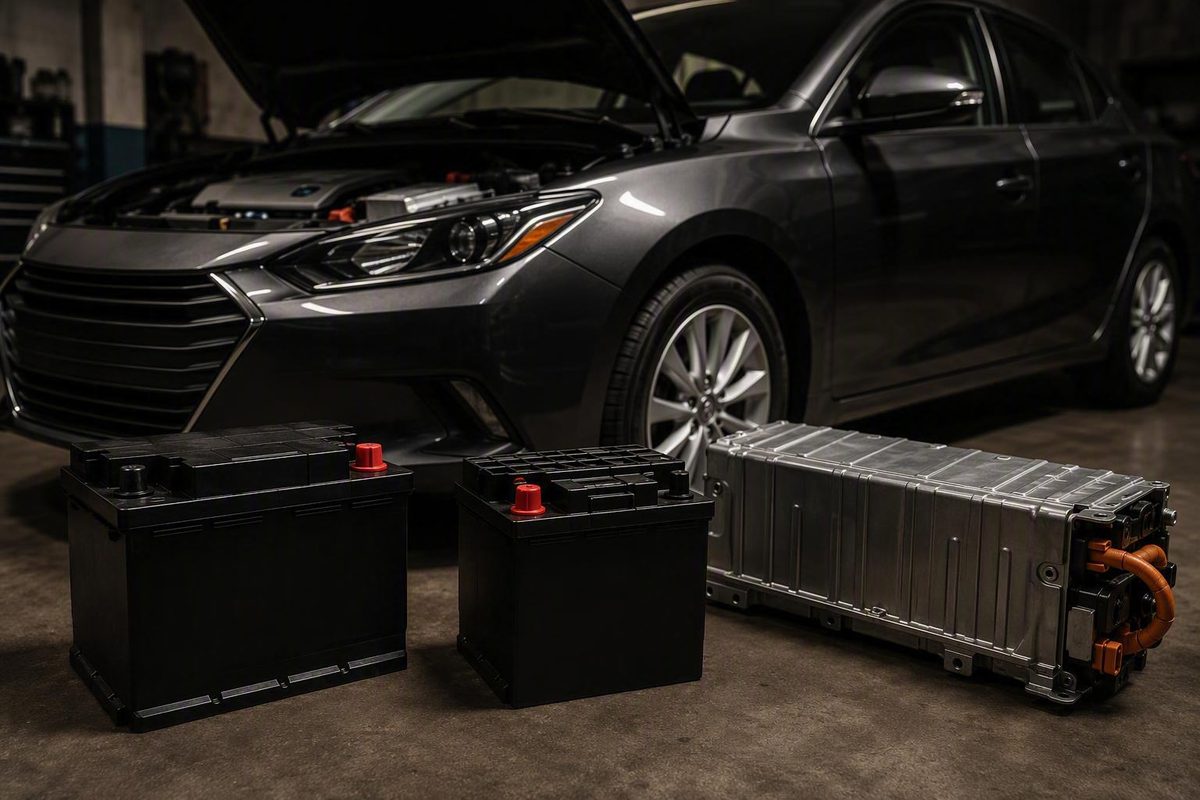
There is no single battery size you should assume fits every 2015 Toyota Camry. First identify whether the car is gasoline-only or hybrid and, on a hybrid, whether you are servicing the 12-volt auxiliary battery or the high-voltage traction pack. Then verify the replacement by VIN, case dimensions, terminal orientation, electrical ratings, and hold-down design before buying.
Start here: identify which Camry battery you need
Choose the correct replacement path before comparing brands or prices:
| Camry and symptoms | Battery system | Next step |
|---|---|---|
| Gasoline Camry with slow cranking or loss of 12-volt power | Conventional 12-volt starting battery | Test the battery and charging system, then confirm replacement fit by VIN and physical details. |
| Camry Hybrid with weak accessory power, no startup, or a suspected auxiliary-battery fault | Auxiliary 12-volt battery | Confirm the diagnosis and hybrid-specific fit, including mounting and any vent connection. |
| Camry Hybrid with hybrid-system warnings or suspected pack failure | High-voltage traction battery | Obtain qualified hybrid-system diagnosis; do not use ordinary 12-volt replacement instructions. |
Engine, trim, hybrid status, and VIN all matter. A 2015 Camry Hybrid LE, for example, is identified in a Toyota dealer parts catalog as a distinct 2.5-liter four-cylinder electric/gas configuration. The catalog selection alone does not provide enough specifications to choose either battery. View the selected Hybrid LE configuration.
A hybrid’s auxiliary battery and traction pack are different components. Hybrid-system warnings therefore should not trigger an automatic purchase of a generic 12-volt battery. Because the traction pack is a high-voltage component, diagnosis and replacement should be handled by qualified professionals. Review the Camry Hybrid traction-pack guidance.
How to verify the correct 12-volt battery fit
Group 24F is a possible search lead for a non-hybrid 2015 Camry SE with a four-cylinder engine, but the support comes from an owner-forum comment framed as a belief—not a confirmed Toyota specification. Do not treat 24F as the universal answer for every 2015 Camry. See the vehicle-specific Group 24F discussion.
A retailer’s 2015 Camry-filtered page displays Groups 24F, 35, 25, and 24. That does not mean those groups are interchangeable or that each product fits every engine, trim, or hybrid configuration; the individual listings still instruct shoppers to verify fitment.
Use this checklist before ordering:
- Confirm the powertrain and trim. Establish whether the car is gasoline-only or hybrid and which battery system needs service.
- Read the installed battery label. Record the group designation, part number, technology, cold-cranking amps (CCA), and reserve-capacity rating if shown. Because a previous replacement may have been incorrect, do not rely on the old battery alone.
- Measure the case. Check length, width, and height, including terminal height and available clearance.
-
Check terminal orientation. Confirm the positive terminal is on the correct side and that the terminal style matches.
-
Inspect the tray and hold-down. The case must sit properly and work with the intended clamp or bracket.
-
Consult the applicable owner documentation or Toyota parts source. Request confirmation tied to the VIN when possible.
- Compare the new and installed batteries before installation. Resolve any difference in size, polarity, terminals, mounting, or technology first.
Match every physical and electrical requirement rather than relying on group number or brand alone.
Compare confirmed-fit choices by specifications, not brand alone
Compare products only after exact fitment has been established. This worksheet allows two or more confirmed candidates to be evaluated side by side without confusing a higher price or CCA rating with better compatibility.
| Candidate | Fit and technology | Performance and condition | Terms and total cost |
|---|---|---|---|
| Battery A | VIN result; dimensions; polarity; hold-down; venting; flooded, EFB, or AGM | CCA; reserve capacity; manufacturing date | Warranty; shelf price; core charge; installation |
| Battery B | VIN result; dimensions; polarity; hold-down; venting; flooded, EFB, or AGM | CCA; reserve capacity; manufacturing date | Warranty; shelf price; core charge; installation |
| Battery C | VIN result; dimensions; polarity; hold-down; venting; flooded, EFB, or AGM | CCA; reserve capacity; manufacturing date | Warranty; shelf price; core charge; installation |
Reject any candidate that fails a physical fit requirement, even if its price, warranty, or CCA rating looks attractive.
As market examples rather than fitment recommendations, one retailer page displayed Group 24F flooded batteries rated from 585 to 750 CCA, a 750-CCA EFB for about $180, and a 710-CCA AGM for about $260 with an advertised four-year warranty. The page also displayed other group sizes, but those products should not be compared until their fit has been confirmed. Review the retailer listings and fitment warnings.
That assortment shows that flooded, enhanced flooded battery (EFB), and absorbed glass mat (AGM) products may appear in a Camry search. It does not establish that EFB or AGM is required for a particular 2015 Camry.
When comparing confirmed-fit choices:
- Require the correct dimensions, polarity, terminal position, hold-down, and any applicable venting.
- Meet or exceed the verified minimum CCA and reserve-capacity requirements.
- Check the manufacturing date rather than assuming all store inventory is equally fresh.
- Distinguish full free-replacement coverage from any later prorated coverage.
- Ask what proof of purchase is required and what exclusions apply.
- Compare the total local cost, including the core deposit and installation, rather than shelf price alone.
A higher price may reflect construction, warranty, brand positioning, or distribution costs rather than better fit or value.
Test the battery and charging system before buying
Slow cranking, dim headlights, corrosion, leakage, and unexplained electrical trouble are reasons to inspect and test the system. They do not prove that the battery itself has failed.
Use a concise diagnostic sequence:
- With the engine off, inspect the battery, terminals, cables, and hold-down.
-
Have serviceable connections cleaned and secured.
-
Obtain a proper battery test.
- If symptoms remain, have the charging system checked.
- Replace the battery only after both the diagnosis and replacement fitment are clear.
A battery-shaped warning light while driving can indicate that the charging system is not maintaining electrical power; it is not definitive proof of battery failure. Reduce unnecessary accessory use and arrange prompt service.
O’Reilly advertises free battery testing at its stores and says customers may bring in the battery or drive to a location for parking-lot testing. Confirm availability and eligibility with the local store before visiting. Check the retailer’s 2015 Camry battery-services page.
What a 2015 Camry battery replacement may cost
Ask for an itemized total that separates:
- Battery-only price
- Installation labor
- Diagnostic or charging-system test fees
- Sales tax
- Delivery or mobile-service charges
- Refundable core deposit
- Any disposal or shop-supply fees
As a location-specific retail example, displayed batteries ranged from roughly $100 to $450, with many listings adding a refundable core deposit of about $22. Prices, inventory, warranty terms, and core charges vary by location and may change, so use these figures only to understand the possible spread—not as a current quote.
A core deposit temporarily increases the checkout total and is generally refunded when the old battery is returned under the seller’s applicable policy. Confirm the return process before leaving the store.
Professional replacement estimates must also be distinguished from battery-only prices. Kelley Blue Book displayed an installed estimate of roughly $275 to $465 near Fairfax, Virginia, including parts and labor. Its dealer estimate was approximately $275 to $325, while its independent-shop estimate was about $395 to $465. These location-specific figures do not establish that one shop type will always cost more or less. Review the location-specific estimate.
A useful quote identifies the exact battery, warranty terms, labor, tax, core charge, testing, and old-battery return process. Do not compare conventional 12-volt replacement costs with a Camry Hybrid traction-pack quote; they concern different components, equipment, and labor.
Safe replacement overview for the conventional 12-volt battery
This procedure applies only to a conventional 12-volt battery whose location and fit have been confirmed. It does not apply to the Camry Hybrid high-voltage traction pack.
Switch off the engine and accessories before beginning. If the battery location, terminal arrangement, mounting hardware, venting, or general configuration differs from what you expected, stop and obtain instructions for that exact vehicle. Do not continue with a leaking or damaged battery, and use professional help if you cannot lift and position it safely.
The supported general sequence is:
- Disconnect the negative cable first.
- Disconnect the positive cable.
- Remove the retaining clamp or hold-down.
- Lift out the old battery.
- Inspect the tray, terminals, cables, and mounting hardware.
- Position the confirmed-fit replacement with the correct terminal orientation.
- Secure the hold-down so the battery cannot move.
- Reconnect the positive cable first.
- Reconnect the negative cable last.
- Verify that the case is secure and both cables are properly seated.
Kelley Blue Book gives the same negative-first removal and positive-first reconnection order.
Use professional service if you cannot identify the terminals, confirm the mounting and vent arrangement, or distinguish a hybrid auxiliary battery from the high-voltage pack. Do not substitute loose mounting, stretched cables, or an incorrectly oriented battery for a confirmed fit.
Return the old battery through the seller’s core-return process or take it to an appropriate battery recycler. Keep the receipt until any core refund has been processed.
How long does a 2015 Toyota Camry battery last?
A general planning range for a conventional automotive battery is about three to five years, but it is not a guaranteed replacement interval.
Age is a reason to test more frequently, not a diagnosis by itself. Have the battery and charging system checked if cranking slows, the battery repeatedly loses charge, or corrosion or leakage appears. On a Camry Hybrid, first determine whether the symptoms involve the auxiliary 12-volt battery or the high-voltage traction pack.