
21 min read ·
How to Choose and Replace the Right Battery for Your Acura
Retail battery examples ranged from about $100 to $380 before a $22 refundable core deposit, with fitment checks, AGM guidance and safe DIY steps.
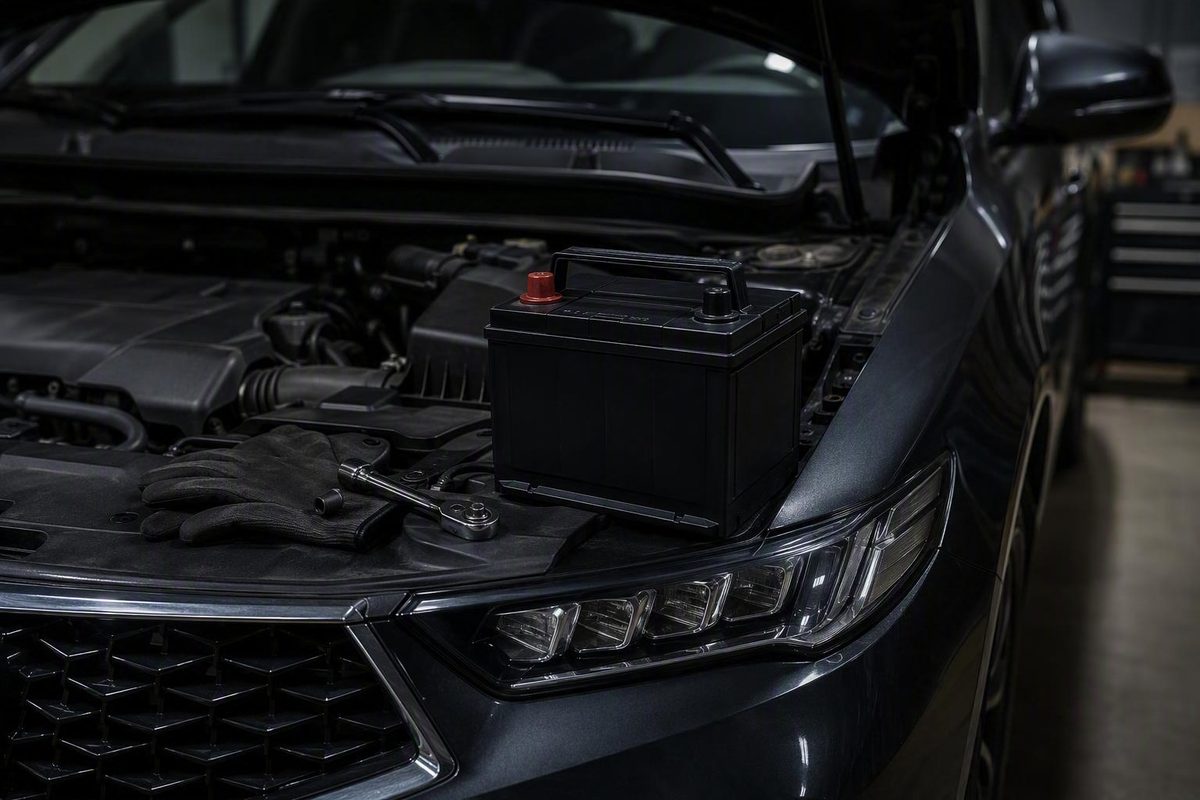
An Acura battery replacement starts with the exact vehicle—not the Acura badge. Before buying, confirm which battery system is involved, test the existing battery and charging system, and verify the year, model, trim, engine, equipment, battery dimensions, terminal layout, technology, cold-cranking amps, reserve capacity, and hold-down design.
This is a general buying, diagnostic, and replacement guide for conventional Acura 12-volt batteries. It is not a model-by-model fitment table or a substitute for current Acura service information. Battery access, torque specifications, sensors, and post-installation requirements remain vehicle-specific.
A fitment-first approach helps prevent three costly mistakes:
- Buying a battery that cannot be mounted or connected correctly
- Replacing a serviceable battery when another electrical component is at fault
- Treating a hybrid propulsion battery like an ordinary 12-volt battery
First identify which Acura battery you are replacing
This guide concerns the conventional 12-volt battery that supports starting or system startup and powers low-voltage electronics. It does not explain how to remove, open, repair, or replace a high-voltage hybrid propulsion battery.
Article scope
Covered: Conventional Acura 12-volt starting and electrical-system batteries Not covered: High-voltage propulsion-pack removal, repair, or installation
A hybrid Acura can have both:
- A conventional 12-volt battery supporting control modules, locks, lighting, accessories, and vehicle startup
- A separate high-voltage battery storing energy for hybrid propulsion
Dealership guidance likewise distinguishes the conventional 12-volt battery from a hybrid or electric vehicle’s high-voltage propulsion battery and notes that the latter requires a different process and specialized equipment. See Northeast Acura’s explanation of the two battery systems.
A no-start condition, clicking, dim lighting, or erratic electronics can justify testing the 12-volt system, but symptoms alone do not establish that the battery has failed. Test the battery, charging system, cables, and connections before ordering a replacement.
The price difference makes correct identification especially important. In listings reviewed for this article, Greentec Auto advertised high-voltage packs for 2012–2015 Acura ILX Hybrid and RLX Hybrid applications at $1,495 to $2,095. The displayed prices varied by selected option and did not clearly establish that installation, taxes, or every configuration was included. Those prices are not comparable with ordinary 12-volt battery prices. Review the vendor’s Acura hybrid-pack listings.
Do not apply the 12-volt replacement sequence in this article to a high-voltage pack. If a hybrid warning appears or you cannot determine which battery system caused the problem, record the exact warning, consult the owner’s manual, and arrange qualified diagnosis before shopping.
How to find the correct battery for an exact Acura
There is no universal “Acura battery.” Fitment can change with model, year, generation, trim, engine, drivetrain, equipment package, and electrical system.
A battery that fits one MDX may not fit another MDX generation. A battery specified for an RDX may be wrong for a TLX, ILX, Integra, or older Acura sedan even when the voltage and case appear similar.
Because the available evidence does not provide authoritative configuration-level fitment for every Acura, this article cannot identify your exact battery from the model name alone. Use the following verification process instead.
- Consult vehicle-specific documentation. Check the owner’s manual and, when necessary, current Acura parts or service information for the exact year, model, trim, engine, and equipment.
- Read the installed battery label. Record the group size, technology, CCA, reserve capacity, terminal arrangement, and part number. Do not assume the installed battery is correct if a previous owner may have changed it.
- Use a current fitment catalog. Enter the complete vehicle configuration. A VIN-based lookup may help resolve uncertain engine or trim information, but compare the result with the vehicle documentation and physical battery before purchasing.
Specifications that must agree
Compare all of the following:
- BCI group size
- Case length, width, and height
- Positive and negative terminal positions
- Terminal type and polarity
- Battery technology
- Cold-cranking amps
- Reserve capacity
- Hold-down location and design
- Clearance around covers, braces, cables, ducts, and sensors
The BCI group size is a standardized code describing general case dimensions and terminal positioning. It is primarily a fitment designation, not a complete performance rating. Batteries in the same group can have different CCA ratings, reserve capacities, warranties, and internal construction.
Cold-cranking amps, or CCA, describe cold-weather starting output. Reserve capacity estimates how long a fully charged battery can continue supplying power when the alternator is not providing output. Neither specification makes up for an incorrect case, reversed terminal layout, incompatible hold-down, or unsuitable battery technology.
Retail and reference sources associate Acura applications with sizes including 24, 24F, 47/H5, 48/H6, 51R, and 94R/H7. These are examples, not a fitment answer. AutoZone’s broad Acura category contains different sizes, technologies, CCA ratings, and warranties, and its listings instruct shoppers to check each product against a specific vehicle. Review the Acura-category listings and fitment prompts.
MDX and RDX reports demonstrate the variation rather than resolving it. Third-party material and owner discussions mention H6, H7, and 24F batteries in different generations or configurations. An RDX owner, for example, reported installing an H6/LN3/Group 48 AGM battery rated at 760 CCA, but that anecdote does not establish fitment for another RDX—or any other Acura. Read the model-specific RDX owner report.
Do not order from an Acura category page alone
A make-level shopping page can be a useful starting point, but it may combine batteries intended for decades of Acura vehicles and multiple powertrains. Complete the exact-vehicle lookup before placing an order.
Before accepting a battery:
- Check its manufacture date or date code.
- Inspect the case for swelling, cracks, leakage, or impact damage.
- Inspect the posts and terminals for damage.
- Compare the label with what you ordered.
- Compare the new and old batteries for dimensions, polarity, terminal position, and hold-down features.
- Confirm the technology, CCA, and reserve capacity.
A matching group-size label is not permission to ignore the other specifications. The battery must also connect correctly, remain securely mounted, and meet the vehicle’s technology and output requirements.
Does your Acura need AGM or a flooded battery?
Flooded lead-acid and absorbed glass mat batteries are different designs. The least expensive battery that physically fits is not automatically an acceptable substitute.
A conventional flooded lead-acid battery contains liquid electrolyte and is common in vehicles with conventional starting and electrical demands. It is generally less expensive than AGM.
An absorbed glass mat battery, or AGM, retains electrolyte in absorbent separators. AGM batteries are sealed and spill-resistant and are commonly used where electrical demand, frequent cycling, or automatic start-stop operation calls for that design. These general characteristics do not mean every recent Acura requires AGM.
The cautious rule is:
Match the battery technology installed or specified for the exact vehicle. If the Acura was factory-equipped with AGM, use another AGM unless authoritative vehicle-specific information expressly permits a different type.
Commercial fitment guidance similarly recommends replacing a factory AGM battery with AGM and emphasizes that group size addresses dimensions and terminal placement rather than all performance requirements. See the battery-technology and fitment guidance.
Do not infer the required technology solely from the vehicle’s age, luxury branding, or number of electronic features. Nor should you assume that installing AGM is appropriate for every older Acura. Use the factory label and exact-vehicle documentation.
Those sources carry more weight than:
- An Acura-wide product page
- A forum recommendation
- A battery chosen for another model year
- A claim that one size fits most vehicles in a generation
- A salesperson’s recommendation made without the complete configuration
Even after confirming the technology, verify:
- Case dimensions
- Terminal orientation
- CCA
- Reserve capacity
- Hold-down compatibility
- Cable reach
- Sensor arrangement
- Clearance around covers and intake components
The available evidence does not include independent testing sufficient to rank battery brands objectively. Correct fitment, suitable technology, battery freshness, warranty terms, seller support, and complete installed cost are more defensible buying criteria than a universal “best Acura battery” label.
Test before replacing: battery failure versus another electrical problem
Request testing if you notice:
- Slow or labored cranking
- Clicking when the start button or key is used
- Intermittent starting
- Dim or flickering headlights or interior lights
- Screens, memory functions, or electronics behaving erratically
- Repeated need for jump-starts
- Automatic start-stop becoming unavailable
- Corrosion around the terminals
- Visible leakage
- A swollen or distorted case
These are clues, not proof. Similar symptoms can result from a discharged but otherwise serviceable battery, loose or corroded connections, damaged cables, a starter fault, weak alternator, wiring problem, or an electrical load that remains active after shutdown.
Understand the battery and alternator’s different jobs
In a conventional starter system, the battery supplies the current used to crank the engine. In a hybrid, the 12-volt battery may instead support control electronics and system startup; the exact arrangement depends on the vehicle.
Once a conventional engine is running, the alternator normally supplies electrical loads and recharges the 12-volt battery. That distinction explains why a new battery does not necessarily solve repeated discharge.
A battery warning light should not automatically be interpreted as an instruction to replace the battery. It can indicate a charging-system problem involving the alternator, drive belt, wiring, connections, or related components.
What a useful diagnosis includes
Ask for:
- A battery-state and health test. This checks whether the battery can hold charge and provide adequate output.
- A charging-system test. This evaluates whether the alternator and regulation system recharge the battery while the engine operates.
- A cable and terminal inspection. Loose clamps, corrosion, poor grounds, and damaged conductors can imitate or contribute to battery failure.
- A hold-down inspection. The battery should remain secure in its tray.
- A parasitic-draw test when appropriate. This is particularly relevant when a charged or newly installed battery repeatedly dies overnight or while the vehicle sits.
Northeast Acura describes this test-first approach and notes that a new battery can still discharge because of a weak alternator, loose or corroded connections, or an ongoing parasitic draw. Review its battery and charging-system diagnostic outline.
Battery age is relevant, but it is not a diagnosis. An older battery with emerging symptoms deserves prompt testing. Reaching a particular birthday does not prove failure, while a newer battery can still be defective, undercharged, damaged, or drained by another fault.
Stop if the battery appears dangerous
Dealership safety guidance specifically warns against jump-starting a battery that is leaking, swollen, or producing a sulfur-like odor.
What Acura battery replacement costs
There is no dependable single national Acura battery replacement price. Budget for a stack of possible charges:
- Battery
- Installation labor
- Battery and charging-system diagnosis
- Sales tax
- Refundable core deposit
- Terminal cleaning
- Cable, clamp, or terminal repair
- Alternator or charging-system repair
- Parasitic-draw diagnosis
- Post-installation checks
- Mobile-service charges, where applicable
If the original complaint comes from a charging fault or persistent electrical drain, it may be only one part of the repair.
Current price examples—not universal quotes
Prices and commercial terms below were checked on September 6, 2026 and can change by location, inventory, and date.
Visible AutoZone Acura-category listings ranged from $99.99 to $379.99, with fully displayed products adding a $22 refundable core deposit. The listings covered different group sizes, battery technologies, CCA ratings, and warranties and were not all confirmed for one vehicle. Compare the displayed Acura-category retail prices.
Northeast Acura in Latham, New York advertised $150 to $300 for commonly installed replacements, depending on model and battery type. It also stated that replacement often takes 30 to 60 minutes when the correct battery is in stock. Those figures are one provider’s estimates, not national prices or guaranteed completion times.
Park Place Acura published a general estimate that labor may add approximately $20 to $40, while noting that installation can sometimes be included with the battery purchase. Access, corrosion, shop policy, and location can change the charge. See the dealership’s general cost discussion.
A commercial MDX/RDX guide estimated $220 to $350 for an aftermarket AGM battery, $300 to $500 or more for dealer replacement, and $50 to $150 for labor. Treat these as seller-published planning figures—not market averages—and confirm whether tax, diagnosis, installation, a core charge, and warranty coverage are included. Review the commercial MDX/RDX estimates.
How a core charge works
Ask whether the quoted total:
- Includes or separately lists the core charge
- Credits the old battery immediately
- Requires a later return
- Has a return deadline
- Requires a receipt
- Accepts an old battery of a different brand or specification
Returning the battery also places it into an appropriate recycling channel rather than household waste.
Ask for an exact, complete quote
Before authorizing replacement, ask:
- Is fitment confirmed for my VIN or complete vehicle configuration?
- Is the battery flooded, enhanced flooded, or AGM?
- What are its group size, CCA, and reserve capacity?
- Does the price include battery testing?
- Does it include charging-system testing?
- Is installation labor included?
- Is terminal cleaning included?
- Are tax and the core deposit included?
- Is old-battery recycling included?
- Will charging output be checked afterward?
- Are required post-installation procedures included?
- What is the free-replacement warranty period?
- Is later coverage prorated?
- Is warranty labor included?
- What proof of purchase is required?
Anecdotal owner-reported prices
Owner reports can provide context but are not representative pricing. In a January 2025 RDX discussion, one owner reported approximate quotes of $178 from a warehouse club or mass retailer, $244 from parts retailers, and $300 from a dealer. In a separate MDX discussion, an owner reported paying about $250 at an oil-change shop. The batteries, dates, locations, installation terms, and warranties were not equivalent. Read the MDX owner discussion and its limitations.
Compare like-for-like batteries and complete installed totals, not just the smallest advertised number.
DIY, parts store, independent shop, or Acura dealer?
The right installation option depends on access, diagnostic uncertainty, battery condition, electronics, and your ability to follow vehicle-specific instructions—not only labor price.
| Option | Main advantage | Main limitation | Best suited to |
|---|---|---|---|
| DIY | Lowest potential labor cost and direct control | Owner assumes responsibility for fitment, safety, access, and reassembly | Straightforward access and a confirmed vehicle-specific procedure |
| Auto-parts retailer | Convenient testing and possible installation with purchase | Installation is not guaranteed at every location or for every vehicle | Accessible batteries without severe corrosion or unusual procedures |
| Warehouse or mass retailer | Potentially competitive battery price | Installation and fitment support vary | Owners who have already confirmed the complete specification |
| Independent shop or mobile provider | Can diagnose related electrical faults | Acura-specific familiarity and pricing vary | Uncertain causes, repeated discharge, or obstructed access |
| Acura dealer | Access to model-specific information and warranty review | May cost more than retail or DIY | Persistent warnings, warranty questions, or unclear procedures |
DIY replacement
DIY may be reasonable only when you can:
- Confirm the exact battery
- Lift and carry it safely
- Access it without improvising around fragile components
- Isolate the disconnected cables
- Manage ordinary corrosion safely
- Remove and reinstall the hold-down correctly
- Avoid disturbing sensors or wiring
- Obtain instructions for the exact model and year
- Complete required post-installation checks
Choose professional installation if access is obstructed, the battery or cables are damaged, corrosion is severe, a terminal-mounted sensor is present, torque specifications are unavailable, or you cannot perform a controlled lift.
Auto-parts retailer
Some retailers advertise complimentary testing and installation with a battery purchase at participating locations. AutoZone says those services are available at most locations, but that does not guarantee installation for every Acura or store. Review the retailer’s general testing and installation policy.
A store may decline installation because of:
- Obstructed access
- Severe corrosion
- A damaged or leaking battery
- Terminal-mounted sensors
- Extensive trim or duct removal
- Unclear post-installation requirements
- Staffing or local policy
Call ahead with the complete vehicle configuration. Ask whether the technician will test the battery and charging system first, clean the connections, reinstall removed components, and verify charging afterward.
Warehouse or mass retailer
Warehouse clubs and mass retailers may offer competitive battery pricing, but installation, appointments, warranty handling, and fitment assistance differ by chain and location.
This option works best when you have already confirmed the complete specification. Check the manufacture date as well as price; battery freshness is a legitimate buying consideration.
Independent shop or mobile provider
An independent shop is often a strong choice when the cause is uncertain. A qualified shop can test the battery and alternator, inspect connections, investigate repeated discharge, and repair damaged cables or terminals.
A mobile provider adds convenience, but confirm that the service includes diagnosis rather than battery delivery alone. Installing a new battery will not correct a weak alternator or ongoing parasitic draw.
Acura dealer
A dealer may offer familiarity with Acura layouts, access to model-specific information, warranty-status review, and diagnosis of persistent warning messages. Those are potential advantages, not proof that dealer installation is necessary for every vehicle.
Dealer service is particularly worth considering when:
- The original or replacement battery may be under warranty
- The battery is difficult to access
- A terminal sensor is present
- Warning messages persist
- The vehicle repeatedly loses charge
- The required post-installation procedure is unclear
- The problem may involve more than the battery
One dealership advertised a typical 30-to-60-minute service window when the appropriate battery is in stock, but actual timing depends on diagnosis, configuration, inventory, workload, and related repairs.
Whichever provider you choose, ask whether it will test the old battery and charging system before replacement and verify charging output afterward.
General Acura 12-volt battery replacement sequence
This is a deliberately limited, generic sequence. It is not a substitute for Acura service instructions for the exact model and year. Battery location, covers, sensors, access steps, torque specifications, and initialization procedures may differ.
If you cannot obtain or follow the vehicle-specific procedure, use professional service.
1. Prepare and inspect
Park securely, select Park, apply the parking brake, and switch off the ignition and accessories. Keep the key or fob away as appropriate. Wear eye protection and suitable gloves, remove jewelry, and control metal tools.
Before disconnecting anything:
- Verify the replacement battery’s technology, dimensions, polarity, terminal layout, and hold-down features.
- Identify the positive and negative terminals.
- Inspect the old battery for swelling, cracks, leakage, damaged posts, or severe corrosion.
- Stop and obtain professional help if the battery appears unsafe.
Generic replacement guidance recommends checking the owner’s manual, using appropriate safety precautions, and confirming fitment before starting. See Kelley Blue Book’s general battery-selection and replacement guidance.
2. Disconnect negative, then positive
For an ordinary 12-volt replacement, the general order is:
- Disconnect the negative terminal first.
- Isolate the negative cable so it cannot return to the post.
- Remove the positive-terminal cover, if present.
- Disconnect the positive terminal second.
If a sensor or wiring assembly is attached to a terminal, stop and consult the exact procedure rather than pulling or twisting the assembly.
3. Remove only documented obstructions
Some Acura batteries are directly accessible; others may have covers, ducts, braces, or trim above or around them. Remove only components identified in the correct procedure.
Do not assume that access is identical across the MDX, RDX, TLX, ILX, Integra, or a related Honda model. Keep fasteners organized and note the routing of cables, clips, and covers.
Remove the hold-down, then lift the battery upright using a stable grip or its intended handle. Stop if the battery is too heavy or awkward to remove safely.
4. Inspect the tray and connections
With the battery removed:
- Inspect the tray for corrosion, damage, and debris.
- Check cable ends and clamps for cracks or excessive material loss.
- Inspect the hold-down hardware.
- Clean appropriate connection surfaces using battery-safe methods.
- Make sure components are dry and correctly routed.
- Repair damaged cables or terminals rather than clamping them onto the new battery.
Severe corrosion or damaged wiring calls for professional repair.
5. Install and secure the replacement
Place the new battery in the correct orientation and verify polarity again. Reinstall the hold-down so the battery cannot move.
Do not invent a torque value or borrow one from another Acura or Honda. Use service information for the exact vehicle’s terminal and hold-down specifications.
6. Reconnect positive, then negative
The general reconnection order is:
- Connect the positive terminal first.
- Reinstall its protective cover.
- Connect the negative terminal last.
- Reconnect any documented sensor or wiring connection exactly as specified.
Generic retailer guidance supports the sequence of negative off first and reconnected last. Review the general replacement order.
7. Reassemble, test, and recycle
Reinstall all covers, ducts, braces, clips, and trim. Confirm that no tool or loose hardware remains in the work area.
Start the vehicle and check:
- Cranking or startup behavior
- Warning messages
- Lighting
- Infotainment
- Climate controls
- Automatic start-stop availability
- Unusual idle or electrical behavior
Verify charging-system operation using the appropriate procedure or have the installer do so. A successful start alone does not establish that the charging system is healthy.
Return the old lead-acid battery to a retailer, service provider, or approved recycling channel. Retain the receipt if it is needed for the core refund or warranty.
After installation: settings, warnings, lifespan, and warranty
Replacement is not complete until the battery is secure, the charging system is operating correctly, and the vehicle behaves normally.
Confirm:
- Reliable starting or system startup
- Normal lighting and electronics
- Secure terminal connections
- A secure hold-down
- Proper charging-system operation
- No persistent battery or charging warning
- No repeated overnight discharge
- No loose cables, covers, or ducts
Settings and relearn procedures vary
Disconnecting power can affect retained settings or system availability. Depending on the model and year, possible effects may involve:
- Clock and saved preferences
- Infotainment reconnection
- Security-code prompts
- Automatic start-stop availability
- Idle behavior
- Power-window initialization
- Terminal-mounted battery sensors
- Other initialization or relearn procedures
Do not assume every Acura requires battery registration or coding. Equally, do not assume that no Acura ever needs initialization, a reset, or a relearn. Available third-party guidance says special programming is normally unnecessary for certain MDX and RDX applications, but it does not settle the requirement for every Acura configuration.
If warnings or unavailable systems persist, check the owner’s manual and obtain model-specific diagnosis. Repeatedly disconnecting the battery is not a reliable repair strategy.
How long the replacement may last
Approximately three to five years is a cautious planning range for many 12-volt car batteries, not a mandatory replacement interval. Kelley Blue Book gives an average as high as six years under favorable conditions while noting that harsh conditions may reduce life to three or four years. See Kelley Blue Book’s battery-life guidance.
Battery life may be shortened by:
- High ambient or under-hood temperatures
- Severe cold
- Repeated short trips
- Long periods of inactivity
- Heavy engine-off electrical use
- Frequent deep discharge
- Loose or corroded connections
- Charging-system faults
- Persistent parasitic draw
- Vibration from an insecure hold-down
Use age as a reason to test more frequently, especially before demanding travel or when symptoms emerge. Do not replace a functioning battery solely because it crossed a calendar threshold, and do not assume a newer battery cannot fail.
Check two possible warranties
Before paying, check:
- Vehicle warranty coverage, which may apply to the original battery depending on age, mileage, terms, and exclusions.
- Replacement-battery coverage, which may apply to a battery purchased previously.
Compare more than the largest number on the label. Determine:
- Free-replacement period
- Prorated period
- Labor and installation coverage
- Diagnostic coverage
- Exclusions
- Proof-of-purchase requirements
- Transferability
- Seller or installer requirements
- Credit-calculation method
As a dealership-published example checked on September 6, 2026, Acura of Escondido advertised a 100-month limited warranty for an Acura Genuine Battery purchased from an Acura dealer. Its summary stated that a defective battery, labor, and installation were covered at no charge during the first 36 months, followed by age-based credit during the remaining 64 months. Eligibility, exclusions, and complete terms require confirmation. Review the dealership’s warranty summary.
A long headline warranty may therefore include a much shorter no-cost replacement period followed by prorated credit.
Acura battery replacement FAQ
What battery size does my Acura need?
It depends on the exact year, model, trim, engine, generation, and equipment. Acura-associated examples include Groups 24, 24F, 47/H5, 48/H6, 51R, and 94R/H7, but none is confirmed for your vehicle without a complete lookup.
Check vehicle-specific documentation, read the installed battery label, and verify the full configuration in a current fitment catalog. Match dimensions, terminal orientation, technology, CCA, reserve capacity, and hold-down design—not just the group number.
How much does Acura battery replacement cost?
Retail examples reviewed on September 6, 2026 ranged from about $100 to $380 for the battery, before a displayed $22 refundable core deposit. One Acura dealership advertised approximately $150 to $300 for commonly installed replacements. These are bounded examples, not national quotes.
The complete invoice may include testing, labor, tax, a core deposit, terminal cleaning, and repairs to cables, connections, the alternator, or a parasitic drain. Request an itemized quote for the exact vehicle.
Does an Acura battery need to be programmed or registered after replacement?
Not every Acura requires battery registration or coding, but post-installation requirements can vary by model, year, equipment, and electrical architecture. Settings may need restoration, and some systems may require initialization, relearning, or diagnosis if warnings persist.
Use the exact owner’s or service information rather than relying on an Acura-wide answer.
How long does an Acura 12-volt battery usually last?
About three to five years is a useful general planning range, although some batteries last less and general estimates can extend to approximately six years under favorable conditions.
Temperature extremes, short trips, inactivity, electrical loads, charging faults, poor connections, and deep discharge can materially change battery life. Test an aging battery rather than replacing it automatically on a fixed date.
Is an Acura hybrid battery the same as the 12-volt battery?
No. A hybrid Acura can have a conventional 12-volt battery for low-voltage systems and a separate high-voltage propulsion battery. Their prices, hazards, diagnostic equipment, and replacement procedures differ.
Do not use ordinary 12-volt replacement instructions on a high-voltage pack. Arrange appropriately qualified service for high-voltage diagnosis or replacement.
Fitment-first Acura battery replacement checklist
- Identify whether the problem concerns the conventional 12-volt battery or a high-voltage propulsion pack.
- Test the battery, charging system, cables, and connections before replacing parts.
- Verify the exact group size, dimensions, terminal layout, technology, CCA, reserve capacity, and hold-down using vehicle-specific information.
- Compare complete installed prices, core charges, and practical warranty coverage.
- Choose professional service when access, damage, corrosion, sensors, repeated discharge, or post-installation requirements are unclear.
The correct Acura battery is determined by the exact vehicle—not by the Acura badge alone.