
3 min read ·
BMW Key Fob Battery: Match the Battery to the Key
A BMW key may use a CR2032, CR2450 or rechargeable battery. Identify the physical key and confirm the old cell before opening it.
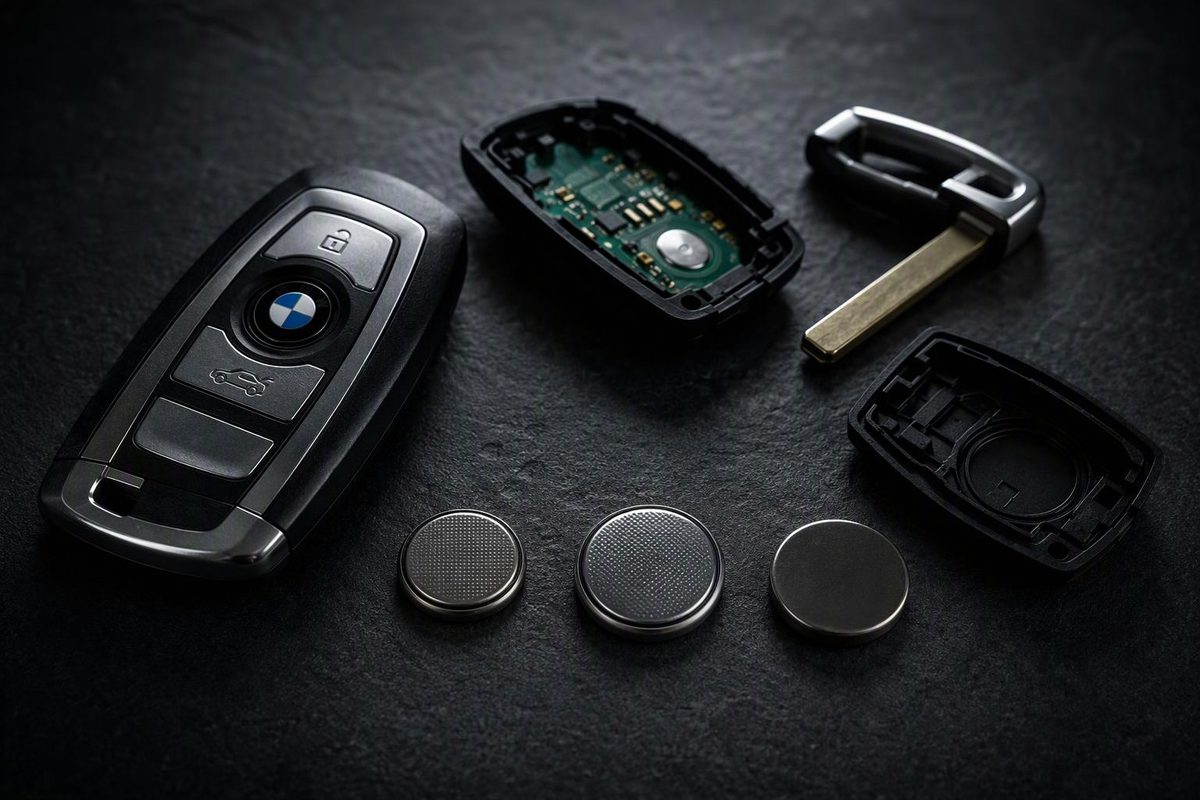
BMW key batteries are not universal. BMW USA documents one CR2032 coin cell for a fob with a removable valet key and rear cover. BMW’s model-dependent guidance also identifies CR2450 as a usual key-battery type, while a BMW Display Key is charged rather than opened for a routine coin-cell replacement.
The reliable buying rule is simple: match the complete number on the installed battery or check the manual for the vehicle and key. Do not order by BMW model name alone. BMW USA provides digital manuals by 17-digit VIN for supported model years (BMW USA).
Identify the key before buying a battery
| Observable key design | Power source or likely battery | Next step |
|---|---|---|
| Removable metal valet key with a snap-off rear housing | One CR2032 in BMW USA’s documented design | Follow the rear-cover procedure below. |
| Rear cover with a battery carrier that slides out from the side | Usually CR2032 or CR2450 | Read the old cell or vehicle manual before buying. |
| BMW Display Key with a screen | Rechargeable | Charge it; do not treat it as a routine coin-cell replacement. |
| Key with no obvious removable battery cover | Not established from appearance alone | Check the manual rather than prying open the housing. |
BMW says its carrier-style replacement process varies by model and normally uses the same battery already in the key, usually a CR2032 or CR2450. For that documented carrier, the positive terminal faces down (BMW). BMW USA’s separate CR2032 procedure instead says to install the new cell in the same position as the removed one (BMW USA). Consequently, “positive side up” is not a safe instruction for every BMW key.
A BMW Display Key can be charged in a compatible vehicle’s wireless charging tray with its lock button facing up. BMW also documents charging through the Micro-USB port on the key’s left side (BMW USA).
Replace a BMW key-fob coin cell
Stop if the key has a display, the housing has no intended battery access, or the new cell’s code does not exactly match the old one.
- Prepare the matching cell. Work over a clear surface. A small flat-blade screwdriver or plastic opening tool may be useful, depending on the key.
- Remove the integrated metal key, if fitted. Press its release and pull it out.
- Open only the designed battery access. For BMW USA’s CR2032 design, remove the rear cover. For the carrier design, hold the rear button, move the cover as directed and slide the carrier out from the side.
- Record the code and orientation. Photograph the installed battery before removing it. Match the full code—do not substitute a CR2032 for a CR2450 or vice versa.
- Release the old cell gently. BMW USA specifies a small flathead screwdriver for releasing the CR2032 from its clips. Avoid bending the contacts or gouging the housing.
- Install the new cell in the same orientation. Seat it fully under the retainers without forcing it.
- Close the housing. Refit the carrier or rear cover, then reinstall the metal key. The edges should sit flush and the clips should engage.
- Test the key. Check lock, unlock, trunk and panic functions where fitted, followed by passive entry and vehicle starting.
If the BMW key still does not work
Check these points in order:
- Confirm that the new cell’s code matches the removed battery.
- Reopen the key and verify the battery’s position and polarity.
- Check that the cell sits beneath the contacts and that no contact was displaced.
- Make sure the cover is completely closed.
- Try another new battery from an intact package.
- Test the spare key. If both keys fail, the fault may be on the vehicle side rather than in one key.
BMW similarly advises checking battery position and polarity, trying another new battery, and contacting a BMW service partner if the problem continues (BMW).
If a weak key is not recognized, BMW documents an emergency-detection method that involves holding the back of the key against a marked point on the steering column (BMW). Check the vehicle-specific manual for the exact location and starting sequence.
Secure the removed battery immediately. The U.S. Consumer Product Safety Commission warns that a swallowed coin cell can cause severe injury and advises covering a removed cell’s terminals with non-conductive tape before taking it to a battery-collection center (CPSC). Keep loose cells and an opened key away from children.