
3 min read ·
How to Change a Subaru Key Fob Battery Without Guessing the Cell
Identify the Subaru fob and battery, open the correct seam, preserve polarity, reassemble it and troubleshoot a remote that still does not work.
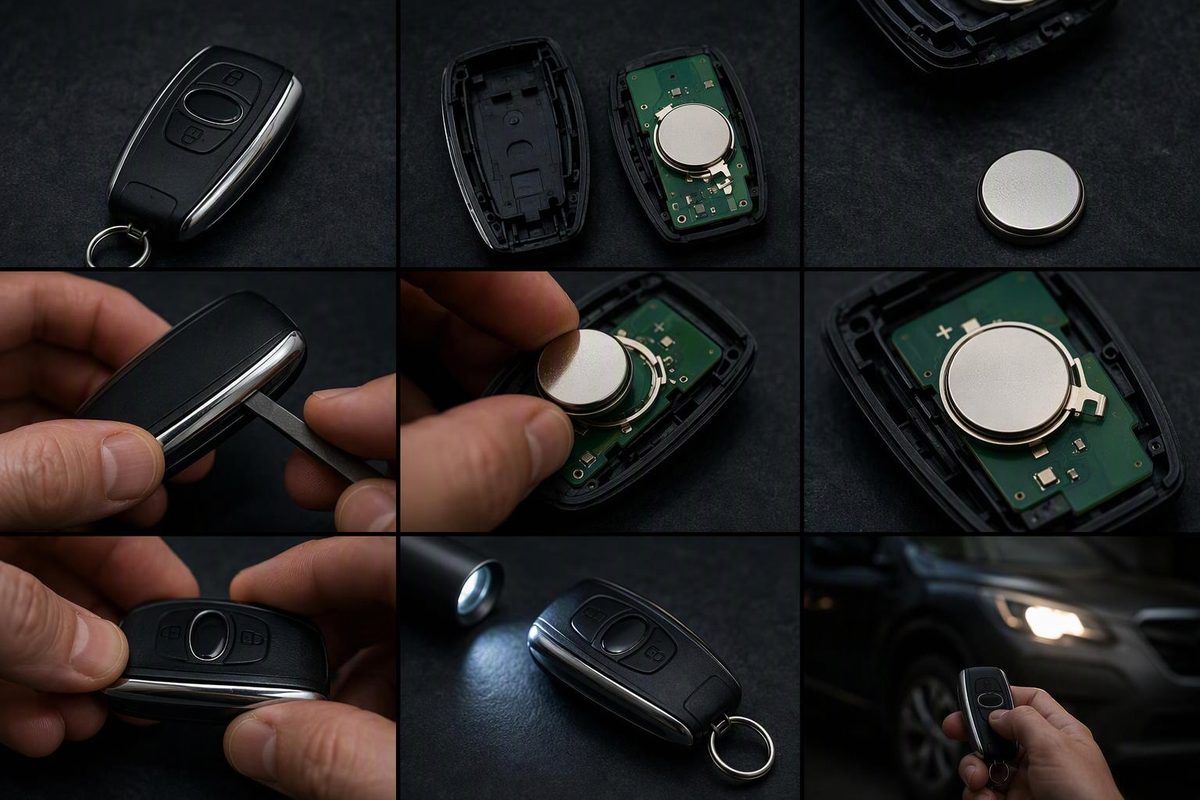
Subaru key fobs do not all use the same battery or opening method. A recent push-button-start access fob may take a CR2032, while a physical-key transmitter may use a CR2025 or CR1620 depending on its year and design. Read the code on the installed coin cell—or check the owner’s manual for the exact year, model and key type—before buying a replacement.
For example, the 2025 Crosstrek manual specifies a CR2032 for its access key fob but a CR2025 for its physical-key transmitter. A 2016 Outback manual instead specifies a CR1620 for the physical-key transmitter. That variation makes the fob itself a better guide than a broad model-name compatibility list (2025 Crosstrek owner’s manual; 2016 Outback owner’s manual, p. 520).
Before opening the fob
You will usually need:
- The exact replacement coin cell
- A small flat-head screwdriver
- Vinyl tape or a thin cloth to cover the screwdriver tip
- A clean, well-lit work surface
Take a photo as soon as the old battery is visible. It records the cell code and polarity before anything is disturbed. Avoid damaging the circuit board or bending the battery contacts. Subaru’s 2025 Crosstrek instructions also say to discharge static electricity first, use a new same-or-equivalent battery, keep the battery and loose parts away from children, and confirm operation afterward (2025 Crosstrek owner’s manual).
Push-button-start access fob: documented CR2032 procedure
Use this sequence only if the casing matches the access fob with a removable emergency key. It is the documented procedure for the 2025 Crosstrek and is also described by a Subaru retailer for the corresponding fob design (Subaru North Orlando).
- Remove the emergency key. Press the release button and pull the metal key from the fob.
- Open the cover. Wrap a small flat-head screwdriver in vinyl tape or cloth. Insert it into the gap exposed by removing the emergency key, then twist gently to separate the case.
- Remove the old cell. Use the protected screwdriver carefully, without levering against the circuit board or bending a contact.
- Install the new battery. On this documented CR2032 design, the positive (+) side faces upward.
- Close the fob. Align the projections and recesses, then press around the perimeter until the case is evenly seated.
- Reinsert the emergency key and test lock, unlock, panic and rear-gate buttons, as fitted.
Stop if the case does not release with light pressure. A hidden screw, a different opening notch or an aftermarket shell means this may not be the correct procedure.
Physical-key transmitter: check the year before proceeding
A Subaru key with an exposed metal blade and buttons in the plastic head is assembled differently. For the physical-key transmitter documented in the 2025 Crosstrek manual, Subaru says to:
- Open the key head with a flat-head screwdriver.
- Remove the small transmitter case from the key head.
- Release the hooks to open that inner case.
- Fit a CR2025 with the negative (−) side facing upward.
- Reassemble the transmitter case and key head.
- Press either the lock or unlock button six times to synchronize the transmitter.
Those details are not universal. The 2016 Outback manual calls for a CR1620, also with its negative side up, followed by the same six-button-press synchronization step (2016 Outback owner’s manual, p. 520). Match the old battery’s full code rather than substituting a coin cell that merely has a similar diameter.
If the Subaru key still does not work
Reopen the fob once and check the simple items:
- The battery code exactly matches the removed cell.
- Polarity matches the original position or vehicle manual.
- The cell sits under the retaining contacts rather than on top of them.
- No contact is flattened, bent or contaminated.
- The circuit board and rubber button pad are seated correctly.
- Every case clip is closed and the emergency key is fully inserted.
- A physical-key transmitter has been synchronized if its manual requires it.
Test the spare key if available. If the spare works but the serviced fob does not, the fault is probably confined to the serviced fob, its battery or the installation. If neither key works—or if the trouble followed water exposure, an impact or visible corrosion—the problem may not be the coin cell. A Subaru retailer or automotive locksmith can test the remote before you order a replacement.
Do not attempt circuit-board repair or buy a new remote until the battery number, orientation, contact position and any model-specific synchronization step have been checked. The same identify-before-opening principle applies when changing a VW key-fob battery.