
4 min read ·
Find the Right Battery for a High-Top Chevy Express
Identify the correct Chevy Express high-top battery by year, engine, label and wiring, with Group 78 fitment checks, current prices and safe swap steps.
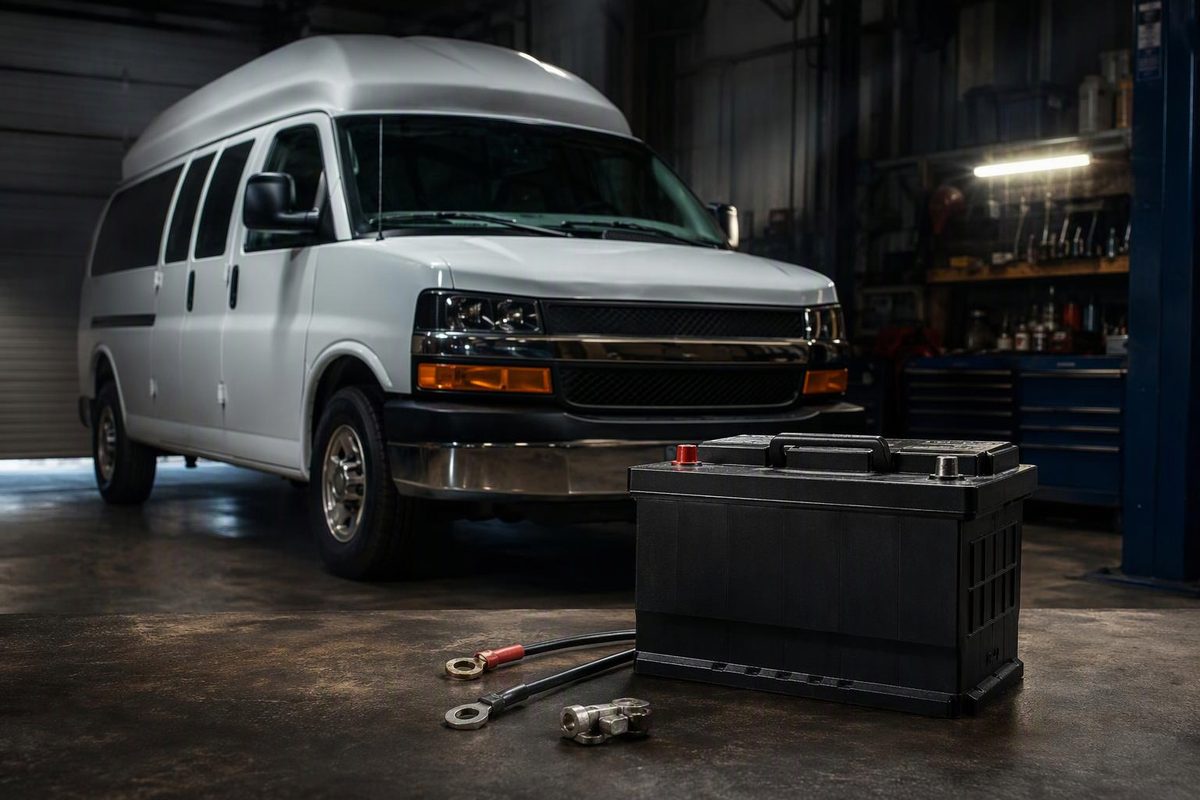
“High top” describes the raised roof on a converted Chevrolet Express, not a battery specification. Do not order a battery from that description alone: identify which battery needs replacement, then match it by model year, engine, installed label, battery role and wiring.
Select what you know about the battery; the tool shows the safest next step.
Chevy Express Battery-System Check
Classify the battery before using a parts listing or replacement procedure.
Do Not Buy Yet
Identify the battery’s role, trace its heavy cables and locate every battery before selecting a replacement.
“High top” is a body-conversion description, not a battery size or electrical specification.
Fitment facts used by this check
- Group 78 is listed for numerous Express 2500 and 3500 model years, including 2025, but is not universal.
- The 2025 GM upfitter manual describes RPO TP3 as dual 770-CCA batteries.
- A house battery must be matched by chemistry, dimensions, polarity, amp-hour needs, duty and venting—not case fit alone.
Sources: 2025 Chevrolet Express owner’s manual and GM Express/Savana electrical body-builder manual.
Identify the Battery System Before Buying
A high roof may have been installed by a mobility, shuttle, camper or conversion-van builder. That builder may also have added an auxiliary or house battery unrelated to the engine-starting battery.
Use this sequence to identify the system:
- Record the VIN, model year, series and engine. Express 1500, 2500, 3500 and 4500 applications are not automatically interchangeable. As one current example, the 2025 manual covers 4.3-liter V6 and 6.6-liter V8 engine compartments and identifies the primary battery there (2025 Express owner’s manual).
- Find every battery. Check under the hood, beneath the body, under seats and inside converter-built cabinets. Follow the heavy cables rather than assuming an interior battery starts the engine.
- Classify each battery. A starting battery cranks the engine and supports the Chevrolet electrical system. A factory second battery belongs to a GM dual-battery arrangement. A house or conversion battery may power interior lights, a lift, an inverter, a refrigerator or rear accessories.
- Photograph the labels and wiring before disconnecting anything. Record the part number, chemistry, CCA, amp-hour rating, dimensions, terminal style and polarity.
This distinction matters because GM documents both one- and two-battery starting and charging layouts for the 2025 Express. Its body-builder manual includes a separate auxiliary-battery relay and schematic for the two-battery system. RPO TP3 is described as dual 770-CCA batteries (GM Upfitter electrical manual). A converter-installed house bank can be different again.
Stop and use the converter’s instructions or an automotive electrical shop if cables disappear behind finished cabinetry, multiple charging sources are present or the battery’s role is unclear. A generic starting-battery procedure is not sufficient for an undocumented house system.
Group 78 Is Common but Not Universal
Group 78 is a strong lead for many Express applications, but it is not universal across every year, engine and conversion. Chevrolet’s parts catalog lists an ACDelco Group 78 battery for numerous Express 2500 and 3500 model years, including 2025. The 2025 owner’s manual still instructs owners to use the replacement number shown on the original battery label (Chevrolet Parts Group 78 listing).
Before paying, verify:
- BCI group or exact case dimensions
- Side-post, top-post or dual-terminal design
- Positive and negative terminal positions
- Hold-down type and cable reach
- Required CCA from the applicable fitment catalog or original specification
- Flooded or AGM construction
- Venting requirements for a battery inside the occupied body
- Starting, auxiliary or deep-cycle duty
Do not substitute an ordinary starting battery for a deep-cycle house battery merely because it fits the tray. Conversely, a house battery’s amp-hour rating does not prove that it can supply the required cranking current. If cold starts are the concern, see when higher CCA helps and when it does not.
Group 78 Examples Range From $149.84 to $308.99
Current U.S. examples show how widely Group 78 pricing can vary. On September 26, 2026, Walmart listed an 800-CCA flooded Group 78 battery at $149.84 and a Group 78 Optima REDTOP at $308.99 (Walmart Group 78 listings). These are comparison points, not proof that either battery fits a particular van.
Chevrolet Parts showed $184.08 MSRP plus an $18 core charge for its ACDelco Gold Group 78 example. The listing says the core charge is refunded when the recyclable old part is returned.
Installation, mobile-service travel and electrical diagnosis are separate. An installed quote should state whether it covers:
- The battery, applicable tax and refundable core deposit
- Charging-system and battery testing
- Terminal cleaning or cable repair
- Labor to reach an underbody or cabinet-mounted battery
- One battery or every battery included in the work
- Disposal or return of each old battery
- Diagnosis of the converter’s isolator, relay, charger or parasitic draw
A straightforward underhood swap may be brief. A boxed-in house bank or dual-battery fault can turn the job into electrical diagnosis. The battery replacement time guide covers the factors that commonly extend the visit.
Replace Only a Confirmed Single Underhood Battery This Way
Use the following sequence only for a conventional single starting battery after confirming fitment. For a factory dual-battery arrangement or converter house system, use the applicable GM or converter procedure because another battery or charger may keep cables energized.
- Park, set the parking brake, switch off the ignition and electrical loads, and remove the key. If the van has remote start, open the hood first; GM specifies this precaution to prevent accidental remote starting during service.
- Wear eye protection. GM warns that lead-acid batteries contain acid that can burn and gas that can explode.
- Photograph and label the cables. Disconnect the negative terminal first and then the positive, keeping the loose cables away from the posts.
- Remove the hold-down and lift the battery upright. Inspect the tray, cables and side-terminal threads for corrosion or damage.
- Install the verified replacement and secure the hold-down. Reconnect the positive terminal first and the negative terminal last. Use the specified terminal and hold-down torque rather than guessing.
- Confirm that the engine starts and that no charging or electrical warning remains. Test the battery and charging system if the original failure was not clearly age-related.
If the old battery repeatedly went flat, replacement may only hide the fault. GM notes that add-on electrical equipment can drain the 12-volt battery even while the vehicle is off. Investigate conversion loads, charging sources and isolator operation before condemning another battery. For extended storage, the 2025 manual advises disconnecting the negative cable or using a battery trickle charger.