
4 min read ·
Ford Escape Battery Replacement: Check the Year, Engine and Reset
Compare Ford Escape 12-volt battery costs, verified fitment examples, access considerations and Ford’s model-specific battery-sensor reset guidance.
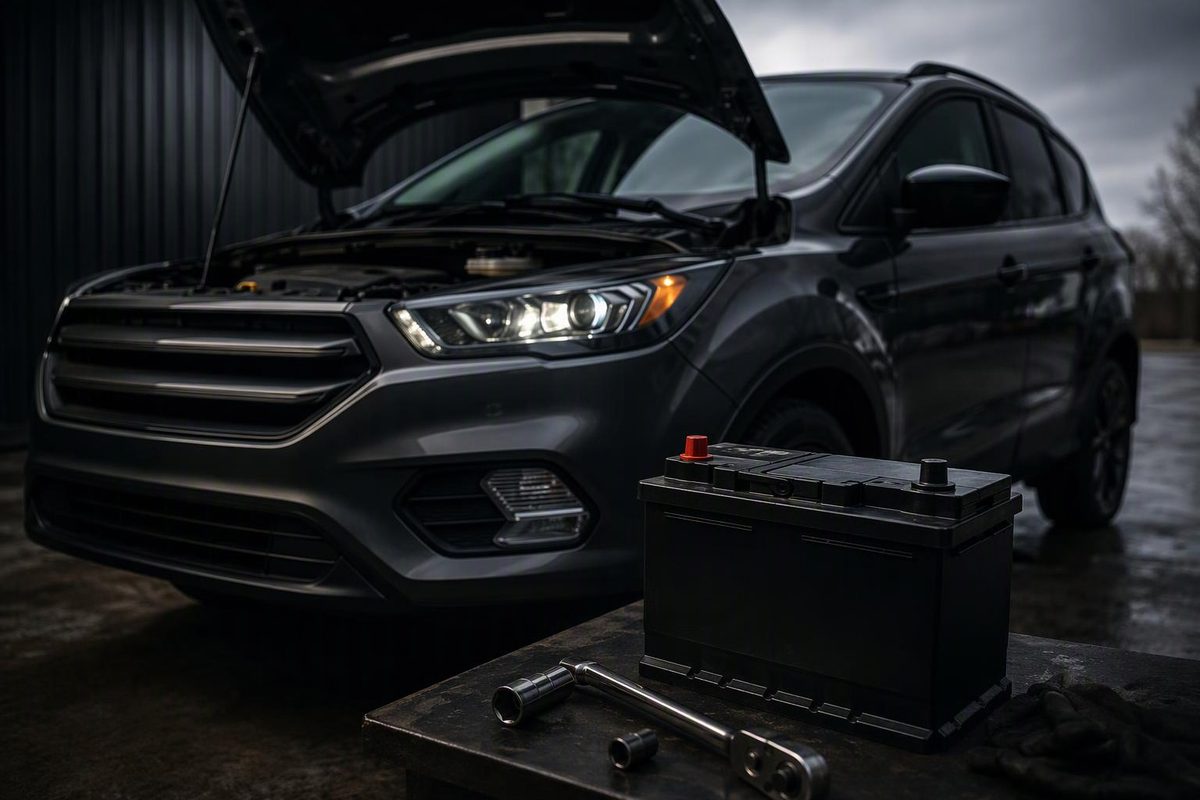
A Ford Escape battery replacement starts with the model year, engine and equipment—not one universal battery size. Ford’s 2017 manual, for example, lists both a 96R battery and an H6 AGM battery depending on configuration. The examples below use U.S./North American manuals.
This guide covers the 12-volt battery, not the hybrid high-voltage pack. For budgeting, RepairPal’s Escape-wide estimate is $278–$308 installed, before taxes and fees. Its listed estimates for 2017–2026 models are higher, at $303–$337. Treat these as comparison points, not quotes for your VIN. RepairPal’s estimates, updated September 3, 2026
Match the replacement before buying
Give the seller your VIN, model year, engine and whether the Escape has Auto-Start-Stop or Intelligent Access. Photograph the installed battery label, but cross-check it against the applicable Ford specification: a previous owner may have fitted the wrong battery.
These are verified examples, not an all-year fitment chart:
| Escape configuration | Battery listed in Ford’s owner’s manual |
|---|---|
| 2017 2.5L | Motorcraft BXT-96R-590 |
| 2017 1.5L or 2.0L EcoBoost | BXT-96R-590; BAGM-48H6-760 for the manual’s “with auto-start-stop / intelligent access” application |
| 2020 1.5L or 2.0L EcoBoost | BHEF-48H6 |
| 2020 2.5L hybrid | BXT-99RT4-A |
Sources: 2017 Escape manual, pages 296–298 and 2020 Escape manual, pages 378–380.
Before accepting a substitute, confirm:
- Case dimensions, terminal orientation and cable reach.
- Hold-down compatibility and clearance under the cover.
- Required battery chemistry, capacity and starting rating.
- Vent-port compatibility wherever a vent hose is fitted.
Tray fit alone does not establish compatibility. If your application specifies AGM, do not select an ordinary flooded battery solely because its dimensions match. Ask the supplier to confirm any current replacement or superseding part against your VIN.
Battery location and access: decide whether to DIY
Access deserves a separate check from fitment. In an Escape owners’ forum discussion, contributors favored removing the wiper cowl for better visibility of the battery, cables and sensor; another preferred removing both the cowl and air-filter box to make lifting easier. These are community experiences, not a universal Ford removal procedure. Escape owners’ access discussion
For 2026 models, Ford identifies the locations explicitly:
- 1.5L and 2.0L EcoBoost: engine compartment. Ford notes that additional components may need removal or disconnection and directs owners to a dealer for detailed access guidance. Ford’s EcoBoost replacement guidance
- Hybrid and plug-in hybrid: luggage compartment, with a battery vent hose included in the removal procedure. Reconnect the venting when installing the replacement. Ford’s hybrid replacement guidance
Stop before disconnecting anything if you cannot identify the safe access route, reach the connections without strain, or lift the battery clear. On a hybrid, leave orange high-voltage wiring and the traction pack alone; Ford reserves high-voltage battery service for an authorized electric-vehicle technician. Ford’s high-voltage precautions, page 196
Before disconnecting
Wear eye protection and suitable protective gloves, remove metal jewelry, and keep flames and sparks away. Use your own year’s instructions for component removal and tightening specifications.
For the 2026 EcoBoost, Ford says to apply the parking brake, switch off the ignition and electrical equipment, and wait at least two minutes before disconnecting the battery. The engine-management system remains powered briefly to store information. Ford’s preparation instructions
The cable-order rule is negative off first, positive off second; positive on first, negative on last. Keep disconnected cables isolated, secure the replacement with its hold-down, and restore any vent hose and covers. This is not a substitute for the Escape-specific access procedure. Battery replacement sequence
Battery-sensor reset versus relearning
Do not assume one internet reset sequence applies to every Escape.
The 2026 Escape manual instructs owners to reset the battery sensor after installing a new battery:
- Switch the ignition on with the engine off.
- Complete the following two actions within ten seconds: flash the high beams five times, ending with them off, then press and release the brake pedal three times.
- Look for three flashes of the battery warning lamp confirming success.
Ford’s 2026 battery-sensor reset
Separately, the 2020 manual describes an eight-hour state-of-charge relearn with the vehicle fully locked and the ignition off. This sleep period is not described as the same operation as the 2026 manual’s sensor reset. For an earlier Escape, have the installer confirm the VIN-specific reset requirements rather than treating overnight parking as proof that all setup is complete. 2020 manual, page 326
What should the replacement cost include?
RepairPal’s Escape-wide estimate separates approximately $214 in parts from $64–$94 labor. Those are estimating figures, not a battery-only retail offer or a dealer price. RepairPal cost breakdown
Ask an independent shop or dealer to itemize:
- Battery part number, chemistry and warranty.
- Access labor and battery/charging-system testing.
- Required sensor reset and other post-replacement setup.
- Taxes, fees and any refundable core deposit, including return terms.
Compare quotes on those same inclusions—not against a battery-only shelf price. For a fuller checklist, see car battery change costs and extra charges.
Before authorizing replacement, request a battery and charging-system test. A discharged battery may need charging and retesting; cable or charging faults can otherwise leave you with another no-start after the swap. RepairPal’s diagnostic guidance