
5 min read ·
Jeep Compass Battery Replacement: Match the Year and Check Both Batteries
Compare Jeep Compass battery fitment and U.S. replacement costs, with auxiliary-battery checks, under-hood access and sensor-learning guidance.
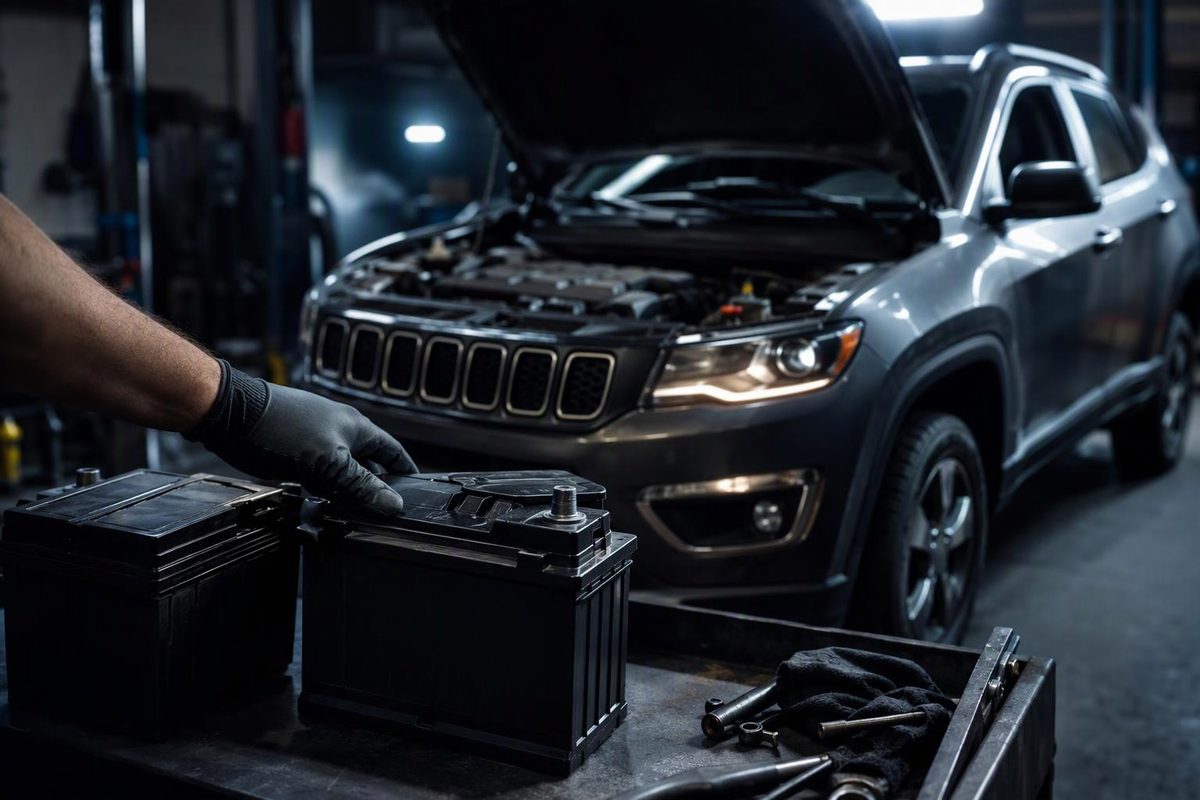
Before buying a Jeep Compass battery, confirm the model year, engine and whether it has an auxiliary battery. A 2016 Compass and a newer stop/start-equipped Compass are not the same replacement job. For the newer vehicle, a quote may cover the main battery only—not the smaller auxiliary unit.
This guide covers conventional 12-volt replacement on U.S. gasoline models, using 2016 and 2024 retail examples. Do not apply these fitment examples to a Compass 4xe traction battery or another market’s hybrid system.
1. Match the battery to the actual vehicle
Use the VIN in a fitment catalogue, then compare the proposed battery with the installed label and tray. Check chemistry, dimensions, terminal orientation, hold-down design, cold-cranking amps (CCA) and capacity where specified. The installed battery may itself be an incorrect replacement, so resolve any mismatch before buying.
| Compass configuration | Useful fitment starting point | What to verify |
|---|---|---|
| 2007–2016 gasoline models | Group 86 is a common catalogue lead | Exact engine/application, required CCA and physical fit |
| 2017 model year | Identify outgoing versus redesigned Compass first | Generation and stop/start equipment—not just “2017 Compass” |
| 2024 gasoline example | Group 48/H6 AGM main battery; AUX14 auxiliary battery where equipped | VIN-specific main-battery specification and whether an auxiliary unit is installed |
AutoZone identifies Group 86 for the earlier generation in its Compass fitment overview and lists Group 86 flooded batteries for the 2016 Compass. Its 2024 catalogue lists H6 AGM main batteries and an AUX14 AGM auxiliary battery. Interstate also lists the 2024 Compass among applications for its MTX-48/H6 AGM battery. These are fitment leads, not approval for every trim or engine.
2017 needs special attention: Jeep sold both the outgoing and fully redesigned Compass in that model year, as Edmunds documents. A year-only search can mix the two.
If your specified battery is AGM, replace it with AGM rather than choosing a cheaper flooded battery merely because it fits. Haynes’ replacement guidance calls for matching the battery specifications and retaining AGM where required.
2. Test before deciding which battery to replace
Slow cranking or repeated jump-starts justify battery and charging-system testing. If the battery is deeply discharged, ask for charging and retesting before it is condemned; cables, wiring or the alternator may also need attention. RepairPal describes this diagnostic sequence.
On a two-battery Compass, request a separate result for the main and auxiliary batteries, using the appropriate testing procedure. Do not accept “battery failed” without knowing which one was tested.
Stop/start being unavailable is not proof that either battery has failed. Jeep’s 2024 owner’s manual lists low charge, battery temperature, cabin heating/cooling demand and several other conditions that prevent an automatic engine stop. A “Service Stop/Start System” message calls for diagnosis, not an automatic parts order.
3. Compare the real replacement cost
These U.S. AutoZone prices were checked on October 14, 2026. They are selected parts-only examples from the displayed store listings, before tax and installation—not a market-wide price range. Local prices and availability may differ.
| Replacement scope | Listed example price |
|---|---|
| 2016: Duralast Group 86, 525 CCA | $209.99 |
| 2016: Duralast Gold Group 86, 650 CCA | $234.99 |
| 2024: Duralast Platinum H6 AGM, 760 CCA | $259.99 |
| 2024: Duralast Platinum Elite H6 AGM, 760 CCA | $289.99 |
| 2024: Duralast Platinum AUX14 AGM, 200 CCA | $159.99 |
The 2016 listings and 2024 listings show a $22 refundable core deposit for each of these batteries. At these prices, either listed H6 plus the AUX14 totals $419.98–$449.98, with another $44 temporarily due if both core deposits apply.
For installed work, RepairPal’s Compass estimate, updated September 3, 2026, is $450–$609, including estimated labor of $70–$103. It excludes taxes and fees and is not a dealer-specific quote or a promise that both batteries are included.
Ask each retailer, independent shop or dealer to itemize:
- Main battery, auxiliary battery, or both—with part numbers and chemistry.
- Testing, installation, terminal cleaning and any damaged hardware.
- Fault-code diagnosis or clearing, if needed.
- Core deposits, tax and warranty terms.
For a broader comparison, see our battery replacement quote checklist.
4. Check access before attempting DIY
The 2018 user guide and 2024 owner’s manual locate the main battery under the hood, behind the vehicle’s left headlight. AutoZone places the auxiliary battery on newer stop/start models in the engine-bay area.
Before loosening anything, inspect access to the clamps, hold-down and any battery sensor or overlying electrical hardware. Wear eye protection and gloves, remove metal jewelry, apply the parking brake, switch the ignition and accessories off, and keep sparks away.
For a confirmed conventional single-battery installation, the basic sequence is negative cable off first, then positive; remove the hold-down and battery, fit and secure the replacement, then reconnect positive before negative. RepairPal outlines this sequence. Use the applicable service procedure for access and fastener torque specifications.
Stop if there are two batteries or unfamiliar sensor connections. Do not assume removing one negative clamp isolates the entire system. Obtain the exact-year service procedure for battery disconnection and reconnection, including auxiliary-battery isolation and sensor handling, before continuing.
5. Allow for sensor learning—not an assumed coding fee
For an intelligent battery sensor (IBS)-equipped Compass, distinguish battery replacement from sensor replacement. Stellantis’ March 2026 STAR guidance, case S1408000384 Revision J, says the IBS does not need replacement merely because a new or recharged battery is installed; it may need state-of-charge adaptation.
This general IBS guidance describes one crank followed by two to four hours of vehicle sleep for internal-combustion vehicles without external charging. After external charging, learning can take up to two days. It is not a VIN-specific Compass replacement procedure, nor does it establish that every Compass needs a paid registration or coding operation.
If a shop quotes a “battery reset,” ask what VIN-specific procedure it means. Persistent warnings, poor cranking or another discharge still need diagnosis; do not replace the sensor or another battery solely because stop/start has not returned immediately.