
2 min read ·
Group 24 Battery Dimensions: Inches, Millimeters and Fit
Group 24 dimensions are 10 1/4 × 6 13/16 × 8 7/8 inches. Compare 24F, 24R, 24H and 24T, then check terminals, clearance and hold-down fit.
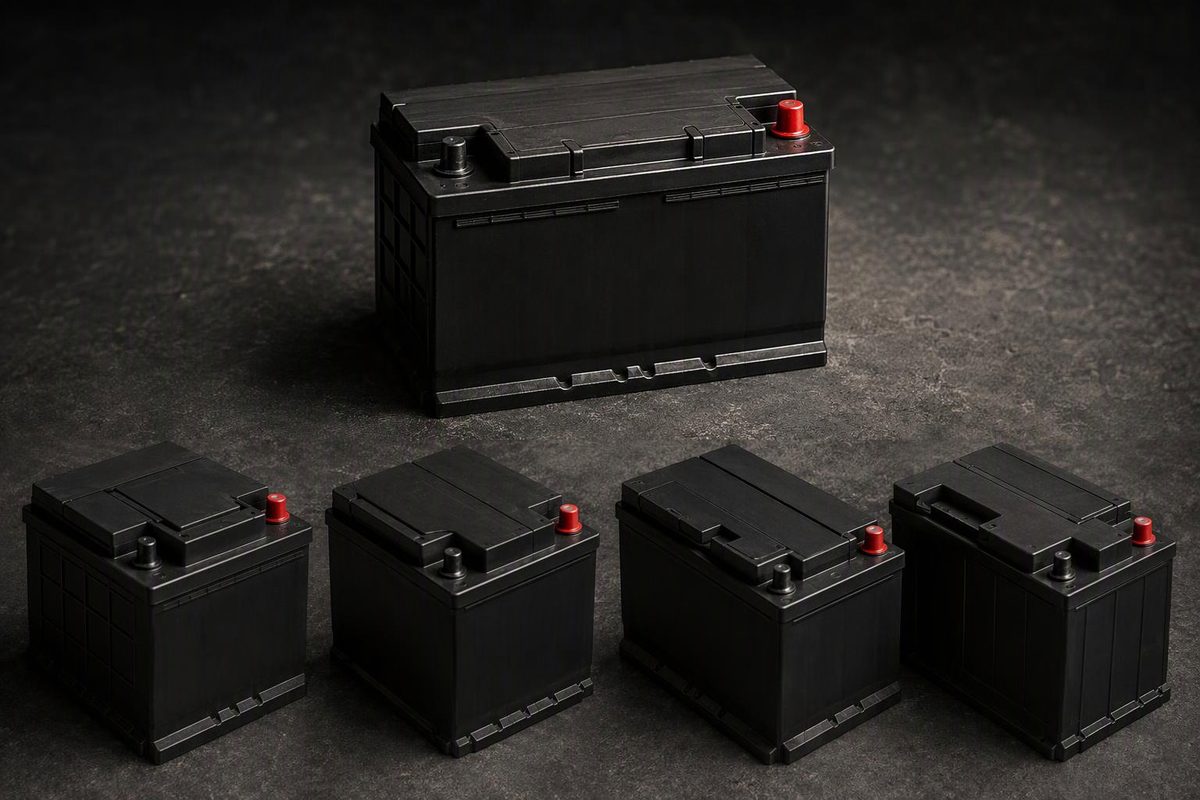
BCI lists Group 24 maximum overall dimensions as 10 1/4 × 6 13/16 × 8 7/8 inches (length × width × height), or 260 × 173 × 225 mm. These are the dimensions in Battery Council International’s group-size chart, not a promise that every product will measure exactly the same.
| Measurement | Inches | Millimeters |
|---|---|---|
| Length | 10 1/4 (10.25) | 260 |
| Width | 6 13/16 (6.8125) | 173 |
| Overall height | 8 7/8 (8.875) | 225 |
The inch and metric values are the chart’s published equivalents; they are rounded, rather than exact mathematical conversions.
Does the height include the terminals?
Yes. Use overall height, including the terminal posts—not just the plastic case height—when checking clearance. The Golden Gate Lotus Club’s reproduction of BCI data explicitly notes that maximum height includes the posts. It also notes that length and width generally include protruding flanges, except bottom hold-down flanges.
Check the exact battery’s dimensional drawing or ask the supplier to confirm its overall measurements if a product listing gives an unclear height. A battery that fits the tray can still be too tall: terminals contacting the hood can cause arcing, and an incorrect height can prevent the hold-down from securing it, as AutoZone’s fitment guidance explains.
Group 24 is not the same as 24F or 24R
Read the complete group designation on the label. BCI lists these as separate sizes:
| BCI group | Maximum L × W × H, inches | Maximum L × W × H, mm |
|---|---|---|
| 24 | 10 1/4 × 6 13/16 × 8 7/8 | 260 × 173 × 225 |
| 24F | 10 3/4 × 6 13/16 × 9 | 273 × 173 × 229 |
| 24R | 10 1/4 × 6 13/16 × 9 | 260 × 173 × 229 |
| 24H | 10 1/4 × 6 13/16 × 9 3/8 | 260 × 173 × 238 |
| 24T | 10 1/4 × 6 13/16 × 9 3/4 | 260 × 173 × 248 |
Source: BCI dimensional specifications, page 15.
The 24F envelope is 1/2 inch longer than Group 24. The 24R shares Group 24’s listed length and width but is taller and uses a different terminal-position layout. BCI also assigns 24F a different assembly layout from standard 24 in its assembly and polarity specifications. Do not treat these variants as interchangeable solely because “24” appears in the name.
Check these before buying
- Confirm vehicle fitment. Use the vehicle’s year, make, model and engine in a battery catalogue, then compare with its service information. Treat the existing battery label as a clue, not proof that a previous replacement was correct.
- Check the tray and hold-down. Compare the exact replacement’s measurements and mounting features with the available space and clamp. Our battery tray guide covers the hardware checks.
- Match the terminal layout. Compare the marked positive and negative posts with the installed cable positions. Stop if the cables would need stretching or rerouting. Reversed polarity can damage vehicle electronics.
- Verify electrical specifications separately. Match the vehicle-required battery technology and ratings; physical size alone is not enough. AutoZone recommends matching replacement size, orientation and capacity in its battery-selection guidance.