
10 min read ·
How to Choose a Tray That Actually Fits and Secures Your Battery
See why group size alone can't confirm fit, which hold-down parts to verify, and how historical prices differ for plastic trays and aluminum packages.
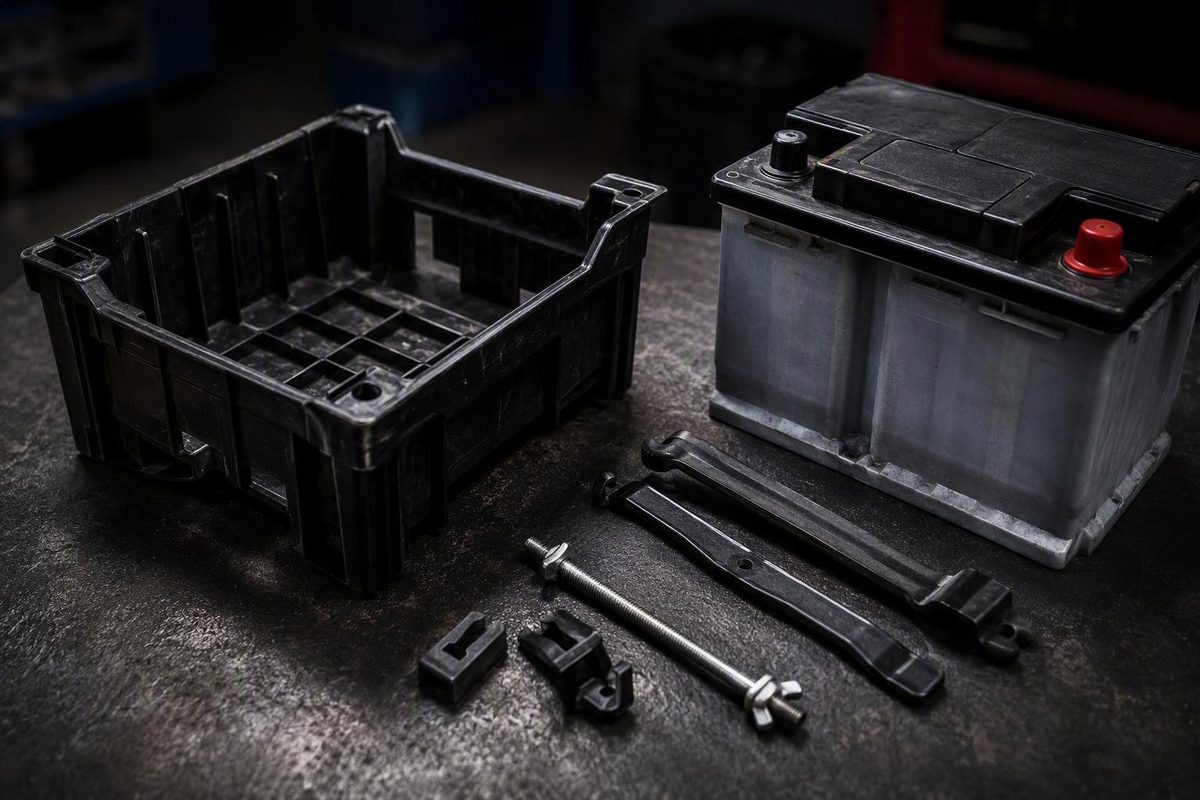
Choose a battery tray by matching both sides of the installation: the exact battery and the vehicle, boat, RV, trailer, UTV, or equipment mounting method. Start with a vehicle-specific assembly for factory mounting points, a battery-model-specific tray when the manufacturer identifies the compatible battery, or a group-size tray for a custom installation only after checking dimensions, clearance, mounting geometry, and the complete hold-down system. A Group 24, 27, or 31 label alone does not guarantee fit.
Related: H7 Battery Group Size: 94R/LN4 Dimensions & Fit.
Start here: which type of tray should you buy?
Use this three-route decision table before shopping:
| Installation | Best starting point | What still needs verification |
|---|---|---|
| Restoring an original vehicle installation | Vehicle-specific replacement tray or assembly | Year, model, production range, part number, brackets, fasteners, and factory hold-down |
| Installing a named battery model | Battery-model-specific tray | Exact battery model, tray configuration, terminal clearance, and included hardware |
| Building a custom or general installation | BCI group-size or universal tray | Battery dimensions, mounting pattern, suitable mounting points, clearance, and retention method |
Retailers organize trays in several incompatible ways. Listings may be based on BCI group size, battery brand or model, vehicle series and production date, voltage or amp-hour capacity, or intended use such as marine, RV, automotive, or commercial equipment.
Vehicle-specific catalogs can become highly granular. Specter Off-Road separates Toyota Land Cruiser battery-tray components into pages for the 40, 55, 60/62, 80, and 100 Series. Its visible 40 Series listing is tied to a production range, illustrating why a similar-looking tray may not match another model or year’s brackets and body mounting points. See the Land Cruiser battery-tray component catalog.
Battery-specific listings take a different approach. LithiumHub advertises Ionic trays in seven sizes and in single-, dual-, or triple-battery configurations for selected 12- and 36-volt batteries. Those electrical specifications help identify a product family, but they do not replace confirmation of the exact battery model, physical dimensions, tray configuration, and clearance.
A BCI group designation is useful for narrowing the search. It does not, on the available evidence, establish matching tray dimensions, mounting holes, terminal clearance, cable routing, or hold-down geometry by itself.
Tray, box, hold-down, brace, or relocation mount?
A battery tray is the base that supports and locates the battery. It may have a raised lip, mounting holes, or slots for retention hardware, but “tray” does not necessarily mean a complete hold-down system is included.
Other commonly mixed terms describe different components:
- Battery box: An enclosure surrounding most or all of the battery, often with a lid.
- Upper hold-down or clamp: A bar or shaped piece that bears against the battery from above.
- Tie-down strap: Flexible retention passing around or over the battery and tray.
- Tray brace or bracket: A structural component connecting the tray to the vehicle or equipment.
- Battery relocation mount: Hardware intended to move the battery from its original position.
- Cover: A shield or lid that is not necessarily a structural hold-down.
Retail categories do not always preserve these distinctions. Amazon’s replacement-tray category includes boxes, upper hold-downs, trays with straps, and relocation mounts. Amazon describes its best-seller ranking as sales-based and frequently updated, so rank, star rating, and review count should not be treated as independent evidence of fit, durability, or safety.
Think of a complete assembly as a stack of separate parts:
- Supporting tray
- Tray-to-vehicle mounting points
- Padding, if specified
- Battery
- Strap or upper clamp
- J-hooks or bolts
- Washers
- Nuts or knobs
- Any separate brace or support bracket
Retailers sell trays, hold-downs, straps, brackets, and hardware separately. Replacing only the base therefore may not restore the complete retention assembly. Inventory the existing parts and identify the required hold-down method before ordering.
Use this battery-tray fitment worksheet before ordering
Record the following information and compare it with a product-level drawing, manufacturer fitment table, or exact part listing—not just a category title.
| Fitment field | Your measurement or answer |
|---|---|
| Vehicle/equipment year, make, and model | ________ |
| Battery manufacturer and exact model | ________ |
| BCI group size, if marked | ________ |
| Battery length | ________ |
| Battery width | ________ |
| Battery height, including terminals | ________ |
| Terminal position and orientation | ________ |
| Cable clearance required | ________ |
| Compartment length, width, and height | ________ |
| Number of batteries | ________ |
| Tray mounting-hole spacing and pattern | ________ |
| Existing mounting points or brackets | ________ |
| Hold-down method: strap, clamp, hooks, or other | ________ |
Measure the actual battery whenever possible. Check whether the tray’s internal footprint will accept it without putting the case, terminals, or cables against a cover, body panel, bracket, or nearby electronics. Include the upper clamp, strap hardware, and terminal height when checking vertical clearance.
For vehicle-specific braces and brackets, use the retailer’s VIN or year/make/model lookup where available. Advance Auto Parts, for example, asks shoppers to select a vehicle before identifying exact-fit components and separately categorizes boxes and trays, braces, brackets, hold-downs, and covers.
For a universal tray, confirm that it can use suitable existing mounting points and that its retention hardware fits the actual battery. A “universal” label does not establish suitability for drilling or structural modification. If the existing mounting arrangement cannot accept the tray as designed, seek application-specific guidance rather than improvising.
Do not select a tray solely because the battery is lithium, 12 volts, 100Ah, or another stated capacity. Even brand-specific lithium trays are offered in multiple sizes and battery-count configurations because chemistry and electrical ratings do not define the complete physical installation.
Compare the complete system, not just the tray material
Plastic, steel, and aluminum trays are all available. The material name alone does not show which product is stronger, safer, more corrosion-resistant, or longer-lasting in a particular installation. Compare dimensions, mounting design, retention hardware, environment, warranty, and replacement-part availability.
The matrix below consolidates the information available on the reviewed product pages. “Not stated” means the reviewed page did not provide that detail; it does not mean the product lacks the feature.
| Comparison field | Basic group-size tray | PowerHouse marine tray | Ionic battery tray |
|---|---|---|---|
| Listed construction | Molded-plastic examples are sold | Seller-listed aluminum | Seller-listed 1/4-inch aluminum |
| Retention hardware | Varies; may be separate | Ratchet strap | Strap or configuration-dependent J-bolts, knobs, and bracket |
| Padding | Not consistently stated | 3 mm rubber pad | Rubber pads or padded bottom |
| Mounting hardware | Often not stated on category pages | Six screws | Mounting screws and pre-drilled holes |
| Drainage | Not stated on reviewed category pages | Not stated | Seller says open design permits drainage |
| Warranty | Product-dependent | Not stated on reviewed collection page | One year for the tray |
| Dimensions | Not stated on reviewed category pages | Exact dimensions not stated | Exact dimensions not stated |
| Intended application | General automotive, marine, RV, or equipment use | Marketed for marine lithium batteries | Boats, RVs, UTVs, lawn equipment, and commercial uses |
PowerHouse’s listed package contents—including the 3 mm rubber pad, ratchet strap, and six screws—are seller-provided specifications rather than independent performance findings. See the PowerHouse aluminum tray collection.
LithiumHub likewise describes quarter-inch aluminum construction, padding, pre-drilled holes, mounting screws, and a one-year tray warranty. Because the page mentions both a strap and a J-bolt-style assembly in different sections, confirm the hardware supplied with the selected configuration on the Ionic tray listing.
The full assembly also matters in factory-style installations. In a user-generated discussion about 1980–1986 Ford F-Series trucks, participants describe two J-hooks, an angled upper clamp, washers, nuts, and possibly an additional support bracket. That is a vehicle-specific illustration of parts that may be missing—not a universal hardware list—and should be checked against the truck’s exact year and configuration in the Ford battery-tray discussion.
Before selecting a system, ask:
- Will it be exposed to water, road spray, or salt?
- Is the application subject to substantial vibration?
- Does it require drainage, electrolyte containment, or both?
- Are the terminals protected from nearby conductive surfaces?
- Is the existing mounting surface suitable for the complete assembly?
- Can replacement straps, clamps, hooks, and fasteners be bought separately?
Do not infer marine, road-vehicle, equipment-manufacturer, or regulatory compliance from marketing terms such as “marine,” “heavy duty,” or “universal.” Verify the requirements that apply to the specific installation.
What battery trays cost: a qualified market snapshot
The retailer captures supplied for this comparison do not include a reliable retrieval date. The figures below are therefore historical displayed prices—not current quotes. Prices, discounts, stock, local availability, and warranties must be reconfirmed before purchase.
-
Basic plastic trays: Remy Battery displayed Group 24, 27, and 31 plastic trays at $6.50, $6.25, and $6.85, respectively. The retailer also listed hold-downs, straps, and hardware separately, so the tray price may not represent the cost of a complete installation. See the Remy Battery category page.
-
Group 24 tray: Advance Auto Parts displayed a NOCO BT24 at $8.99 with a stated one-year warranty. The same category included boxes, braces, brackets, hold-downs, and support trays, so product function must be checked before prices are compared. See the Advance Auto Parts listing.
-
Aluminum marine packages: PowerHouse Lithium displayed Group 20, 24, 31, 5D, and GC8 trays at $49.99 each. The seller described them as aluminum packages with a rubber pad, ratchet strap, and six screws, making them materially different from a bare plastic base. See the PowerHouse tray collection.
These examples are not like-for-like. A battery box, upper hold-down, bare tray, vehicle-specific brace, and complete aluminum package perform different roles and may include different hardware. Compare the installed-system cost: tray, brace, padding, retention hardware, mounting fasteners, and any missing factory parts.
Availability also requires direct confirmation. PowerHouse Lithium displayed both “In stock” and “Unavailable” for its listed trays. Dakota Lithium displayed an “In Stock” label on one tray while also stating that ordering was temporarily unavailable on its battery-tray category page. A visible listing is not proof that the selected configuration can ship.
Inspect the old tray before deciding to reuse, repair, or replace it
Remove loose debris and inspect the existing installation before assuming the tray is the only failed component.
Inspection checklist:
- Surface rust or deep scaling
- Cracks, holes, or perforated metal
- Softened, flexing, or visibly weakened areas
- Torn or enlarged hold-down slots
- Loose tray braces or support brackets
- Missing hooks, nuts, washers, clamps, or fasteners
- Standing water
- Blocked drainage
- Damage or corrosion in the surrounding mounting structure
Use this decision path:
- Tray appears intact: Clean it, clear debris, inspect drainage, and reassess the mounting and retention points.
- A removable component is damaged or missing: Replace it only after verifying the correct part and fitment.
- Tray or surrounding mounting metal is perforated or weak: Obtain vehicle-specific repair guidance or professional evaluation.
- Fabrication or welding is required: Have the supporting structure assessed rather than covering the damage with a universal tray.
A published Porsche 944 guide makes a model-specific distinction between limited and structural damage. It describes minor treatment when holes are absent or very small, but replacement metal when holes are large or the tray bottom is weak. The guide attributes leaks to standing water, clogged drainage, or a missing cover and warns that water can reach nearby DME wiring and control units. Those recommendations are limited to the Porsche 944; consult the Porsche 944 battery-tray repair guide for its original context.
Surface cleanup is not a structural repair. If the tray support or surrounding body metal is weak, perforated, or requires cutting, fabrication, or welding, have it evaluated by a qualified repair professional.
Final pre-purchase checklist
Before placing the order, confirm:
- [ ] Exact battery manufacturer and model recorded
- [ ] BCI group size recorded, if applicable
- [ ] Actual battery length, width, and height measured
- [ ] Tray’s internal dimensions verified
- [ ] Terminal position and cable clearance checked
- [ ] Compartment and cover clearance checked
- [ ] Correct number of batteries selected
- [ ] Mounting pattern matches suitable existing mounting points
- [ ] Complete hold-down method identified
- [ ] Included strap, clamp, hooks, brackets, and fasteners documented
- [ ] Padding requirements checked
- [ ] Exposure to water, salt, or vibration considered
- [ ] Tray-specific warranty checked separately from any battery warranty
- [ ] Replacement retention hardware is available
- [ ] Price and stock reconfirmed
- [ ] Return policy reviewed
Save the product drawing, part number, fitment result, and included-hardware list. Similarly titled products may be different components or configurations, and a low headline price may exclude the strap, upper clamp, J-hooks, brace, padding, or mounting fasteners needed to complete the installation.
Do not order until both the battery fit and the vehicle or equipment mounting method are verified.