
5 min read ·
Check Group 35 Battery Size, Specs and Fit
Compare Group 35 battery dimensions, right-positive terminal layout, CCA, chemistry and price examples, plus the fit checks to make before buying.
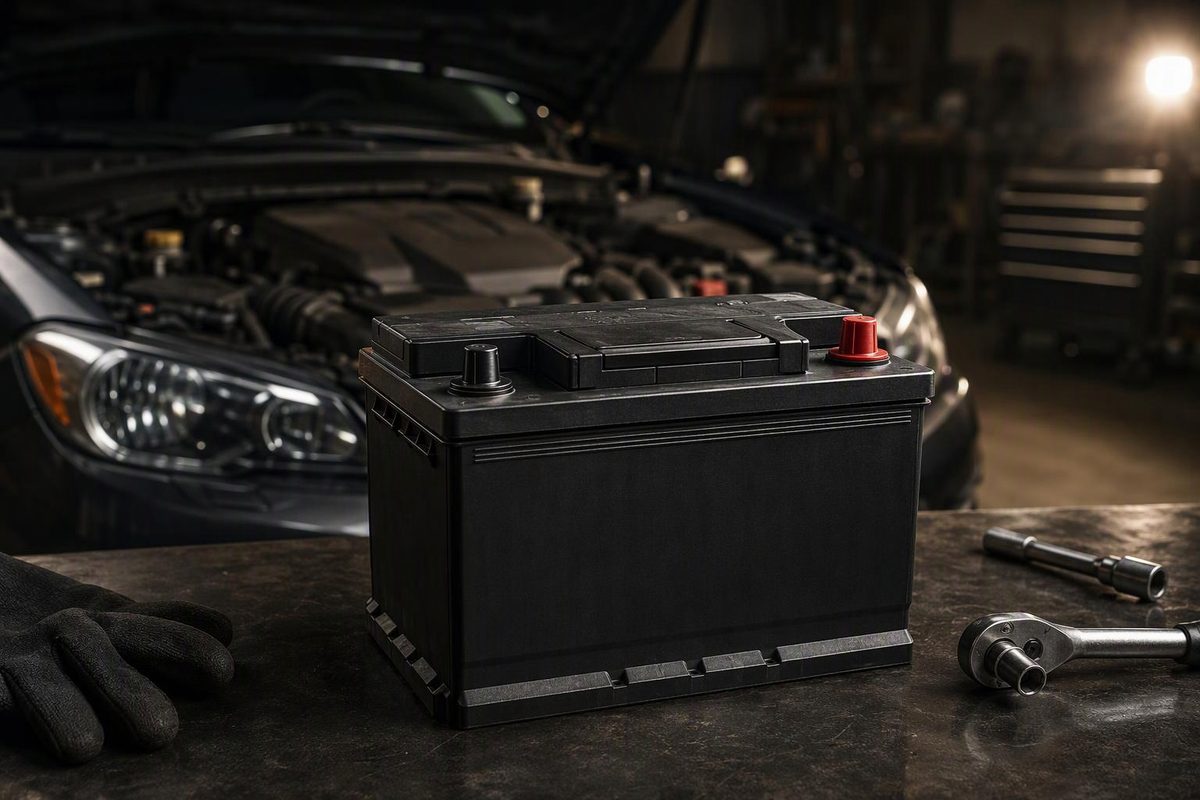
A BCI Group 35 is a 12-volt automotive battery size with maximum overall dimensions of 9 1/16 × 6 15/16 × 8 7/8 inches (length × width × height), or 230 × 175 × 225 mm. Its reference layout uses SAE top posts with the positive terminal on the right. These specifications come from the Battery Council International group-size table and a Cummins BCI specification sheet.
Group 35 identifies the general package, not the correct battery for every vehicle that can physically hold it. Before buying, confirm the exact year, make, model, engine and trim, then match the required chemistry, cold-cranking amps (CCA), terminal position and hold-down.
Choose a battery type and enter any CCA or price limit; the matching examples update below.
Group 35 Example Matcher
Filter the three cited listings by chemistry, minimum CCA or listed battery price. Fitment still must be confirmed for the exact vehicle.
3
listed examples shown
| Battery | Type | CCA | Price |
|---|---|---|---|
| Continental 35-P | Flooded | 450 | $142.99 |
| Listed weight: 33.2 lb. | |||
| Continental 35-AGM | AGM | 650 | $299.99 |
| Listed weight: 34 lb. | |||
| Optima RedTop 35 | AGM | 720 | $279.99 |
| 31.5 lb; 90-minute reserve capacity; 9.38 × 6.75 × 7.69 in. | |||
No listed example meets all selected limits. This does not establish that no suitable Group 35 battery exists.
Source: manufacturer listings cited in the article; prices and specifications checked September 28, 2026.
Group 35 Specifications at a Glance
| Specification | Group 35 reference |
|---|---|
| Voltage | 12 volts, six cells |
| Maximum dimensions | 9 1/16 × 6 15/16 × 8 7/8 in |
| Metric dimensions | 230 × 175 × 225 mm |
| Terminal type | SAE top post; BCI Type A or A2 |
| Reference polarity | Right-hand positive |
| BCI OE reference range | 300–640 CCA; 48–113 Ah |
| Available technologies | Flooded, EFB and AGM |
BCI labels the CCA and amp-hour figures as original-equipment reference ranges. They are not mandatory ratings for every replacement battery. A Group 35 marking also does not identify the battery’s chemistry or exact performance.
Current Group 35 products are sold as conventional flooded, enhanced flooded and absorbed glass mat batteries. For example, Continental lists a Group 35 EFB battery, while its other Group 35 listings include conventional flooded and AGM models.
Check the dimensions of the specific product rather than relying only on the BCI envelope. The Optima RedTop 35 is listed at 9.38 × 6.75 × 7.69 inches (length × width × height), making it longer and lower than the BCI reference dimensions. When tray, bracket or hood clearance is tight, use a current vehicle-fitment catalogue and measure the available space.
Group 35 and Group 25 Have Opposite Reference Polarity
BCI Groups 25 and 35 share the same listed maximum dimensions, but their reference terminal arrangements differ. The Cummins chart identifies Group 25 as left-hand positive and Group 35 as right-hand positive. A Group 25 battery may therefore sit in a Group 35 tray while leaving the cables crossed over the case, stretched or unable to reach.
Do not rotate a battery or force a cable to compensate for the wrong layout. Compare the + and − markings on the candidate and installed batteries while viewing both from the same orientation.
Also inspect the battery tray and hold-down. Matching external dimensions do not prove that the lower ledge, top bracket or clamp will secure a particular case. Verify the case length, width and total height, including the posts, as well as cable reach and clearance above both terminals.
Group 35 Does Not Specify Chemistry or Performance
Three current product listings illustrate the differences within the same group size:
- The Continental 35-P flooded battery was listed at 450 CCA, 33.2 pounds and $142.99.
- The Continental 35-AGM was listed at 650 CCA, 34 pounds and $299.99.
- The Optima RedTop 35 AGM was listed at 720 CCA, 90 minutes of reserve capacity, 31.5 pounds and $279.99.
These were online prices and specifications checked September 28, 2026. Availability, tax, installation and any refundable core deposit can change the amount paid.
The comparison shows why “Group 35” is not a performance grade. Meet the vehicle’s specified CCA and capacity requirements, and understand what reserve capacity means, rather than choosing solely by the largest number. The high-CCA battery guide explains when additional starting capacity is useful.
Do not downgrade the battery technology merely because another Group 35 case fits. Varta says a vehicle equipped with an AGM battery should receive another AGM battery. It associates EFB batteries with simpler start-stop systems and says AGM may replace EFB when greater performance is needed.
Varta also warns that using the wrong technology in a battery-managed vehicle can disrupt start-stop or comfort functions and reduce battery life. Check the exact application in the vehicle maker’s information or a current battery catalogue before changing chemistry (Varta).
Six Fitment Checks Prevent the Common Buying Errors
- Confirm the exact application. Enter the year, make, model, engine and trim in a current fitment catalogue. Use the VIN or ask a dealer parts department when several batteries are listed.
- Read the installed battery’s label. Record the group, CCA, reserve capacity or amp-hour rating, and whether the battery says flooded, EFB or AGM. Treat the installed battery as a clue rather than conclusive proof because an earlier replacement may be incorrect.
- Compare terminal positions. Check the positive and negative posts directly. Do not assume Groups 25, 35 or 85 can substitute for one another because their footprints look similar.
- Check physical retention and clearance. Measure the case and confirm the hold-down style, cable reach, terminal clearance and hood clearance. The battery must not be able to move in the tray.
- Check electronic requirements. Consult the owner’s manual or service information for battery-monitoring resets, registration or relearn procedures. Group size does not determine whether these steps are required.
- Compare the complete price. Ask whether the quote includes the battery, installation, testing, terminal cleaning, electronic setup, tax and core deposit.
Return the old lead-acid battery within the seller’s deadline if a core deposit applies. Deposit requirements and refund periods vary by state, as BCI’s state recycling-law summary shows.
Some Group 35 Installations Require Vehicle-Specific Procedures
Stop and obtain vehicle-specific instructions or professional help if the battery is buried under major components, mounted in the passenger compartment, fitted with a vent tube, connected to a battery sensor you cannot handle correctly, or subject to registration after replacement.
For a conventional accessible battery, the vehicle manual remains the controlling procedure. Toyota’s general guidance says to switch the vehicle off, wear gloves and eye protection, disconnect the negative cable first, remove the restraint, and reconnect positive before negative. It also says to check that the installed battery cannot move in its bracket (Toyota).
Group 35 is the correct starting point only when a current fitment source assigns it to the exact vehicle. The final match still requires the correct polarity, chemistry, electrical ratings, venting and hold-down—not merely a case marked “35.”