
15 min read ·
When Your Honda CR-V Actually Needs a New Engine Air Filter
Use 15,000-30,000 miles only as a planning range. Check your CR-V's manual and dashboard reminder first, and inspect sooner after substantial dust or debris.
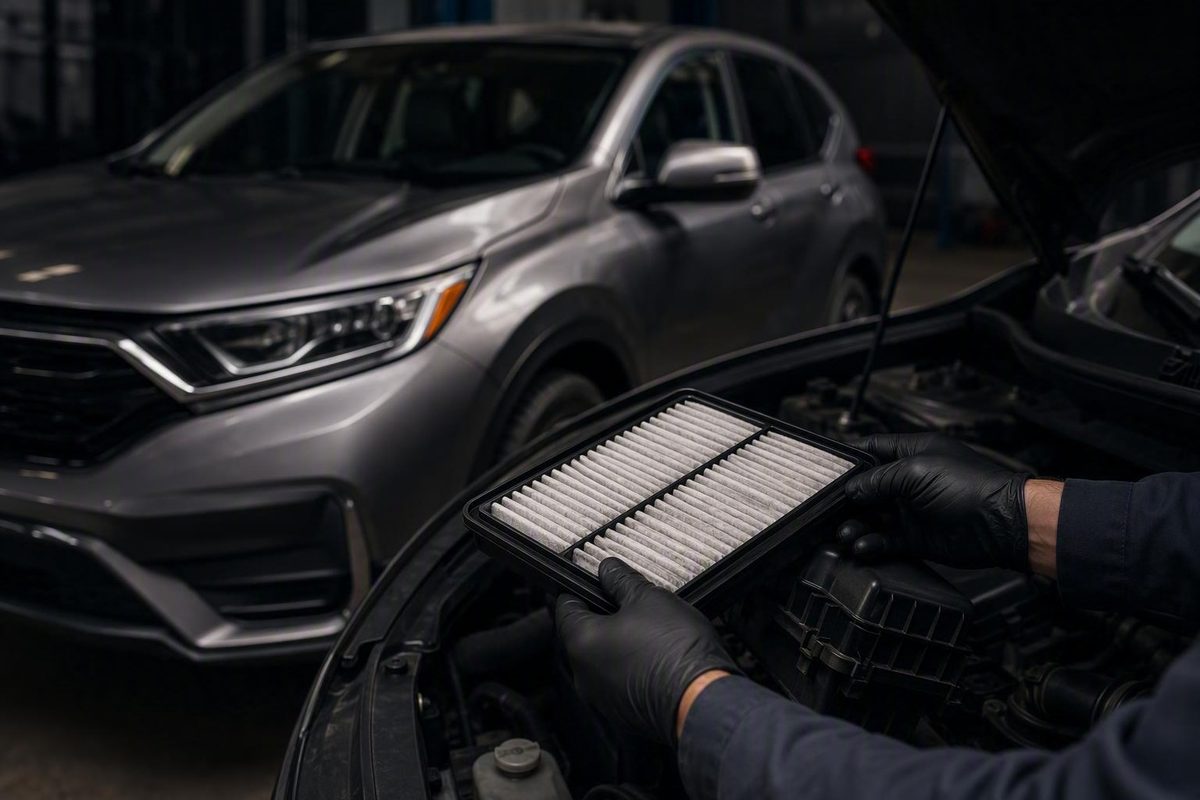
The short answer: use 15,000–30,000 miles as a planning range, not a universal rule
For many Honda CR-V owners, 15,000–30,000 miles is a reasonable planning range for engine-air-filter replacement. That range appears in Gunn Honda’s CR-V air-filter guidance, but it is dealership advice—not a supported factory interval for every CR-V.
Silko Honda’s CR-V planning schedule uses 30,000 miles or two years under normal driving, while explicitly warning that its table is not universal. It directs owners to confirm the correct service through the vehicle’s owner documentation and Maintenance Minder rather than treating the table as an official schedule for every CR-V.
Other published recommendations are more conservative. Zeigler Honda of Racine uses 15,000–20,000 miles as a general baseline and says actual timing may vary with the driving environment and Maintenance Minder indications in its CR-V service guide.
That variation is why one online number should not automatically be applied to every model year and configuration. Use this decision hierarchy instead:
- Check the documentation for your exact CR-V. Identify the model year, engine or hybrid powertrain, and market so that you consult the correct owner’s manual and maintenance information.
- Read the complete Maintenance Minder display when applicable. Record the full letter-and-number code, not just the oil-life percentage or a general description such as “maintenance light.”
- Inspect the filter during routine maintenance. Visible contamination or clogging can justify action before a generic mileage milestone.
- Use 15,000–30,000 miles as a planning fallback. It can help you anticipate an inspection or service expense while you verify the vehicle-specific instructions.
- Inspect more frequently after substantial dust or debris exposure. Regular dirt-road, gravel-road, construction-zone, muddy-road, or off-road use can load a filter more quickly.
The available interval evidence consists of dealership and auto-parts-retailer guidance. It does not include an official, model-year-specific Honda CR-V manual. These sources are useful for establishing common planning ranges, but they do not prove that Honda requires every CR-V to receive a new filter at the same mileage.
The practical answer is therefore: follow the manual and Maintenance Minder for your CR-V first. If you have not yet verified those instructions, plan to inspect the engine air filter within roughly 15,000–30,000 miles and sooner when the vehicle regularly encounters substantial dust or debris.
Why CR-V air-filter recommendations range from 12,000 to 30,000 miles
Different recommendations often cover different vehicles, conditions, and purposes. A retailer may publish a conservative interval for a defined range of model years, while a dealership may provide a broad table intended primarily for maintenance planning. Neither type of guidance automatically represents a universal Honda factory requirement.
Here is how the principal recommendations compare:
| Source type | Vehicles covered | Stated interval | Limitation |
|---|---|---|---|
| Honda dealership service blog | CR-V; no model year or engine specified | 15,000–30,000 miles | Gunn Honda presents this as general CR-V guidance, not as a quoted model-year-specific Honda schedule. |
| Auto-parts retailer how-to guide | 2011–2016 CR-V | 12,000–15,000 miles commonly recommended | O’Reilly limits its guide to the listed model years and directs owners to the Honda manual for the manufacturer’s recommendation. |
| Honda dealership CR-V service guide | CR-V; no single model year or powertrain specified | 15,000–20,000 miles as a baseline | Zeigler Honda describes this as a baseline that may change with conditions and Maintenance Minder indications. |
| Honda dealership planning schedule | CR-V planning reference | 30,000 miles or two years under normal driving | Silko Honda says its table is not universal and tells owners to verify the service through their manual and dashboard display. |
These figures serve different purposes:
- 12,000–15,000 miles is an auto-parts retailer’s common recommendation for 2011–2016 CR-Vs.
- 15,000–20,000 miles is a dealership baseline not tied to one model year or engine.
- 15,000–30,000 miles is broad dealership guidance used for general planning.
- 30,000 miles or two years comes from a dealer planning table that expressly warns against treating it as universal.
Several factors may contribute to the spread:
- Model coverage: Advice limited to 2011–2016 vehicles should not automatically be transferred to earlier or later generations.
- Vehicle identification: Model year, engine or hybrid system, and market help determine which manual, maintenance information, and replacement part apply.
-
Operating environment: Direct exposure to dust, dirt, and debris may lead to earlier contamination.
-
Inspection versus replacement: A source may encourage frequent inspection without establishing that a new filter is required at every inspection.
- Planning versus vehicle instructions: A broad mileage chart can help with budgeting, but it does not supersede documentation written for the actual vehicle.
Do not average the published numbers and assume the result is a Honda requirement. Instead, determine which guidance applies most closely to your CR-V and whether the source is presenting manufacturer documentation, a dealer planning benchmark, or a retailer’s recommendation.
In particular, do not transfer the retailer’s 2011–2016 interval or replacement procedure automatically to a 2017, 2023, or other CR-V. The supplied evidence establishes the retailer’s guidance only for the model years it names.
If you cannot immediately locate the correct manual, use the broad planning range to decide when to begin checking the filter. It should prompt an inspection and verification—not force an automatic replacement regardless of the filter’s condition or the vehicle’s instructions.
How to use the owner’s manual and Honda Maintenance Minder
The owner’s manual and corresponding maintenance information for the exact CR-V should take priority over a generic interval found online. When the vehicle is equipped with Maintenance Minder, use the full dashboard indication in conjunction with that documentation.
General dealership guidance says modern Honda maintenance timing may account for actual use and that exact timing can vary by model and year. Beaverton Honda therefore advises owners to consult the manual and dashboard reminders instead of relying on one universal mileage schedule in its overview of Honda maintenance timing.
This matters because a generic mileage table cannot identify the exact vehicle or interpret its dashboard display. It may also include a time-based planning point that a low-mileage driver reaches before the corresponding mileage.
Silko Honda’s cited planning guide defines Maintenance Minder subcode 2 as:
- Replace the engine air filter
- Replace the cabin air filter
- Inspect the drive belt
The same guide tells readers to record the complete code and verify it against the applicable owner documentation. The supplied evidence does not establish that subcode 2 is available or implemented identically across every CR-V model year, powertrain, and national market, so treat that dealer explanation as a prompt for verification rather than a universal substitute for the manual.
Use this checklist to identify the correct instructions:
- Record the model year. This helps you select the correct owner documentation and procedure.
- Identify the powertrain. Note the engine or hybrid configuration rather than relying only on the CR-V model name.
- Record the drivetrain and trim if requested by the documentation or parts listing. These details help distinguish the exact vehicle, although the supplied evidence does not establish that drivetrain alone changes the engine-filter interval.
- Confirm the market. Use documentation intended for the country or region in which the vehicle was sold.
- Read the complete dashboard display. Record every letter, number, and listed maintenance item.
- Consult the corresponding manual section. Confirm both the code meaning and the service instructions.
- Distinguish the two air filters. Verify whether a reminder, estimate, or receipt covers the engine filter, cabin filter, or both.
- Keep a service record. Note the date, mileage, filter identification, and work performed.
If you no longer have the printed manual, obtain the official owner documentation that matches the vehicle’s model year and market through Honda’s owner-information channel for that market or a Honda dealer. Verify the document’s model-year coverage before relying on it; this article cannot provide one official schedule that covers every CR-V.
A generic web recommendation should not override information that clearly applies to the specific vehicle. Conversely, a distant planning milestone should not discourage inspection when the filter is already substantially contaminated or clogged.
The three information sources have different roles:
- Owner documentation establishes the vehicle-specific maintenance framework.
- Maintenance Minder identifies service through the vehicle’s dashboard system.
- Inspection reveals contamination, clogging, debris, or an installation problem that mileage alone cannot show.
When dusty or debris-heavy driving calls for earlier attention
Direct contaminant exposure is the clearest reason to inspect the engine air filter more frequently. Relevant conditions include:
- Regular driving on dusty or muddy roads
- Frequent travel on gravel or other unpaved routes
- Off-road use
- Repeated exposure to construction dust
- Dry environments with windblown material
- Polluted or debris-heavy operating environments
Dealership pages also mention stop-and-go traffic, road-salt dust, humidity, climate, short trips, and other demanding use. Ken Ganley Honda, for example, recommends visual inspection at every oil change and discusses construction dust, road-salt dust, humidity, and traffic as possible local considerations in its CR-V air-filter guidance.
Those observations should not be converted into a precise formula. The available evidence does not show that gravel roads reduce filter life by a particular percentage, that stop-and-go traffic requires one exact interval, or that every CR-V used under demanding conditions needs replacement at the same mileage.
It also does not support turning a dealer’s suggested extreme-use figure or a local dealership recommendation into nationwide Honda guidance. No single shortened severe-use interval is established for all CR-Vs.
A more defensible rule is:
As direct dust and debris exposure increases, shorten the interval between inspections. Decide whether to replace the filter using the applicable vehicle guidance and the filter’s actual condition.
Consider two common situations.
Mostly paved-road use: A CR-V driven mainly on clean, paved roads may need no additional schedule beyond its manual, Maintenance Minder, and routine inspection. If the vehicle-specific instructions have not yet been located, the broad dealer planning range can indicate when to begin checking the filter.
Frequent gravel-road or construction-zone use: A CR-V repeatedly driven through visible dust, loose road material, or construction debris merits earlier and more frequent inspection. That does not mean replacing the filter after every dusty trip. It means checking before the usual planning milestone and responding if the filter is substantially contaminated or clogged.
Exposure also varies in intensity. An occasional maintained gravel driveway is not equivalent to a daily commute on a dry unpaved road. Passing through a construction area once is not equivalent to following traffic through visible construction dust every day.
The goal is not to replace a usable filter unnecessarily. It is to prevent a generic mileage figure from delaying inspection when the vehicle routinely operates in an environment that loads the filter with contaminants.
How and when to inspect the engine air filter
Inspection connects general mileage guidance to the condition of the filter actually installed in the CR-V. Some dealership pages recommend checking it at every oil change. That can be a practical inspection point when the correct housing can be identified and properly reclosed.
The engine air filter traps dirt, dust, leaves, and other airborne contaminants before intake air reaches the engine. Material collected on or around the filter can therefore provide useful evidence about the vehicle’s operating environment.
During an inspection, look for:
- Substantial dirt or dust accumulation
- Leaves, insects, or other loose debris in the housing
- Filter media that appears obviously clogged
- Contamination inconsistent with ordinary dry debris
- A filter that is not seated correctly in the housing
- A housing lid that was not properly secured after previous service
Ordinary discoloration alone does not prove that replacement is required. A filter is expected to collect contaminants, so some visible color change occurs through normal use. Focus on substantial loading, evident clogging, contamination, and correct seating rather than color alone.
Coggin Honda Jacksonville distinguishes the engine filter from the cabin filter, describes the engine filter as removing dust, dirt, and debris from incoming air, and recommends routine checks on its CR-V air-filter page. Its mileage claims remain dealership guidance rather than a verified model-year-specific factory schedule, so the strongest supported takeaway is the value of inspection and manual verification.
If you remove the filter for inspection, first verify that the procedure applies to the exact model year and powertrain. Observe how the existing filter is positioned, clear loose debris as directed by the applicable procedure, and make sure the correct replacement is seated properly before securing the housing.
Do not assume that a part fitting another CR-V generation will fit yours. Verify the replacement against the exact vehicle rather than relying only on a broad “Honda CR-V” description.
Inspection complements the manual and Maintenance Minder; it does not replace them.
Symptoms that warrant inspection—but do not diagnose a dirty filter
Dealership and retailer sources associate a dirty or clogged engine air filter with possible symptoms including:
- Reduced fuel economy
- Sluggish or hesitant acceleration
- Unusual engine or idle sounds
- Misfires
- Exhaust smoke
- Starting difficulty
- A check-engine or service-engine light
- General performance complaints
For example, Holman Honda Centennial lists sluggish acceleration, worsening fuel economy, black exhaust smoke, and a service-engine light as possible indications while advising owners to consult the manual for the precise schedule in its general Honda filter guidance.
O’Reilly’s 2011–2016 CR-V guide also mentions poor fuel economy, odd engine noises, and misfires as possible reasons to check the filter. These are retailer-reported associations, not proof that a dirty filter caused the symptom.
All of these symptoms are nonspecific. Fuel-economy changes may accompany changes in traffic, weather, tire pressure, trip length, driving style, or mechanical condition. Acceleration problems, misfires, smoke, starting difficulty, unusual sounds, and warning lights may originate in systems that cannot be evaluated through an air-filter inspection alone.
If a performance complaint develops, inspecting the filter is a reasonable basic maintenance check. Confirm whether it is substantially contaminated, visibly clogged, or seated incorrectly. It is also useful to consider whether the complaint began immediately after work involving the filter housing.
Replacing the filter speculatively is not a substitute for diagnosis. Seek qualified assistance for:
- A persistent or flashing check-engine light
- Repeated misfires
- Exhaust smoke
- A continuing starting problem
- Stalling
- Significant or worsening loss of power
- An unresolved abnormal engine noise
- A filter housing that cannot be properly secured
Do not promise that a new filter will restore a particular amount of power, acceleration, or fuel economy. A contaminated or incorrectly installed filter may be relevant, but the available evidence does not support a guaranteed measurable improvement for every CR-V.
The proper logic is simple: a symptom may justify inspecting the filter, but it does not identify the filter as the cause. Replace a filter that is due, substantially contaminated, or clogged; diagnose persistent engine symptoms separately.
Engine filter versus cabin filter—and what DIY owners should know
A Honda CR-V has two distinct air-filter functions:
- The engine air filter cleans outside air before it enters the engine intake.
- The cabin air filter filters air serving the passenger compartment through the heating, ventilation, and air-conditioning system.
Changing one does not replace the other. If a service estimate, receipt, parts listing, or reminder says only “air filter,” ask which filter it means. If it says “air filters,” confirm that both are included and that the correct parts have been identified.
This distinction matters when interpreting Maintenance Minder subcode 2. The Silko Honda guide cited earlier describes that code as including replacement of both the engine and cabin air filters, plus drive-belt inspection. Confirm that meaning against the documentation for the exact CR-V before authorizing or performing the work.
The supplied evidence provides one bounded example for 2011–2016 Honda CR-Vs only.
For those model years, O’Reilly locates the air-filter housing on the driver’s side of the engine bay and shows a lid retained by three clips. Its procedure is:
- Release the three housing-lid clips.
- Lift the lid.
- Remove the old filter.
- Clear loose debris.
- Seat the replacement correctly.
- Secure the lid.
Those details come from O’Reilly’s 2011–2016 CR-V instructions cited in the comparison table. They should not be generalized to every CR-V. The available evidence does not establish that another generation uses the same housing location, filter, fastening arrangement, or access procedure.
Before beginning work on another model year:
- Identify the exact model year and powertrain.
- Verify the correct replacement filter for that vehicle.
- Confirm the housing location using applicable documentation.
- Check what type of fasteners the housing uses.
- Follow a procedure written for that model-year range.
- Confirm that the filter seats correctly and that the housing closes as intended.
- Record the date, mileage, and filter identification.
If you cannot verify the correct part or procedure, or cannot close the housing properly, consult a qualified professional. O’Reilly likewise advises consulting a certified mechanic or other qualified professional when appropriate.
The final decision rule is: check the exact CR-V manual and dashboard reminder first, use 15,000–30,000 miles only as a broad planning range, inspect during routine service, and inspect sooner after substantial dust or debris exposure. Replace a filter that is clearly contaminated or clogged, but treat warning lights and persistent engine symptoms as reasons for diagnosis rather than proof that the filter is at fault.
Is 30,000 miles the official air-filter interval for every Honda CR-V?
No. The Silko Honda planning guide cited above lists 30,000 miles or two years under normal driving, but it explicitly says its table is not universal.
Treat that figure as a planning milestone, not as an official requirement for every CR-V. Confirm the applicable service through the owner documentation and Maintenance Minder for the exact vehicle.
What does Honda CR-V Maintenance Minder subcode 2 mean?
The cited Silko Honda guide defines subcode 2 as:
- Replace the engine air filter
- Replace the cabin air filter
- Inspect the drive belt
Verify that interpretation in the documentation for your exact model year and market. The supplied evidence does not establish that the code is implemented identically across every CR-V generation and configuration.
How often should I inspect the filter if I drive on dusty or unpaved roads?
Inspect it more frequently than you would under predominantly clean, paved-road use. The evidence does not establish one universal shortened mileage interval for every CR-V, so base the inspection frequency on how often and how intensely the vehicle encounters dust and debris.
Daily travel on dry gravel roads or through visible construction dust calls for earlier attention than occasional use of a short, maintained unpaved route. Follow the applicable manual and Maintenance Minder, then use the filter’s visible contamination and clogging as additional evidence.
Can I use the 2011–2016 CR-V replacement instructions for a newer model?
Not unless you first verify that the instructions apply. The documented 2011–2016 example uses a driver-side housing with a lid retained by three clips. The supplied evidence does not show that a newer CR-V has the same layout or fastening arrangement.
Confirm the correct filter, housing location, and procedure for the exact model year and powertrain before beginning.
Can a dirty engine air filter cause the check-engine light or poor acceleration?
A dirty or clogged filter may be associated with a warning light or sluggish acceleration, but neither symptom confirms that the filter is responsible. Both can have unrelated causes.
Inspecting the filter is a reasonable first maintenance check. Replace it if it is due, substantially contaminated, or clogged. If a check-engine light, acceleration problem, misfire, smoke, starting difficulty, or unusual noise persists, have the vehicle properly diagnosed rather than continuing to replace parts based on symptoms alone.