
4 min read ·
Jeep Grand Cherokee Battery Replacement: Identify the Battery Before Buying
Plan a Grand Cherokee 12-volt battery replacement with cost estimates, 2018 fitment examples, auxiliary-battery checks and sensor-learning guidance.
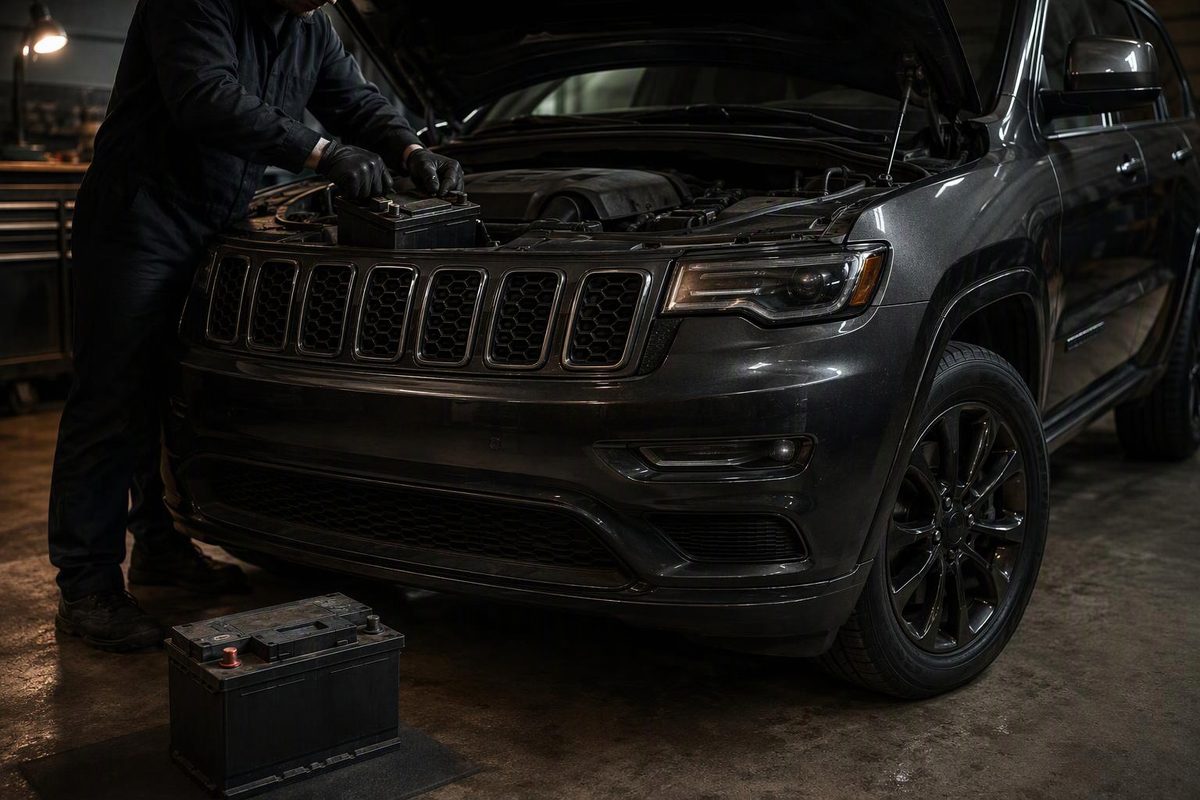
Start with the model year, engine and stop/start equipment—not just “Grand Cherokee.” The battery specification can change, and a stop/start-equipped vehicle may have a separate auxiliary battery. A quote should identify which battery is being replaced.
For cost context, RepairPal’s U.S. estimates checked October 9, 2026 were $544–$593 for the Grand Cherokee and $575–$615 on its 2024 Grand Cherokee L page. These are estimator ranges, not dealer quotes or guaranteed prices for replacing both batteries. (Grand Cherokee estimate, 2024 Grand Cherokee L estimate)
This guide covers planning a 12-volt battery replacement, not traction-battery work on a Grand Cherokee 4xe. The fitment examples below are for the 2018 Grand Cherokee; do not carry them over to a Grand Cherokee L or another model year.
1. Confirm the location and exact battery size
Do not assume every Grand Cherokee battery is under the hood. For the 2018 Grand Cherokee, battery-catalogue application notes place the main battery under the front passenger seat. For your vehicle, check the applicable owner’s manual and service procedure before moving trim or disconnecting cables. (2018 application notes)
The following are fitment leads for specific configurations, not a universal buying chart:
| 2018 Grand Cherokee configuration | Main-battery fitment lead |
|---|---|
| 3.6L with stop/start | Group 48 / H6 AGM |
| 3.6L without stop/start | Group 94R AGM |
| 5.7L, 6.2L or 6.4L | Group 94R AGM |
| 3.0L diesel | Group 49 AGM |
These entries come from application notes in the 2018 parts catalogue. The catalogue also flags varying factory battery sizes and optional fitments, so the engine alone is not enough to authorize a purchase.
Before ordering, compare the VIN-based application with the installed battery’s label, dimensions, terminal orientation, hold-down and vent connection. Confirm the required cold-cranking amps and reserve capacity too. If the application and installed battery disagree, resolve the mismatch rather than assuming the previous replacement was correct. Do not replace a specified AGM with a conventional flooded battery. The cited 2018 application notes specify AGM and external venting.
2. Test before choosing the repair
Slow cranking or repeated jump-starts justify battery and charging-system testing. A discharged battery may need charging and retesting rather than immediate replacement; cables, wiring or the charging system can also cause trouble. (RepairPal diagnostic guidance)
On a dual-battery stop/start system, request separate test results for the main and auxiliary batteries before authorizing replacement. Do not assume a stop/start warning identifies the failed part. Chrysler’s February 2023 IBS diagnostic communication explains that low state of charge and other conditions can inhibit stop/start. It also distinguishes an auxiliary-battery voltage-difference fault from an intelligent battery sensor (IBS) fault.
3. Compare the complete cost—not just the battery price
For DIY, the battery purchase is only part of the total: account for tools, testing and any damaged fittings. For an independent shop or dealer, request an itemized quote showing:
- Main battery, auxiliary battery or both, with part numbers and specifications.
- Battery testing and charging-system diagnosis.
- Access and installation labor.
- Vent fittings, damaged terminals or hold-down repairs, if needed.
- Any VIN-specific electronic setup and fault-code work.
- Tax, fees, core credit and replacement-warranty terms.
Use the same requested scope when comparing providers. The RepairPal ranges above do not establish a separate dealer price or a two-battery package price. Our battery-change cost guide explains the charges that can sit outside the advertised battery price.
4. Decide whether DIY access is sensible
Treat an under-seat swap as more than an ordinary underhood battery change. Obtain the exact service procedure for your configuration before starting, including seat positioning, battery isolation and fastener torques. This planning guide is not a complete removal procedure.
Stop before electrical disconnection if you cannot identify how every fitted 12-volt battery is isolated. Do not apply a single-battery cable sequence blindly to a dual-battery vehicle. Leave seat removal or restraint-system wiring work to a qualified technician if you lack the relevant procedure.
During installation, preserve the specified vent connection and secure the correct hold-down. If the replacement cannot be clamped securely or its terminals and vent do not align, stop—the fit is not acceptable.
5. Verify electronic learning and post-installation operation
Battery registration, sensor learning and clearing diagnostic faults are different operations. Do not assume either a BMW-style registration requirement or “no setup needed” across all Grand Cherokee years.
Chrysler’s IBS guidance says the sensor does not need replacement merely because a battery is new or recharged, but state-of-charge adaptation may be necessary. It describes learning through one crank followed by two to four hours of vehicle sleep. This is general diagnostic guidance, not a VIN-specific replacement procedure; have the installer confirm applicability and any additional requirements. (Chrysler IBS guidance)
Before accepting the job, verify secure installation, starting performance and charging operation. If stop/start remains unavailable, distinguish a charge/learning condition from an active fault. Persistent warnings or another no-start need diagnosis—not an automatic second battery purchase.