
5 min read ·
Choose and Replace the Right Battery for a JNC660
Compare the JNC105 with 12V 22Ah AGM alternatives on fit, starting duty and price, then follow the documented JNC660 battery-removal sequence.
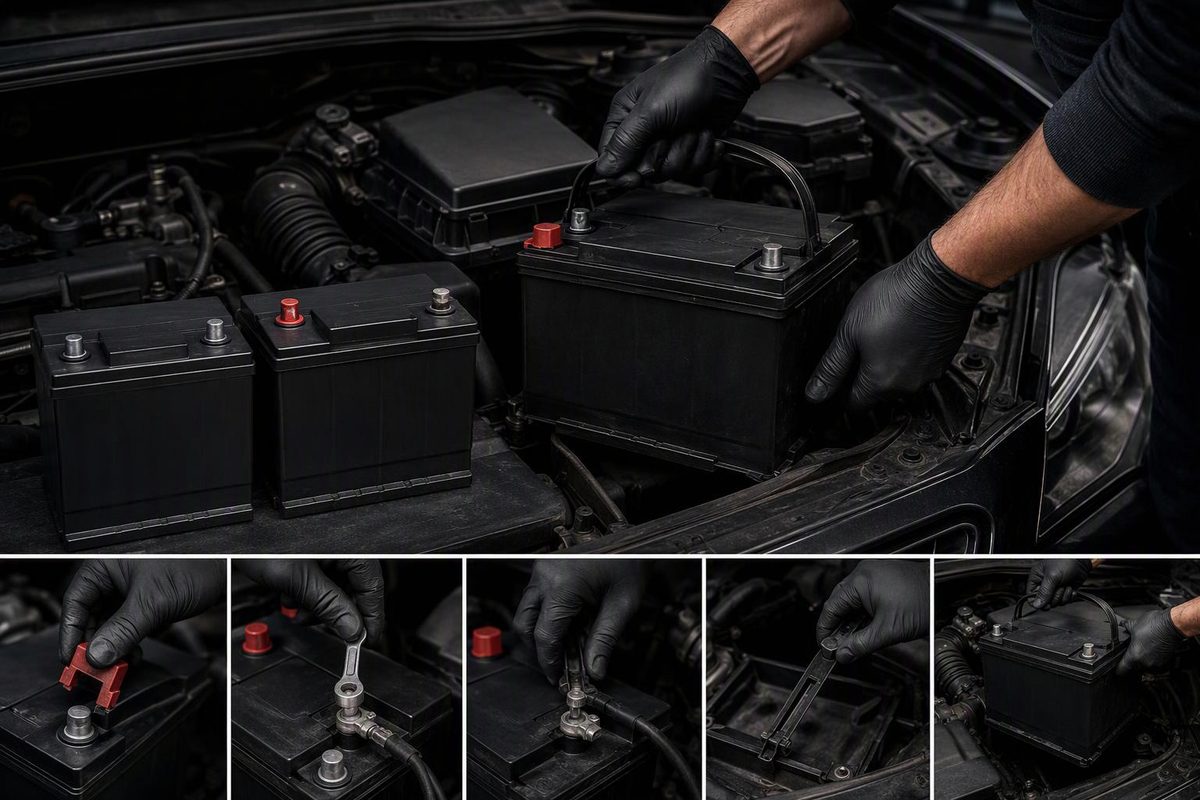
The model-specific replacement for a Jump-N-Carry JNC660 is the Clore JNC105 PROFORMER, a 12-volt, 22Ah sealed lead-acid battery designed for high-current jump starting. A generic 12V 22Ah AGM may fit, but matching its voltage, capacity and dimensions does not prove that it can equal the original battery’s starting output.
Choose a battery and enter the delivered prices to compare replacement cost with a complete JNC660.
Battery Cost Check
The starting values are the listed prices captured September 27, 2026. Replace them with current delivered prices when available.
JNC105 Costs 77% as Much
$29.03 less than a complete unitThat comparison uses $96.99 for the battery and $126.02 for the complete JNC660.
Battery shipping is not included in the starting JNC105 price. Cost alone does not establish aftermarket starting performance.
Sources: Zip’s JNC105 listing, Lowe’s aftermarket listing and Home Depot JNC660 listing. Prices can change.
Specifications the Replacement Must Match
| Item | What to Verify |
|---|---|
| Model-specific replacement | Clore JNC105 PROFORMER |
| Voltage | 12V |
| Capacity | 22Ah |
| Chemistry | Sealed lead-acid; aftermarket candidates are commonly AGM |
| Aftermarket terminal style | Nut-and-bolt, often listed as NB |
| Aftermarket case size | Roughly 7.1 × 3.0 × 6.6 inches |
| JNC660 output rating | 1,700 peak amps; 425 cranking amps |
Clore rates the complete JNC660 at 1,700 peak amps and 425 cranking amps. It says the unit’s PROFORMER battery is specifically designed for vehicle jump starting (Clore Automotive).
The manufacturer explains that jump-start batteries need robust internal connections and plates capable of delivering a large burst of current. Batteries intended mainly for low, steady backup-power loads are constructed for a different job (Clore’s battery explanation).
That distinction matters when comparing inexpensive replacements. A seller may advertise the same 12V rating, 22Ah capacity and approximate dimensions without publishing a comparable cranking-current rating. Amp-hour capacity measures stored energy; by itself, it does not establish high-current starting performance.
The JNC105 Is the Safer Performance Match
A retailer lists the JNC105 as the OEM replacement for the JNC660, JNC770/JNC770R and JNCAIR. Its listing specifies 22Ah, 1,700 peak amps, included hardware and instructions (Zip’s). This is the more defensible choice when preserving the JNC660’s specified starting performance matters.
Consider a generic replacement only after matching all of the following to the battery removed from your unit:
- 12V sealed lead-acid AGM chemistry
- case dimensions and clearance inside the housing
- nut-and-bolt terminal type
- positive and negative terminal positions
- 22Ah capacity
- cable reach and hardware fit
- stated suitability for high-current engine starting
One aftermarket JNC660 listing specifies a 12V 22Ah AGM battery with NB terminals and a 7.09 × 3.03 × 6.57-inch case (BatteryClerk). Another lists a 7.13 × 3.01 × 6.57-inch 22Ah AGM with nut-and-bolt terminals (Lowe’s).
Those measurements are seller specifications for particular aftermarket products, not a published dimensional specification covering every JNC660 battery. Open the unit, inspect the terminal arrangement and measure the installed battery before ordering. Small differences can affect cable reach, terminal clearance and whether the case closes without pressing on a connection.
Do not install a lithium battery or another charging chemistry merely because it fits. The JNC660 and its built-in charger were designed around a sealed lead-acid battery.
Replacement Cost Can Approach the Price of a New JNC660
Prices captured September 27, 2026 provide this comparison:
| Option | Listed Price |
|---|---|
| JNC105 | $96.99 before shipping at Zip’s |
| Aftermarket 12V 22Ah AGM | $46.99 at Lowe’s |
| Complete JNC660 | $126.02 at Home Depot |
The complete-unit price comes from a Home Depot JNC660 listing. At these particular prices, the JNC105 costs about 77% as much as a complete new jump starter before any battery shipping charge.
Prices and availability change. Compare the battery’s delivered price—not merely its shelf price—with the delivered price of a complete unit. The less expensive aftermarket battery creates a larger nominal saving, but its price does not answer whether it can deliver the JNC660’s specified starting performance.
Battery-only replacement makes the most sense when the housing, charger, gauge, cables and clamps remain in good condition. Price a complete unit or qualified repair if the charging system is unreliable, the cable insulation or clamps are damaged, or the housing is cracked.
Test and Inspect the Unit Before Opening It
A low gauge reading alone does not prove the battery has failed. Inspect the cord and housing, then recharge the unit according to its manual. The manual says to recharge after every use and every three months while unused; leaving it discharged can greatly reduce battery life.
Green on the gauge indicates jump-start capability, yellow means recharge, and red means recharge immediately (JNC660 manual copy). If the unit returns to a low indication soon after a proper recharge, the battery or charging system may require attention, but the gauge alone does not isolate which component is faulty.
Do not open the unit if the battery is leaking or swollen, the housing has serious impact damage, or charging causes unusual heat or odor. The manual directs owners to have a damaged unit checked by a qualified service person.
Remove the Old Battery in the Published Order
Wear eye protection and remove rings, watches and other metal jewelry. Work away from flames and sparks. The battery can deliver enough short-circuit current to heat a tool severely, so never bridge its terminals.
The published JNC660 manual gives this removal procedure:
- Secure both clamps where they cannot touch each other or a common conductor.
- Lay the JNC660 on its front.
- Remove the 13 rear-case screws, including six in the cable-management tracks.
- Lift off the rear case half, starting at the bottom.
- Photograph and label the wire positions before disconnecting anything.
- Remove the bolts holding the wires to the two battery terminals. Do not let a tool contact both terminals.
- Lift the battery from the front half of the case.
The screw count and removal order come from the published JNC660 manual transcription. That manual documents removal but does not provide a comparably detailed installation sequence. Follow the instructions supplied with the replacement battery rather than assuming that removal steps alone provide a complete installation procedure.
The new battery must sit without force, with the same terminal orientation and wire routing as the old one. Confirm polarity before attaching either lead, reinstall all hardware, and make sure the case does not pinch a cable. Stop if the terminals are reversed, the cables cannot reach naturally or the case presses against a terminal connection.
After reassembly, recharge the JNC660 fully with its built-in charger before depending on it for a jump start.
Recycle the Removed Lead-Acid Battery
Do not place the sealed lead-acid battery in household trash or a municipal recycling bin. The EPA advises returning lead-acid batteries to a battery retailer or taking them to a local solid-waste or household hazardous-waste collection program (US EPA).
Cover the terminals with nonconductive tape for transport. Follow local handling instructions rather than transporting a leaking or visibly damaged battery as though it were intact.