
8 min read ·
Check Whether a 51R Battery Fits Before You Buy
Compare Group 51R dimensions, terminal layout, flooded and AGM ratings, and U.S. price examples. Check vehicle approval, cable reach and hold-down fit.
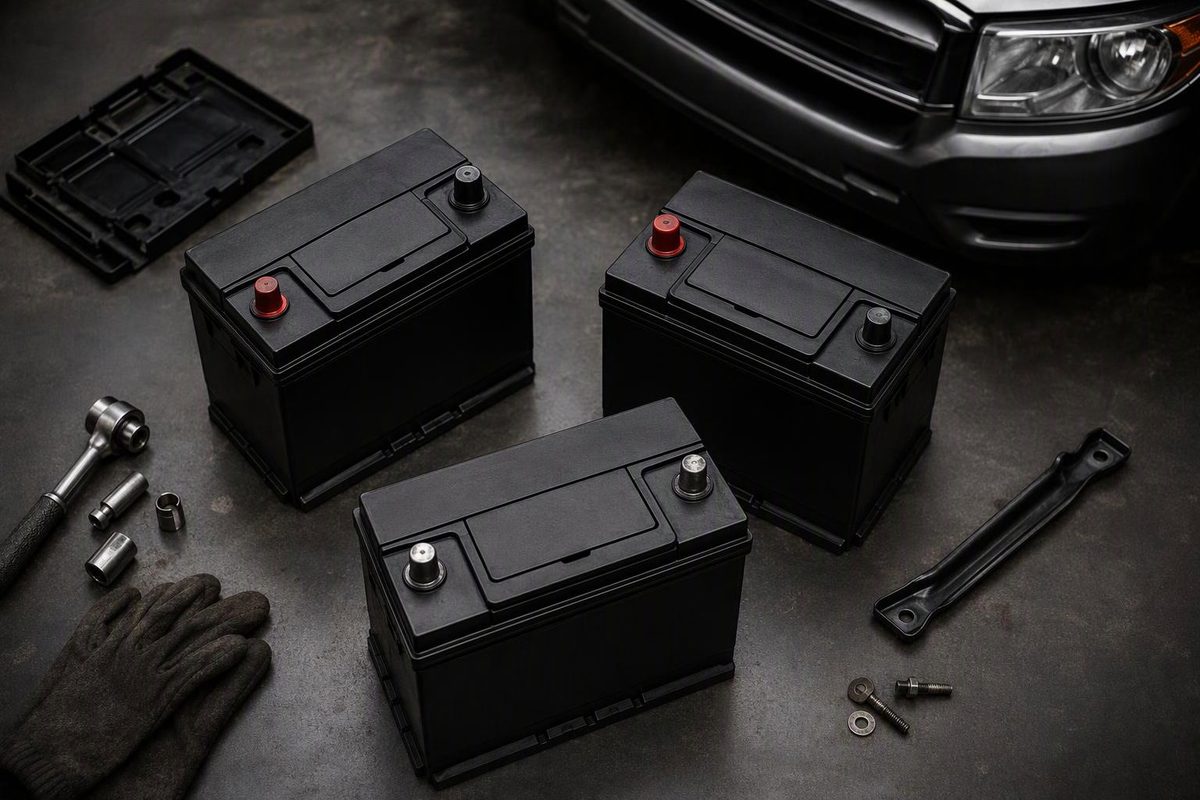
Battery group size 51R identifies a 12-volt automotive battery with BCI maximum overall dimensions of 9 3/8 × 5 1/16 × 8 3/4 inches (238 × 129 × 223 mm), measured length × width × height. Buy it only when your vehicle specifies 51R and the exact product matches the terminal layout, retaining hardware, technology and electrical requirements. Group 51 shares its dimensional envelope but has a different terminal arrangement; it is not an automatic substitute. The group number describes physical specifications, not a fixed capacity or universal vehicle fit.
Select what you have verified; the checker shows whether to proceed or what to check next.
51R Replacement Fit Check
Use the exact year, engine, variant and market, or a VIN-based parts check. The old label alone is not approval.
Check dimensions, +/− post layout, cable reach, post type, hold-down, terminal clearance and any vent connection.
Verify flooded, EFB or AGM requirements and the specified CCA and capacity ratings.
Verify the Vehicle’s Specified Group
Do not buy on case size alone. Confirm that the exact vehicle calls for 51R, then check physical fit and electrical requirements.
9 3/8 × 5 1/16 × 8 3/4 in
238 × 129 × 223 mm
Length × width × height
51 and 51R share this envelope, but their terminal layouts differ.
This checker summarizes your confirmations; it is not a vehicle fitment database. With JavaScript disabled, all three checks must be confirmed manually.
Sources: BCI group-size chart and classification guidance; product and application listings cited in the article. Dimensions are group maxima, not every product’s exact measurements.
Group 51R Dimensions Set the Maximum Envelope
BCI’s specification chart lists Group 51R with these maximum overall dimensions:
| Measurement | Inches | Millimeters |
|---|---|---|
| Length | 9 3/8 | 238 |
| Width | 5 1/16 | 129 |
| Height | 8 3/4 | 223 |
These are maximum overall dimensions, not a promise that every 51R battery measures exactly the same. Use the envelope to understand the group, then use the exact part’s specifications to check the installation. A seller’s product measurements are more useful than assuming the group label tells you every detail of the case.
For example, O’Reilly lists its Super Start Platinum 51RTPLT AGM at 9 5/16 × 5 × 8 5/8 inches, slightly smaller than the BCI envelope. That difference does not make it a different group. It does mean you should check how the particular battery engages the vehicle’s retaining hardware rather than expecting every replacement to duplicate the old case exactly.
Keep length, width and height in the same order when comparing specifications. A measurement copied without its label is easy to compare against the wrong side of the tray. Use either inches or millimeters consistently; the BCI chart provides both.
Tray Fit and Hold-Down Fit Are Separate Checks
A battery that sits in the tray but cannot be secured is not a suitable replacement. Check the footprint against the tray, then check whether the retaining bracket engages the intended part of the case. Clearance above the terminals is a separate requirement from clearance around the sides.
Do not treat an apparently roomy tray as permission to install any battery that fits inside it. The replacement still needs the specified post type and polarity, the correct retaining arrangement and any required vent connection. Our battery tray fitment guide explains the separate checks for trays and retaining hardware.
If a product listing gives the group but omits the measurements or installation details you need, those details remain unverified. Ask the supplier to confirm them for the exact part number. A general statement that a retailer sells 51R batteries does not establish that a particular product fits your vehicle.
Group 51 and 51R Differ in Terminal Layout
Group 51 and 51R share the same BCI dimensional envelope, but BCI lists them separately because their terminal arrangements differ. O’Reilly identifies the positive terminal on its Super Start Premium Group 51 battery as “Top Left,” versus “Top Right” on its Super Start Premium Group 51R battery.
Compare the old and new batteries in the same orientation, using their molded + and − markings. “Right” in a product description should not be interpreted as the vehicle’s passenger side. Turning a battery around changes what appears left or right to the person looking at it; the molded markings identify the actual polarity.
Both vehicle cables must reach their correct posts without stretching or changing the intended routing. If the replacement puts the positive post where the negative cable normally reaches, stop and recheck the specified group and exact product. Matching case dimensions does not resolve a terminal-layout mismatch.
This is why a listing that simply says “Group 51” is not enough when the vehicle calls for 51R. Confirm the suffix on the product itself and check the post layout before installation. Do not rely on a photograph of a different battery used to illustrate a retailer’s broader product range.
Group 151R Is Not Another Name for 51R
BCI lists Group 151R at a maximum 188 × 125 × 225 mm. It is substantially shorter in length than Group 51R, despite the similar designation. The shared “R” suffix does not make the two groups interchangeable.
When checking a label or search result, read the complete group designation. A result for 151R does not answer a search for 51R. If a vehicle lookup suggests a different group from the battery already installed, resolve that discrepancy through the vehicle information rather than choosing whichever case looks closest.
Vehicle Listings Are Leads, Not Universal Approval
Interstate’s 51R AGM application listing includes vehicles such as the 2015 Honda Civic, 2015 Honda CR-V and 2014 Acura TSX. These examples establish that the catalogue includes those vehicles; they do not approve every engine, trim or market version of those models.
Confirm the exact year, engine, variant and market in the supplier’s vehicle lookup or through a VIN-based parts check. A recommendation for one Civic model year is not evidence for all Civics, and an AGM application listing should not be read as approval for every 51R product.
The existing battery label is useful evidence, but it is not the final authority. Photograph its group, part number and ratings so you can compare them with the vehicle requirements. The previous owner or installer may have fitted an incorrect battery, so replacing it like for like can repeat the same error.
Verify the Group Before Comparing Products
Start with the group specified for the exact vehicle. Then confirm that the product listing actually identifies 51R, rather than a neighboring group number or a battery described only as fitting the same brand of vehicle.
BCI identifies dimensions, terminal arrangement and technology among the factors used in battery classification and fitment. The group designation therefore narrows the physical choice, but it does not replace the rest of the application check.
If the supplier’s lookup and your vehicle information disagree, treat fitment as unresolved. The price table below cannot settle that disagreement: a cheaper battery is not a suitable choice until its application is confirmed.
Match Technology and Electrical Requirements Separately
Verify whether the vehicle requires flooded, EFB or AGM technology, along with its specified cold-cranking amps (CCA) and capacity ratings. Those requirements cannot be inferred from “51R.” Two batteries with the same group designation can have different technology and ratings.
Likewise, 51R does not mean 51 amp-hours or 500 CCA. The number belongs to the group designation. Read CCA and capacity from the exact product’s specifications, then compare those values with the vehicle’s requirements.
This draft’s source material does not provide a universal minimum CCA or amp-hour requirement for every 51R application. There is no single threshold here that can approve a battery for all vehicles using this group.
Flooded and AGM 51R Batteries Need Application Approval
Both flooded and AGM 51R batteries are available. AGM is not automatically appropriate simply because its case fits. Interstate’s AGM guidance advises checking the vehicle application or owner’s manual and notes that flooded-to-AGM substitution is not suitable in every application.
Separate the technology decision from the price decision. First establish which technology is approved for your vehicle. Only then compare products within that approved choice, using the electrical ratings and physical specifications of each exact model.
The two O’Reilly examples below illustrate why the group number alone is insufficient. Their technology, CCA and reserve capacity differ even though both are sold as 51R batteries. Neither listing, by itself, proves that one is the correct upgrade or replacement for your car.
Listed 51R Prices Are Not Installed Totals
These U.S. online price examples were checked October 4, 2026. The product links above identify the exact models; store pricing can vary.
| Battery | Technology | CCA / Reserve Capacity | Battery Price |
|---|---|---|---|
| Super Start Premium 51RPRM | Flooded | 450 / 70 min | $214.99 |
| Super Start Platinum 51RTPLT | AGM | 500 / 75 min | $264.99 |
Both listings showed an additional $10 refundable core charge. Treat the listed battery price and the core deposit as separate parts of the purchase. Confirm the retailer’s return requirements before assuming the deposit will be refunded.
These are battery-only examples, not complete installed-job quotes. The source material does not provide an installation labor figure or a nationwide installed price range. A shop quote needs to state whether it includes labor, terminal cleaning, retaining-hardware repairs, required resets or registration, tax and the core deposit.
Compare like totals when choosing between a retail purchase and a shop replacement. A shelf price that excludes installation is not directly comparable with a quote that includes the vehicle-specific replacement work. Equally, a higher-priced AGM battery should not be selected solely because it appears to offer more performance; application approval still comes first.
Compare Ratings Only After Fit Is Confirmed
The flooded example lists 450 CCA and 70 minutes of reserve capacity. The AGM example lists 500 CCA and 75 minutes of reserve capacity. Those figures belong to these two products, not to every flooded or AGM battery in Group 51R.
Keep CCA and reserve capacity separate when reading a listing. Do not turn a reserve-capacity figure into an assumed amp-hour rating or use the group number as a substitute for either measurement. For backup-power comparisons, see what battery reserve capacity means.
The price examples do not supply amp-hour ratings, so an amp-hour comparison remains unknown. If that rating is needed for your application, obtain it from the exact product specifications rather than filling the gap with a value from another 51R battery.
Proceed Only After the Replacement Procedure Is Confirmed
Once the group, physical installation, technology and ratings are verified, check the replacement procedure for the exact vehicle. Battery location, access, resets and any registration or coding requirements must be established by vehicle; “51R” does not tell you whether those steps apply.
For an over-the-counter purchase, retain the exact part number and specifications you checked. Confirm the supplied battery matches them before removing the old one. For a shop replacement, ask which battery model will be installed and whether the quoted work covers the vehicle’s required procedure.
A 51R label is the starting point for a replacement, not the final approval. The correct choice is the exact product that meets the vehicle specification, places both posts correctly, secures properly in the tray and carries the approved technology and ratings.